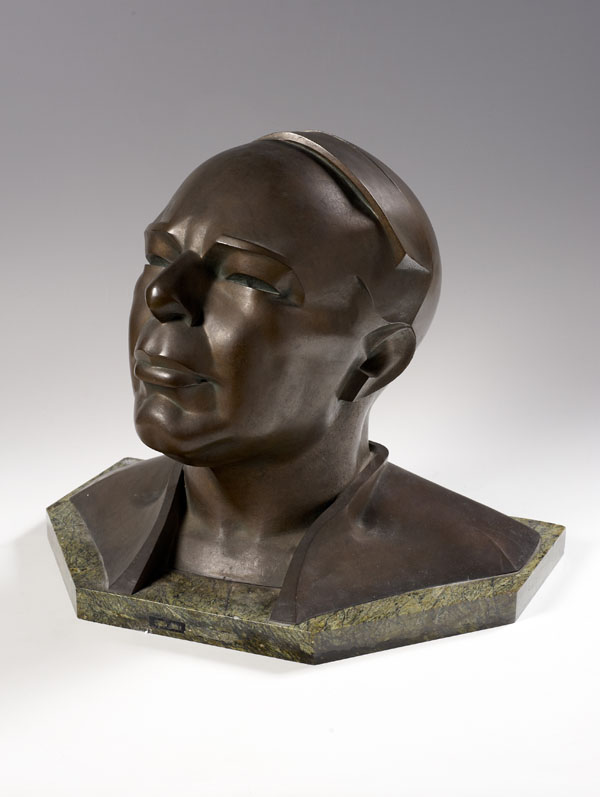
Ben Uri collection
Work by Zeev Ben-Zvi
Biography
Sculptor Zeev Ben-Zvi (Beniamin Kujawski) was born into a Jewish family in Ryki, Poland in 1904 and studied at the Academy of Art in Warsaw before immigrating to Palestine in 1924. After working for two years with Boris Schatz (1866–1932), founder of the Bezalel Academy of Arts and design in Jerusalem, Ben-Zvi taught sculpture at Bezalel from 1926–7, subsequently holding a teaching post there intermittently until his death. Ben-Zvi’s early naturalistic style gave way to a more intense expression based on Cubist techniques and he became known for his portrait sculptures and his masks from beaten copper. His work influenced a subsequent generation of sculptors.
Ben-Zvi lived in England from 1937–9, where he began to use more rounded forms and to minimise detail, as can be seen in his head of Lord Hore Belisha, exhibited at the Royal Academy in summer 1938 and admired in the 'Western Morning News' (02 May 1938) as 'a simplified faithful likeness' of the Secretary of State for War. In the same year he had a notable solo exhibition at the newly founded Bond Street gallery of German-Jewish refugee art dealer Francis (né Franz) Matthiesen (1898–1963). During the Second World War his work became more abstract. After his return to Jersualem he became a lecturer at Bezalel and created a monumental sculpture at Mishmar Haemek, In Memory of the Children of the Diaspora (1947), which has been described as ‘the apogee of Israeli monumental sculpture’. Zeev Ben-Zvi died in Jerusalem in 1952. In 1953 he posthumously received both the Dizengoff Prize and the inaugural Israel Prize for Sculpture. His work is represented in the UK in the Ben Uri Collection.
Search Ben Uri archive for more information about Zeev Ben-Zvi
Artist keywords
Bezalel School of Art | Cubism | Matthiesen Ltd | Poland | sculptor | Warsaw Academy of Art
1 work/s by this artist from the collection are shown below. For a more detailed record and image please click on the link.