Ben Uri collection
Work by Frederick Feigl
Biography
Painter Fred (né Bedřich) Feigl was born into a Jewish family in Prague, Bohemia, then part of the Austro-Hungarian Empire (now Czech Republic) on 6 March 1884. He studied briefly at the Prague Academy of Arts – from which he was expelled owing to his enthusiasm for the avant-garde artists Munch, Van Gogh and Gauguin. Shortly afterwards, he co-founded the modernist art group 'Osma' (The Eight), comprising seven painters including Bohuslav Kubiŝta and Willi Nowak and one sculptor, Max Horb. In reaction to academic traditions, they 'strove ... to break with the dogma of the imitation of nature which reactionary Prague then demanded and to wrestle with the new problems of colour and form' ... For Feigl it was the concept of light in particular which defined his art and his entire development as a painter', noted the Czechoslovakian art historian J.P. Hodin in a later review of Feigl’s career (Fred Feigl at 80, Ben Uri Gallery, 1964). With a bursary from the German Academy of Arts and Sciences in Prague, Feigl studied at the Antwerp Academy of Art and the Académie Julian in Paris and travelled to Yugoslavia and Italy. After his return, Osma staged two exhibitions in 1907 and 1909.
After 1910 Feigl settled with his German fiancée, Margaret, in her native Hamburg; they married in 1911 and he earned his living by portraiture. He held his first solo exhibition of oil paintings, etching and drawings at the J.B. Neumann Graphisches Kabinett in Berlin in 1912 and over the next twenty years established a significant reputation in Germany. He visited Palestine in 1932. Following Hitler’s accession to the German Chancellorship in 1933, the Feigls returned to Czechoslovakia, where Feigl became Chairman of the progressive Prague Secession group (established 1928, closed 1937). Following the German occupation in March 1939, the Feigls fled Prague.
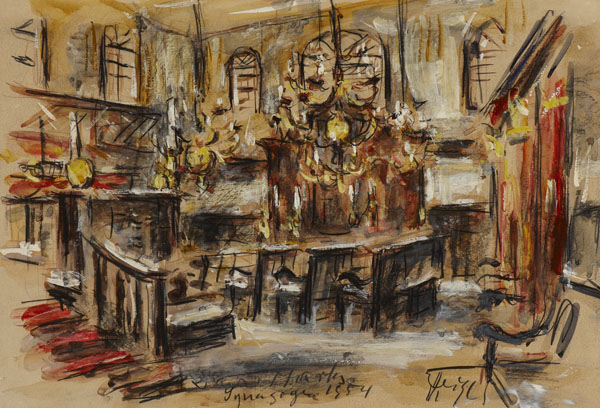
Settling in London in April 1939, Feigl participated in exhibitions including the First Group Exhibition of German, Austrian, Czechoslovakian Painters and Sculptors, sponsored by the Free German League of Culture at the Wertheim Gallery in 1939, and Artists Aid Jewry at the Whitechapel Art Gallery in 1943. In 1941 he helped organise the exhibition Three Czechs: Bedrich Feigl, Frieda Salvendy, Karel Vogel at Leicester Museum and Art Gallery, who purchased four of his works. A 60th birthday solo exhibition was held the Czechoslovak Institute (1944), and an 80th birthday solo show at Ben Uri in 1964, where he also had a solo show in 1959 and participated in many group exhibitions; he was a member of the Arts Committee from 1944 onwards. His work included depictions of coffee houses and restaurants, which he referred to as ‘the marketplaces of life’, as well as Biblical lore, Greek mythology, portraits and landscapes, particularly of London landscapes, including Hyde Park, Regents Park and the Thames at Richmond.Frederick Feigl died in London, England on 19 December 1965. His work is held in international collections and in the UK in the Ben Uri Collection and Leicester Museum & Art Gallery. A retrospective Friedrich Feigl The Eye Sees the World was held in the Czech Republic in 2016 (Cheb Gallery of Fine Arts, followed by a showing in České Budějovice), accompanied by a Czech-German monograph, edited by curator, Professor Nicholas Sawicki, including an essay on Feigl's British years, co-authored by Rachel Dickson and Sarah MacDougall.
Search Ben Uri archive for more information about Frederick Feigl
Artist keywords
Académie Julian | avant-garde | Ben Uri Arts Committee | Ben Uri member | Hitler émigré | Jewish | painter | Prague
2 work/s by this artist from the collection are shown below. For a more detailed record and image please click on the link.