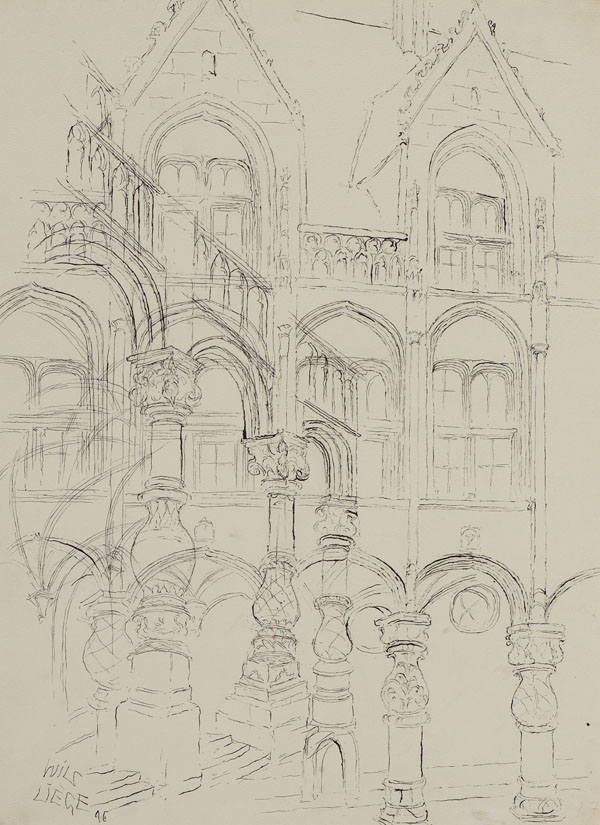
Ben Uri collection
Work by Katerina Wilczynski
Biography
Graphic artist Katerina (known as Käthe) Wilczynski was born into a Jewish family in Posen, Prussia (now Poznań, Poland) on 7 July 1894 and raised in Berlin. She studied art at the Leipzig Academy for Graphic Arts (1916–17), the Berlin School of Arts and Crafts under Emil Orlik (1917), the Royal Academy of Graphic Arts and Book Trade in Leipzig, under Hugo Steiner-Prag (1918), and finally, the Academy of Fine Arts, Berlin, under Hans Meid. In the 1920s she lived and worked in Berlin, travelling frequently to Paris and contributing illustrations to German art magazines including Alfred Flechtheim's Der Querschnitt and the satirical, left-wing weekly ULK. In 1930 Wilczynski moved to Rome on a Prix de Rome scholarship, where she was commissioned 'to draw and paint many ancient buildings, where demolition was required by replanning of the city' (Rome: London, Nicholson & Watson, 1946). Following Italy's introduction of new racial laws in 1938 stripping Jewish citizens of their rights, she moved to London in 1939. During the Second World War, she drew London buildings and landmarks damaged by bombing and contributed pieces to the war artists exhibition held at the National Gallery, c. 1941; one purchased by the War Artists' Advisory Committee, headed by Kenneth Clark. The exhibition toured to Somerville College, Oxford in 1942, where that June she held a solo exhibition of drawings and watercolours including portraits of Oxford academics, followed by two exhibitions at fellow émigré William Ohly's Berkeley Galleries in London in 1942 and 1944.
Wilczynski was deeply embedded within the émigré network and spent part of the war in Richmond, staying with the Old Master dealer Arthur Kauffmann (1886–1983) and his doctor wife Tamara, who also offered refuge to the émigrée art dealer Grete Ring, whose bombed out premises (a branch of Gallery Cassirer) at Cleveland Row Wilczynski depicted in 1941. She participated in group exhibitions with the AIA (Artists' International Association), including For Liberty (1943), annual shows of works by Jewish artists at Ben Uri Gallery (1944, 1945, 1946 and 1949), with Lea Bondi Jaray's St George's Gallery (1950) and with the Women's International Art Club between 1944 and 1966. Postwar she travelled widely including in Greece and Italy; holding two solo exhibitions at the émigré run Roland, Browse & Delbanco Galleries: ‘Drawings of Rome and Petits Riens’ (1946) and ‘Mediterranean Fantasies’ (1949), with many further solo shows including at émigrée Erica Brausen’s Hanover Gallery (1955), the Trafford Gallery (1962), and at the Ansdell Gallery, London (1970). A.A.M. Stols published ‘An artist's Diary in Pictures: Pen and Ink Drawings of a Continental Journey’ in the Hague in 1949 (distributed by Bruno Cassirer) and she illustrated several books including ‘Rome’ (1946), 'Daphnis and Chloe' (1946), 'Homage to Greece' (1964) and 'The Love Songs of Sappho' (1966). A retrospective was held in Berlin in 1975.
Katerina Wilczynski died in London, England on 12 November 1978. A memorial exhibition was held at the New Art Centre, Chelsea in 1980. Her work is held in UK public collections including the Ashmolean, the Ben Uri Collection, the British Museum, the Imperial War Museum, the National Portrait Gallery, the V&A and the Walker Art Gallery, Liverpool, as well as in museums in Dresden, Cologne and Rome, the Bibliothèque nationale de France in Paris, and the Weisman Museum at the University of Minnesota.
Search Ben Uri archive for more information about Katerina Wilczynski
Artist keywords
AIA (Artists' International Association) | Der Querschnitt | draughtswoman | graphic artist | Hitler émigrée | illustrator | Jewish | Lea Bondi Jaray | Paris | Poland | Prix de Rome | ULK | War Artists' Advisory Committee | woman artist | Women's International Art Club
5 work/s by this artist from the collection are shown below. For a more detailed record and image please click on the link.