Ben Uri collection
Work by Halina Korn
Biography
Painter and sculptor Halina Korn (née Korngold) was born into a Jewish family in Warsaw, Poland on 22 January 1902. During the 1920s, Korn studied journalism at the School of Political Sciences in Warsaw and also trained as a singer at the Warsaw Conservatory. In 1939, on holiday in France, she was reunited with the Polish painter Marek Żuławski, whom she had met the year before, until they were separated by the outbreak of war, and she left for Paris. Following the Nazi occupation of France in 1940, she escaped on a ship bound for the USA that stopped in Falmouth and was held in a British refugee camp before being reunited with Żuławski, whom she later married in 1948.
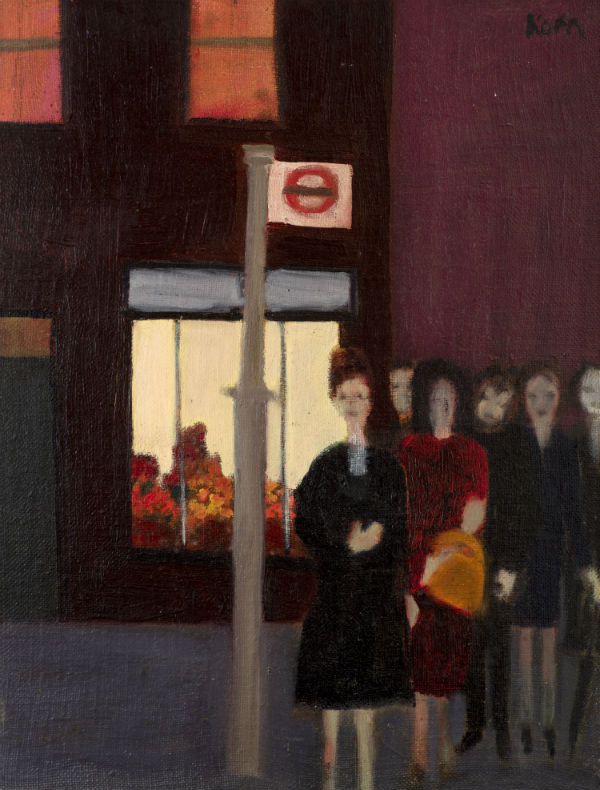
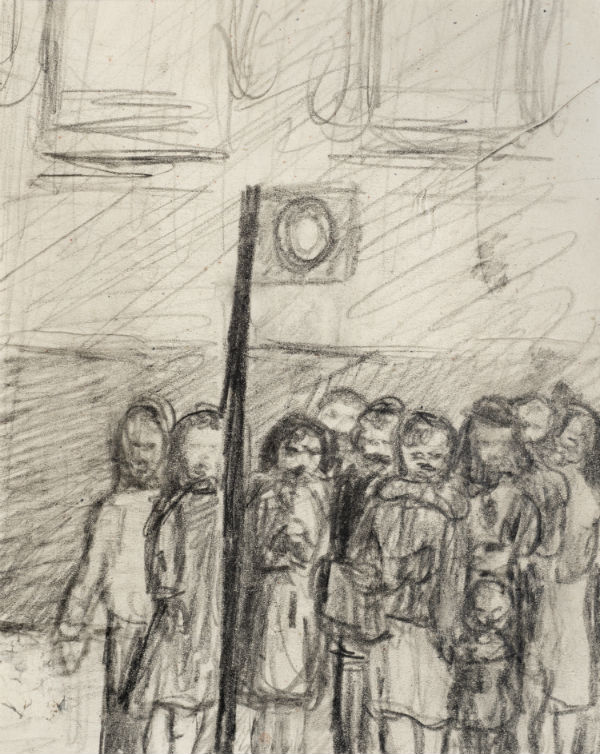
She began painting and sculpting shortly after arriving, c. 1941, largely self-taught as a painter and sculptor, although encouraged by Żuławski; she signed her works ‘Halina Korn’. After the war, having learned that her entire family had been killed (her sister, Jadzia, perished in Auschwitz), she suffered from depression and was later diagnosed as bipolar. Her art acted as a powerful form of therapy, and she concentrated on everyday life and subjects. She observed, ‘A bunch of human beings at Lyons is as beautiful as a bunch of flowers. The landscape of Kilburn High Road gives me the same kick as the most picturesque Italian scene. I am not looking for beauty nor for ugliness’. In 1942 she exhibited with the Women’s International Art Association (WIAC), and also exhibited with the Artist’s International Association (AIA), Ben Uri Gallery, the Royal Academy and with the London Group. A solo exhibition, Paintings of London Life, was held at the Mayor Gallery in 1948 and another of Paintings, Sculpture and Drawings at the New Artists Forum, Chelsea in 1965.
In the 1950s Korn wrote art reviews for the BBC’s ‘Round the Galleries’ broadcast. She exhibited with the London Group (1951), held a solo show at the Beaux Arts Gallery (1953), and participated in an exhibition of Polish Painters in Britain at the Crane Gallery, Manchester in 1955. In 1958, she read an excerpt from her memoir at Stefan and Franciszka Themerson’s Gaberbocchus Common Room in London. Korn was mentioned in GS Whittet’s article, ‘New British Artists’, in The Studio magazine in 1960, and in 1965 she participated in the international exhibition Artists Against Racialism at the Savage Gallery in London. In the same year, after a period of depression, she underwent brain surgery. Halina Korn died in London, England on 2 October 1978. In the UK, her work is represented in the Ben Uri Collection and the Anthony Petullo Art Collection (A Collection of Self-Taught and Outsider Art). A photograph of Korn by Walter Hanlon is in the National Portrait Gallery. A retrospective was held at Camden Arts Centre in 1981, and her childhood memoir was published in Warsaw in 1983.
Search Ben Uri archive for more information about Halina Korn
Artist keywords
AIA (Artists' International Association) | Hitler émigré | London Group | refugee | self-taught | Warsaw | Women's International Art Club
2 work/s by this artist from the collection are shown below. For a more detailed record and image please click on the link.