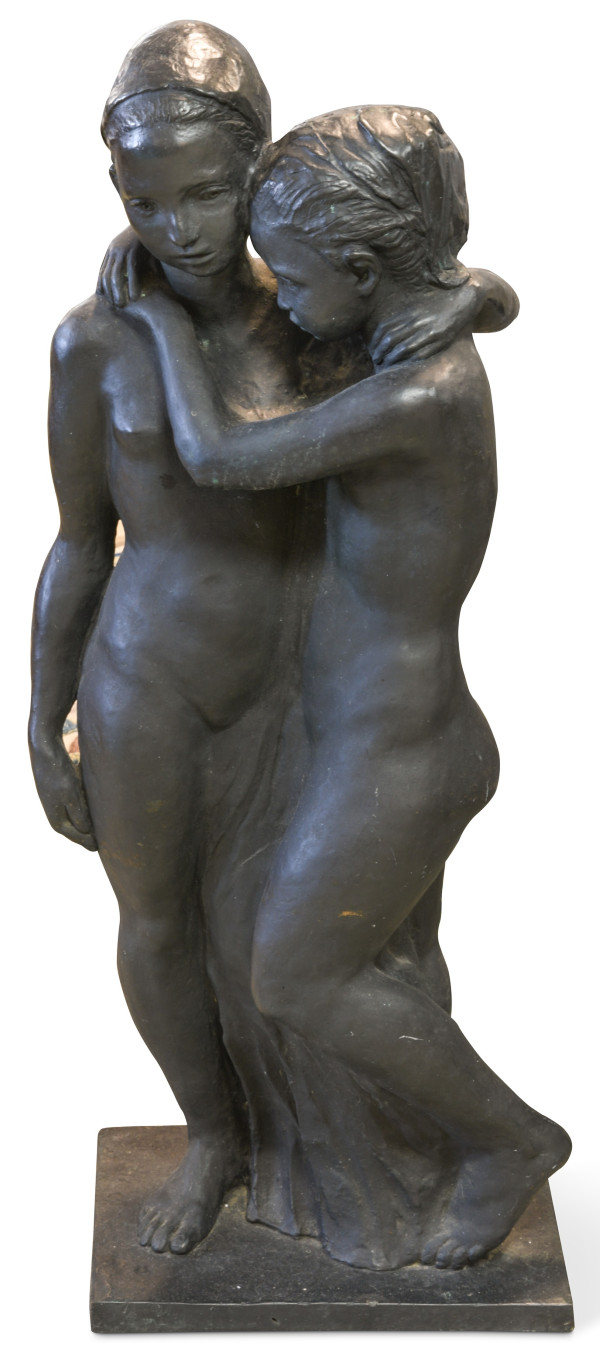
Ben Uri collection
Work by Georg Ehrlich
Biography
Sculptor, painter and graphic artist Georg Ehrlich was born into a Jewish family in Vienna, Austria-Hungary (now Austria) on 22 February 1897 and studied at the Kunstgewerbeschule (School of Arts and Crafts, now Angewandte, University of Applied Arts, Vienna) from 1912–15, mastering etching and lithography. During the First World War, he served in the Austrian army. He later moved to Munich, holding his first solo exhibition there in 1920 and establishing a reputation as a graphic artist working in an Expressionist manner. In 1924, after returning to Vienna, he worked predominantly as a sculptor in a realist style and his first commission, a memorial for the blind organist Josef Labor (1928, Vienna, Central Cemetery), was followed by many others, and he exhibited widely. He was awarded a Gold Medal at the World Exhibition, Paris, in 1937, but in the same year fled to England, joined a few months later by his wife, Bettina (née Bauer, 1903–85), a painter and later a successful illustrator, who also assisted him in casting and patinating his bronzes. Ehrlich's work was included in the Exhibition of Twentieth Century German Art mounted at the New Burlington Galleries in London, as a riposte to the Nazi so-called 'Degenerate Art' exhibition mounted in Munich in 1937. He held a solo show at the Matthiesen Gallery, London, in 1939.
In June 1940 Ehrlich was interned as a so-called ‘enemy alien’ in Hutchinson Camp on the Isle of Man, participating in the first camp exhibition in September 1940. After release, he participated in wartime refugee exhibitions, including those under the auspices of the AIA (Artists' International Association): Artists’ Aid Russia (1942, Wallace Collection), Artists’ Aid Jewry (1943, Whitechapel) and 'For Liberty' exhibition (1943). He held a second solo show in London at Viennese refugee art dealer Paul Wengraf's Arcade Gallery in 1945. Ehrlich also exhibited frequently at Ben Uri Gallery in 1944, 1951, 1953, 1955, 1956, 1961 and 1968.
His public commissions include a pietà Bombed Child (1943, Chelmsford Cathedral), a small, classical war memorial, Pax (1945, Canley Cemetery, Coventry), and the double-figure, Young Lovers (1951, now in the Festival Gardens outside St Paul’s Cathedral, London). His Two Sisters (1944) is at Essendon Primary School, Welwyn Garden City (another version is in the Ben Uri Collection). A regular Royal Academy exhibitor, Ehrlich became an Academician in 1963, had an Arts Council exhibition in 1964, and was a member of both the Royal Society of British Arts and the London Group. His bronze portrait heads include Benjamin Britten (1950–52).
Georg Ehrlich died in Lucerne, Switzerland, on 1 July 1966, and was buried in Vienna. A memorial exhibition was held at the O'Hana Gallery, London, in 1968. His work is represented in UK collections including the Arts Council Collection, the Ben Uri Collection, the British Museum, the National Portrait Gallery, the Red House, Aldeburgh, Tate and the V&A, and in many international museums including in Austria, Belgium, Germany, Holland, Israel, Italy and the USA.
Search Ben Uri archive for more information about Georg Ehrlich
Artist keywords
AIA (Artists' International Association) | Austria | expressionism | Festival of Britain | Hitler émigré | Hutchinson Camp | internment | Isle of Man | Kunstgewerbeschule Vienna | London Group | New Burlington Galleries | Royal Academician | Royal Academy | Royal Society of British Arts | sculptor | Vienna
1 work/s by this artist from the collection are shown below. For a more detailed record and image please click on the link.