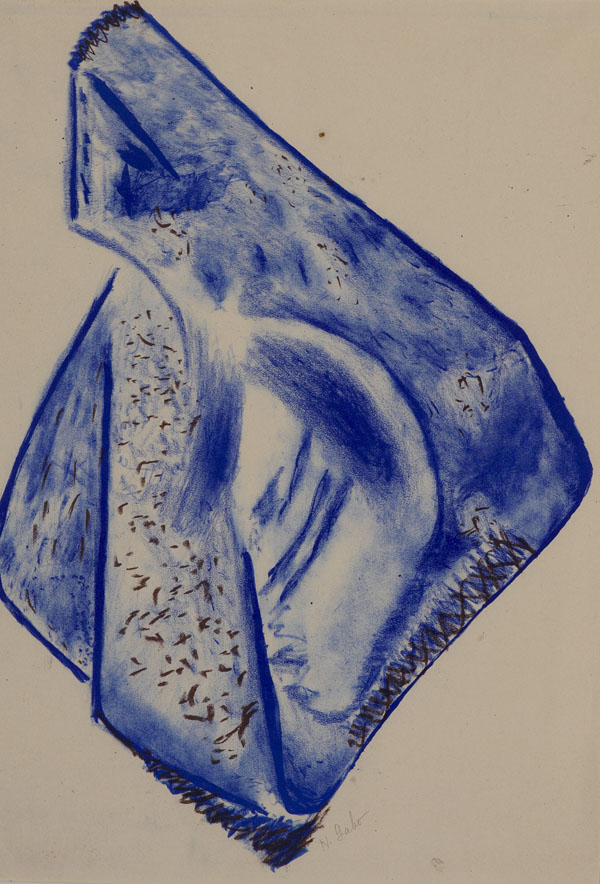
Ben Uri collection
Work by Naum Gabo
Biography
A pioneer of constructive art, Naum Gabo was born Neyemiya Borisovich Pevzner into a Jewish family in Bryansk, Russia on 5 August 1890. His older brother was fellow artist Antoine Pevsner and Gabo changed his name, in order to avoid confusion between them. He began making sculptures in Norway but returned to Russia at the time of the Revolution. In 1920 Gabo wrote the Realistic Manifesto, an expression of the aims and philosophy behind his art. Two years later he left Russia for Berlin, where he worked on sculptures and architectural projects close to the Bauhaus and the De Stijl groups until 1932.
He moved to Paris and exhibited with the Abstraction-Création group, however, he soon left for England. There, he edited 'Circle: International Survey of Constructive Art' (1937) with Leslie Martin and Ben Nicholson and discovered the new transparent material of perspex, which he explored in his sculpture. He visited and exhibited in the USA in 1938, however, he only moved there after the Second World War in 1946. Gabo exhibited widely in both the USA and Europe and lectured at Yale, Harvard, and Chicago. In 1971 he was awarded an Honorary KBE by Queen Elizabeth ll. He continued to receive honours, prizes, commissions and international recognition until the end of his life. He died in Waterbury, Connecticut, USA on 23 August 1977. His work is represented in numerous UK public collections including the Barber Institute of Fine Arts, Birmingham, Kettle's Yard, Cambridge and the Tate.
Search Ben Uri archive for more information about Naum Gabo
Artist keywords
Abstraction-Création | Bauhaus | Berlin | Constructivism | De Stijl | Hitler émigré | Jewish | KBE | Paris | Russia | sculptor
1 work/s by this artist from the collection are shown below. For a more detailed record and image please click on the link.