Ben Uri Collection

Big Bang
Artist information
Name Vitaly Komar and Alexander Melamid
Find more work in the collection by this artist
Find out more about this artist
Vitaly Komar and Alexander Melamid were born in Moscow, Russia; Komar on 11 September 1943 and Melamid on 14 July 1945. They both studied at the Moscow Art School from 1958–60 and the Stroganov Institute of Art and Design, graduating in 1967, the year in which they held their first joint exhibition. They subsequently joined the Moscow Union of Artists and took up teaching posts. However, the controversial nature of their works resulted in arrest in 1974 and both immigrated first to Israel in 1977, and then to New York, in 1978.
Although their co-authorship of artworks ceased in 2003–4, Komar and Melamid are two of the best known artists to emerge from the USSR in the late 1960s and early 1970s, as the founders in 1972 of the controversial SotsArt, a type of work which fused Russian Socialist Realism with elements of conceptual art, Western Pop Art and Dada. ‘We are not just an artist. We are a movement’ they famously declared, never precisely defining the role each played within the creation of any individual artwork.
Object Details
Date 2003
Object type drawing
Medium watercolour and pastel on paper
Materials and techniques pastel (medium) drawing (technique) paper (support)
Unframed 101 x 75.5 cm
Framed 103 x 77.7 cm
Signed inscribed (lower right) '221'
Acquisition presented by Vitaly Komar and Alexander Melamid 2004
Accession number 2004-10
Display status not on display
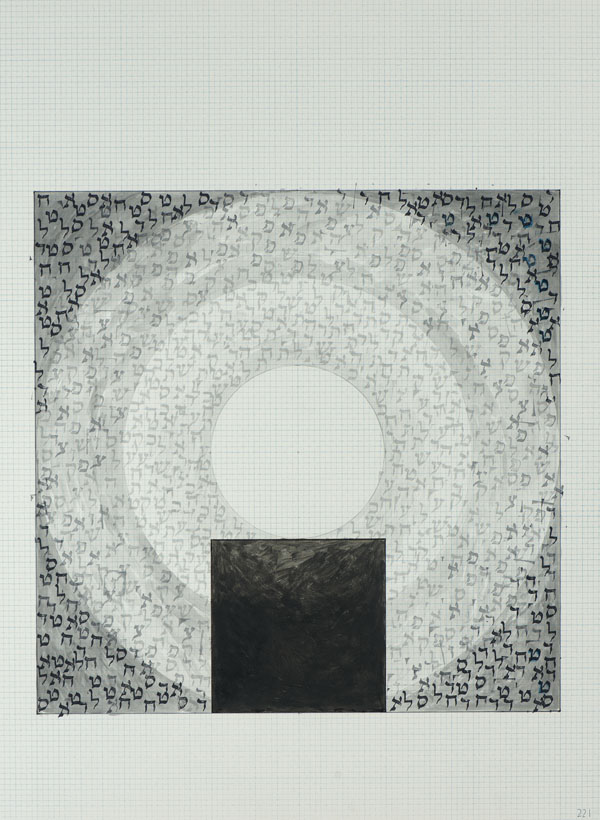
Following their co-founding of 'Sots Art' [Soviet Pop Art] in the early 1970s and their pioneering role in the Post-modern movement, during the 1980s -90s Komar and Melamid’s repertoire expanded to include conceptual projects involving music, monumental sculpture, performance and even the teaching of elephants in Thailand to paint, often accompanied by publications to disseminate their ideas. Symbols of the Big Bang, of which this work is part, is devoted to the synthesis of irony and spirituality and references the very moment of the creation of the universe. It was the duo’s last major collaborative project in 2001–3, exhibited first in New York and then in Moscow, and draws on a range of abstract, ancient and geometric symbols in a series of drawings and paintings, including the swastika, the square and the Star of David, to explore links between mysticism and science, creating ‘The visual image of the beginning of our universe and our world’. Some of the works were intended to form the basis for designs for stained-glass, which the Russian authorities refused to allow. This drawing, as with the whole series, is executed like a mathematical problem on graph paper, it overlays a sun-like element radiating outwards in concentric circles, with a sinister, brooding block-like form. On closer inspection, the surface is dappled with Hebrew letters, creating a dynamic surface suggesting the explosive moment of creation. Big Bang was the winning entry in the Painting and Drawing Section of Ben Uri’s International Jewish Artist of the Year Award in 2004.
Keywords
Selected exhibition history
2004
International Jewish Artist of the Year 2004 (IJAYA)
Ben Uri Gallery - The London Jewish Museum of Art
2006
Recent Acquisitions 2001-2006
Ben Uri Gallery - The London Jewish Museum of Art
2015
Out of Chaos – Ben Uri: 100 Years in London
Somerset House
Literature
Rachel Dickson and Sarah MacDougall, eds., 'Out of Chaos: Ben Uri, 100 Years in London' (London: Ben Uri Gallery, 2015) pp. 134-135; David Glasser, intro., 'Recent Acquisitions 2001-2006' (London: Ben Uri Gallery, 2006), p. 14 (illus. included); Anthony Julius et.al., Komar & Melamid: Symbols of the Big Bang (New York: Yeshiva University Museum, 2002), p. 46.
Hover mouse cursor over image to zoom (you can also use the mouse wheel).