Ben Uri Pre-Eminent Collection

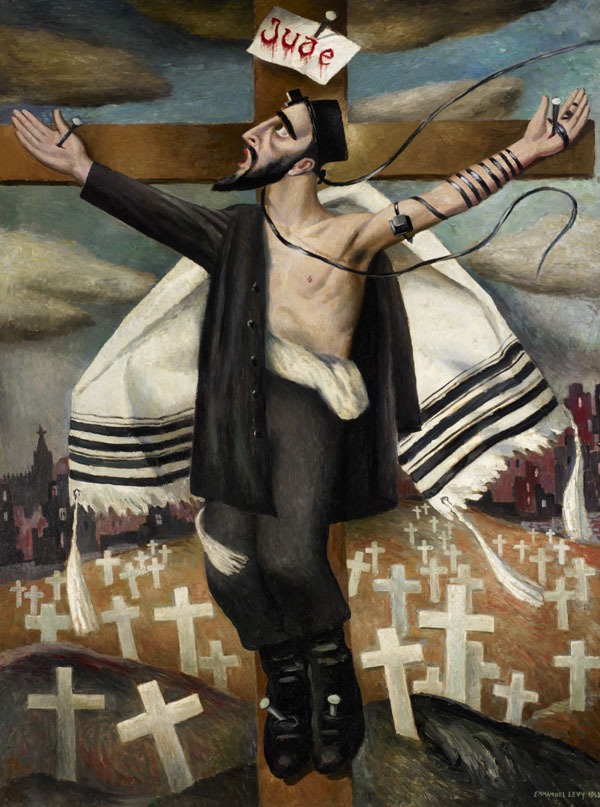
Crucifixion
Artist information
Name Emmanuel Levy (1900-1986)
Born Manchester, England
Died London, England
Find more work in the collection by this artist
Find out more about this artist
Emmanuel Levy was born to Russian-Jewish immigrant parents in Hightown, Manchester, England in 1900. Like Jacob Kramer, he was one of a small group of Jewish artists, whose families, fleeing persecution, restrictive legislation and economic hardship settled in the north of England as part of a wider wave of Jewish migration to Britain at the close of the nineteenth century. Hightown was immortalized by the Jewish writer Louis Golding in his best-selling novel Magnolia Street (1932), which Levy later adapted as a radio play. His father was the beadle at the Great Synagogue, Cheetham Hill and he attended the local Jews’ Free School, before studying at Manchester School of Art under Adolphe Valette between 1919 and 1922, together with L. S. Lowry (whose portrait he drew), as well as at St Martin’s School of Art in London, and in Paris. He returned to Manchester for his first solo show in 1925. His early work included Jewish subject matter, such as The Mourners (Sitting Shiva) (1928, Ben Uri Collection), executed in a semi-Cubist manner. In 1928 Levy was appointed a special instructor in life drawing at Manchester University School of Architecture upon the recommendation of Valette, whom he succeeded. He also gave popular public demonstrations in portrait painting. From 1929, for several years, he was Art Critic for Manchester City News and the Evening News and his 60-year career was so closely associated with his native city that Lord Ardwick described him as ‘a Manchester man through and through. But’, he continued, ‘there is nothing provincial or even distinctly English in his work. He is a citizen of the world’.
Although he experimented with Cubism and Surrealism, Levy abandoned these styles in favour of naturalism, specializing in figurative work exploring the human condition. His wife, Ursula Leo (1915–1984), one of his pupils and a painter in her own right, was a German-Jewish refugee from Nazism and during the Second World, he painted ‘Crucifixion’ (1942), a cri-de-coeur against Jewish persecution under the Nazis in mainland Europe. He held six solo exhibitions in Manchester between 1925 and 1963, with further solo shows in London, including at Ben Uri (1953, 1978 and 1989), where his work was also shown from 1935 onwards in numerous group shows; a further solo show was held in Brunner, Norwich in 1952.. Retrospectives were held at Salford City Art Gallery (1948), Fieldborne Galleries, London (1976) and Stockport Art Gallery (1982). He also exhibited with the AIA (Artists' International Association) including in 1953 and 1954.
Emmanuel Levy died in London, England in 1986. His work is represented in UK Collections including the National Portrait Gallery, Manchester Art Gallery, Salford Museum and Art Gallery and the Whitworth. In 2014 Ben Uri Gallery curated a posthumous retrospective, Made in Manchester: Emmanuel Levy, at Manchester Jewish Museum.
Object Details
Date 1942
Object type painting
Medium oil on canvas
Materials and techniques oil (medium) painting (technique) canvas (support)
Unframed 98 x 73.5 cm
Framed 114.5 x 90 x 6.3 cm
Signed and dated (lower right): Emmanuel Levy 1942
Acquisition acquired at Bonhams through the generous assistance of the members of the Board of the Uri Gallery 2004
Accession number 2004-2
Display status On display in Gladys Hynes: Radical Lives, Charleston Lewes (until 11 October 2026)
Emmanuel Levy's Crucifixion is a personal protest against Jewish persecution by the Nazis in mainland Europe during the Second World War and his most powerful work in this genre, using the figure of Christ as a symbol for Jewish suffering. He remarked, ‘I felt the urge to paint this picture long before 1942, the year it was eventually painted. The thought ‘we are being crucified’ kept recurring to my mind over and over again until I was finally impelled to put the thought down on canvas. It was originally called ‘Europe 1942’ when it was first shown that year in the Manchester City Art Gallery. It was changed to ‘Crucifixion 1942’ because of its deeper significance. The initials I.N.R.I – a piece of Roman cynicism – has been replaced by the word JUDE (German for Jew) written in blood, a truer and more terrifying fact thus bringing my conception into the twentieth century’ (Emmanuel Levy, cited Exhibition of Jewish Artists, McLellan Galleries, Glasgow, 1951, cat. no. 53).
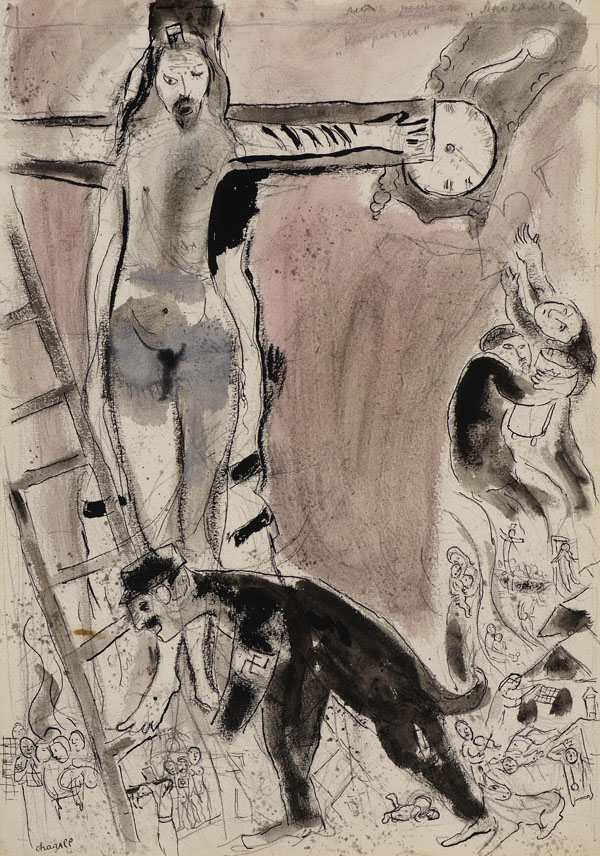
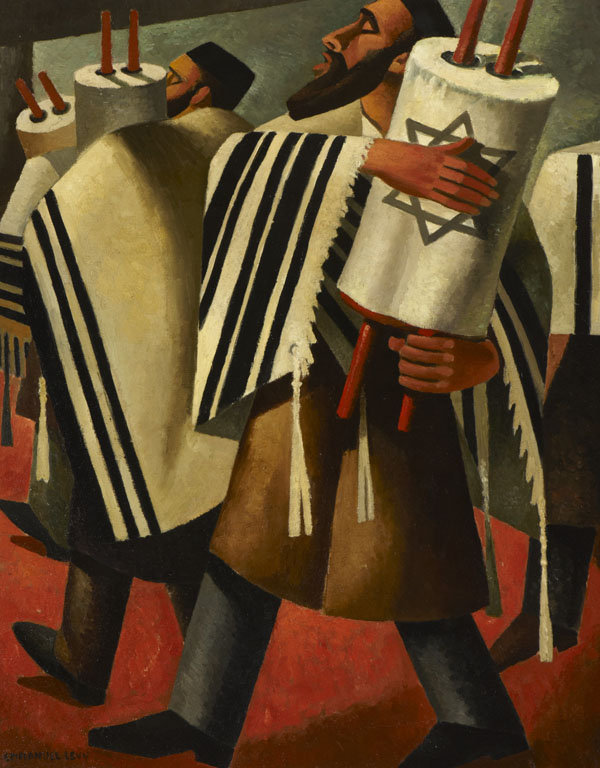
From the nineteenth century onwards, Christ had been variously depicted as a preacher, scholar, mystical visitor or a victim of anti-Semitism by Jewish artists, including Maurycy Gottlieb, Wilhelm Wachtel and Marc Chagall. Levy draws on both Jewish and Christian imagery to present Christ as an orthodox Jew with his Tallit (prayer shawl) and prayer phylacteries. The rows of white crosses (traditionally marking Christian graves) symbolise the many Jews who were being killed at the time. Religious iconography was a dominant theme in Levy’s work, and his Two Rabbis with Scrolls of the Law (Ben Uri Collection) employs a similar pared-down modern style and bold patterning, but instead illustrates the joyous Jewish festival of Simchat Torah. Levy’s central theme, however, was always the human condition.
Keywords
crucifixion | genre scene | Jewish | Nazi | suffering
Selected exhibition history
1942
Exhibition
Manchester City Art Gallery
1951
Exhibition of Jewish Artists
Mclellan Galleries
2004
The Modern and the New: An Examination of the Permanent Collection alongside New Works by Invited British, European and American Jewish Artists
Ben Uri Gallery - The London Jewish Museum of Art
2006
Recent Acquisitions 2001-2006
Ben Uri Gallery - The London Jewish Museum of Art
2009
Homeless & Hidden 2: World Class Collection Homeless & Hidden
Ben Uri Gallery
2010
Apocalypse: unveiling a lost masterpiece by Marc Chagall and 50 selected masterworks from the Ben Uri Collection
Osborne Samuel
2010
Cross Purposes: Shock and Contemplation in Images of the Crucifixion
Ben Uri Gallery
2014
Made in Manchester: The Art of Emmanuel Levy (1900-1986)
Manchester Jewish Museum
2015
Out of Chaos – Ben Uri: 100 Years in London
Somerset House
2018
Acquisitions and Long-Term Loan Highlights Since 2001
Ben Uri Gallery
2023
Art, Identity, Migration - Ben Uri at the London Art Fair
Business Design Centre
2023
A Brush with Evil: Peter Howson's Holocaust Crowd Scene II
Ben Uri Gallery
2024
The Decorative Fair
Evolution London
2024
US: From There to Here - Britain's Gain
Ben Uri Gallery and Museum
2025
Ben Uri 110/25: From Local to Global
Ben Uri Gallery
2026
Gladys Hynes: Radical Lives
Charleston Lewes
Literature
Janet Wolff, Anglo-Jewish Manchester: Refuge and Reparation (Manchester: Manchester University Press, 2026), pp. 89-90, illus., p. 89; Sarah MacDougall (foreword), Important Additions to the Collection since 2000 (London: Ben Uri Gallery and Museum, 2025), p. 7, illus., p. 65; Hans-Jürgen Beck, Annäherung an Jeschua, Vol. 2 (J.H. Röll, Germany 2025), pp. 233, 277, 278, illus; Monica Bohm-Duchen, A Jewish Jesus: Monica Bohm-Duchen explores Christian imagery in the work of Jewish artists, Art and Christianity (Winter 2020), pp. 2-9; Sarah MacDougall, Emmanuel Levy, Encylopedia of the Bible and its Reception (de Gruyter online, 2018); Rachel Dickson and Sarah MacDougall, eds., Out of Chaos: Ben Uri - 100 Years in London (London: Ben Uri Gallery, 2015), pp. 96-97, illus; Sarah MacDougall, Made in Manchester: the Art of Emmanuel Levy (exh. texts, Jewish Museum Manchester and Ben Uri Gallery, 2013); Oil Paintings in Public Ownership in Camden (London: The Public Catalogue Foundation, 2013), p. 26, illus; David Breuer-Weil, Emmanuel Levy, Crucifixion, 1942, in ed. N. Hepburn, Cross Purposes: Shock and Contemplation in Images of the Crucifixion (London: Mascalls Gallery and Ben Uri Gallery, 2010), p. 35, illus.; Apocalypse: Unveiling a lost masterpiece by Marc Chagall (London: Ben Uri Gallery, 2010); David Glasser, intro., Recent Acquisitions 2001-2006 (London: Ben Uri Gallery, 2006), p. 10, illus; Exhibition of Jewish Artists (Glasgow: McLellan Galleries, 1951), cat. no. 53 (lent by the artist).
Hover mouse cursor over image to zoom (you can also use the mouse wheel).
To license this image contact Bridgeman images
Related works
Apocalypse en Lilas, Capriccio
by Marc Chagall
Two Rabbis Carrying the Scrolls of the Law
by Emmanuel Levy
Christ on the Cross
by Arnold Auerbach