Ben Uri Pre-Eminent Collection

Racehorses
Artist information
Name David Bomberg (1890-1957)
Born Birmingham, England
Died London, England
Find more work in the collection by this artist
Find out more about this artist
David Bomberg was born to Polish-Jewish parents in Birmingham, England on 12 May 1890. The family moved to Whitechapel in 1895, where he later became prominent among the ‘Whitechapel Boys’ - the term applied to a loose, informal group of young, Jewish, mainly immigrant artists who were either born, raised or worked in the East End in the first two decades of the 20th century, and who, both collectively, and individually, made an important contribution to British Modernism. Initially apprenticed as a chromolithographer, he attended night classes under Walter Sickert and also worked as an artist’s model before studying at the Slade School of Fine Art, where he was seen as a ‘disturbing influence’. In 1913 Bomberg visited Paris with Jacob Epstein, making contact with artists including Modigliani and Picasso. Bomberg’s harrowing service in the trenches during the First World War was compounded by a disastrous experience as a commissioned war artist, explored in a series of related drawings. His postwar disillusionment is most powerfully expressed in the masterly Ghetto Theatre (1920), purchased the same year for the Ben Uri Collection, initiating a lifelong relationship. Afterwards Bomberg made a series of peopled landscapes before travelling in 1923 to Jerusalem, where he began to work en plein air for the first time. Following expeditions to Jericho, Petra and Wadi Kelt, he produced a series of detailed, realistic landscapes, which evolved from tightly topographical treatments into a looser, characteristically expressionistic style, heralding the painterly achievements of his final years.
After a series of disappointments in the 1930s and 1940s Bomberg concentrated on portraits of friends and family, as well as a series of searching self-portraits. Although only reluctantly granted a Second World War commission to paint a bomb store in 1942, Bomberg produced many drawings and paintings on the subject, among them an impressive, large-scale study for a projected (but unrealised) mural. Following his visit to Spain in 1929, a renewed vigour resulted in a series of works based on the cathedral at Toledo, flowering on his second visit in 1934–35, into dramatic landscapes of the gorge at Ronda and flickering night-time processions during Holy Week. These experiments were curtailed by the onset of the Spanish Civil War, but over a decade later picked up and progressed in the west country, where his loosened handling verged on the abstract, and in Cyprus in 1948. His final works culminated in the fulfillment of his early promise after his return to Ronda, where he spent his last years. After becoming seriously ill, Bomberg travelled back to England, but died in London shortly after his return, on 19 August 1957. His work is represented in the UK in a number of important public collections including the Ben Uri Collection, the British Museum, the Imperial War Museum, the Tate, and the V&A. A posthumous touring exhibition (Pallant House, Chichester; Laing Art Gallery, Newcastle; Ben Uri Gallery, London), accompanied by a monograph, was organised by Ben Uri in 2017-18.
Object Details
Date c. 1912-13
Object type drawing
Medium black chalk and wash on paper
Materials and techniques chalk (medium) drawing (technique) paper (support)
Unframed 41.5 x 66.2 cm
Framed 73 x 97 cm
Signed and dated (lower right): D. Bomberg 1913
Acquisition Acquired at Sotheby's in 2004; Ben Uri was generously represented in this acquisition by James Holland-Hibbert of Hazlitt Holland-Hibbert with the assistance of Art Fund, the HLF and the MLA/ V&A Purchase Grant Fund, The Julius Silman Charitable Trust, Pauline and Daniel Auerbach, Sir Michael and Lady Heller, and anonymous donors
Accession number 2004-8
Display status Not on display
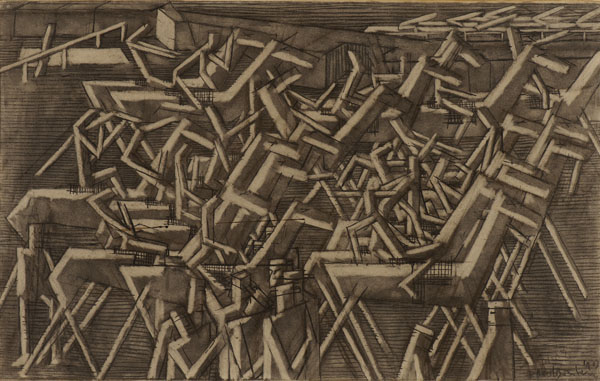
This radical chalk-and-wash drawing was among Bomberg's five exhibits in the so-called ‘Jewish Section’ that he co-curated with Jacob Epstein at the Whitechapel Art Gallery’s exhibition 'Twentieth Century Art: A Review of Modern Movements' in May 1914 (he had previously shown it at the Friday Club in February and included it again in his solo show at the Chenil Gallery in July). Bomberg's friend John Rodker (a racing enthusiast) also reproduced the drawing as a frontispiece in The Dial Monthly, explaining that it was set in a paddock at a race meeting, that the two figures on the front right of the composition were bookies, those to their left spectators, and that the style was ‘cubist’; adding ‘It is not intended to be comic’. Executed in 1913, when Bomberg was only 22, Racehorses is a key transitional work, which demonstrates his absorption and understanding of the contemporaneous European avant-garde, skilfully reworked into a drawing of startling power and originality.
Even before he became a student at the Slade School of Fine Art, Bomberg had begun to employ a shallow picture space and to simplify his forms. By 1913 he was producing ‘Cubist compositions’ including one featuring the wooden ‘donkey’ on which students sat to sketch in the Slade life class (which bears a close resemblance to Bomberg’s stiffly-jointed racehorses). His understanding of Cubism was enhanced by his visit to Paris in 1913 and he was also aware of the 1910 Futurist Manifesto with its explanation that ‘a running horse has not four legs, but twenty, and their movements are triangular’. He shared a fascination with mechanisation with the nascent Vorticist movement, reflected in his manifesto accompanying his first solo show at the Chenil gallery, London, in July 1914, where he explained that his object was ‘the construction of Pure Form’. However Bomberg also combined modernist techniques with allusions to older processes: the close-grained texture of the picture is reminiscent of woodcuts, and the monochrome colouring akin to that in photography of the day. He would have been familiar with Eadweard Muybridge’s famous photographs of the ‘animal in motion’, and his racehorses also neatly illustrate what Muybridge himself noted in his ‘Prelude to Analyses’, that ‘during very rapid motion by a good horse, the aggregate of the body preserves a nearly horizontal line'. Like Bomberg’s other innovative works, Racehorses was generally viewed with hostility and incomprehension when first exhibited with the Jewish Chronicle calling his racehorses ‘Opposed to all that is rational in art’.
Selected exhibition history
1914
Jewish Section, Twentieth Century Art: A Review of Modern Movements
Whitechapel Art Gallery
1914
Pictures by Members of the Friday Club
Alpine Club Gallery
1914
Works by David Bomberg
Chenil Gallery
2006
Recent Acquisitions 2001-2006
Ben Uri Gallery - The London Jewish Museum of Art
2007
Bomberg's Relevance
Ben Uri Gallery - The London Jewish Museum of Art
2009
Homeless & Hidden 1: World Class Collection Homeless & Hidden
Ben Uri Gallery
2009
Whitechapel Boys
Whitechapel Art Gallery
2009
Sir Muirhead Bone: Artist & Patron
The Fleming Collection
2010
Apocalypse: unveiling a lost masterpiece by Marc Chagall and 50 selected masterworks from the Ben Uri Collection
Osborne Samuel
2013
Nash, Nevinson, Spencer, Gertler, Carrington, Bomberg: A Crisis of Brilliance, 1908-1922
Dulwich Picture Gallery
2013
Selected Highlights from over 200 works acquired during 2003-2013
Ben Uri Art Gallery
2015
Out of Chaos – Ben Uri: 100 Years in London
Somerset House
2016
100 for 100: Ben Uri Past, Present & Future
Christie's South Kensington
2016
Out of Chaos: Touring exhibition
Laing Art Gallery
2017
Bomberg: Touring Exhibition
Pallant House Gallery
2018
Bomberg
Ben Uri Gallery and Museum
2018
Acquisitions and Long-Term Loan Highlights Since 2001
Ben Uri Gallery
2018
Bomberg: Touring Exhibition
Laing Art Gallery
2019
Mark Gertler: Paintings from the Luke Gertler Bequest & Selected Important UK Collections
Ben Uri Gallery
2023
Art, Identity, Migration - Ben Uri at the London Art Fair
Business Design Centre
2023
Futurliberty
Museo del Novecento
2025
Ben Uri 110/25: From Local to Global
Ben Uri Gallery
Literature
Sarah MacDougall (foreword), Important Additions to the Collection since 2000 (London: Ben Uri Gallery and Museum, 2025), p. 6, illus., p. 67; Sarah MacDougall and Rachel Dickson, Bomberg (London: Ben Uri Gallery and Museum, 2017); Rachel Dickson and Sarah MacDougall, eds., Out of Chaos: Ben Uri; 100 Years in London' (London: Ben Uri Gallery, 2015), pp. 40-41; Selected Highlights from over 200 works acquired during 2003-2013 (London, Ben Uri Gallery, 2013), illus; Sarah MacDougall, ‘Something is Happening There’: The Whitechapel Boys, 1914 and the Great War', in ed., Michael J K Walsh, London, Modernism, and 1914 (Cambridge: Cambridge University Press, 2010), pp. 122-147; David Glasser, intro., 'Recent Acquisitions 2001-2006' (London: Ben Uri Gallery, 2006) p. 7, illus; Andrew Graham-Dixon, In the Picture, The Sunday Telegraph Magazine, 13 March 2005; Sarah MacDougall, David Bomberg's Racehorses (Ben Uri Gallery, 2005); Richard Cork, David Bomberg (New Haven and London: Yale University Press, 1987), pp. 46, 96; John Rodker, 'The New Movement in Art', The Dial Monthly, May 1914, pp. 184-8; L. K., 'Jewish Art at Whitechapel', Jewish Chronicle, 15 May 1914, p. 10.
Hover mouse cursor over image to zoom (you can also use the mouse wheel).