Ben Uri Collection

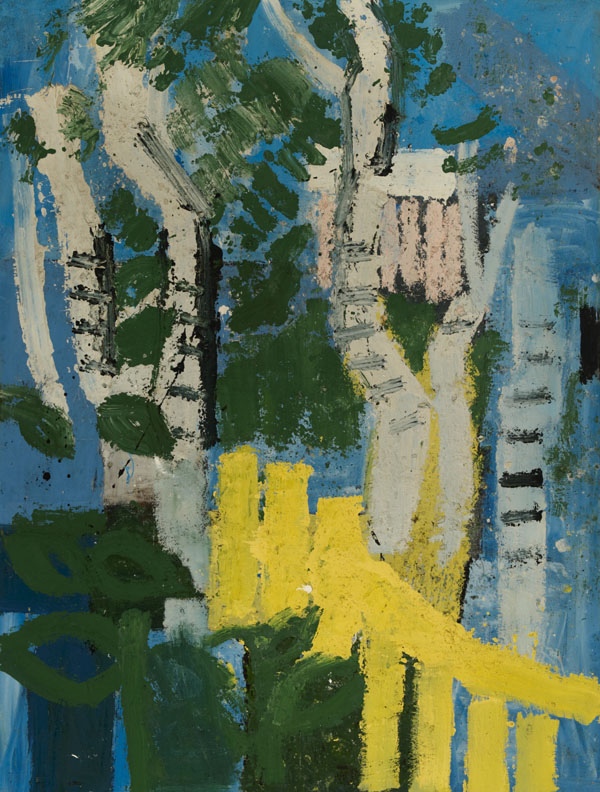
White Trees and Yellow Fence
Artist information
Name Joash Woodrow (1927-2006)
Born Leeds, England
Died Manchester, England
Find more work in the collection by this artist
Find out more about this artist
Joash Woodrow was born into a Jewish family in Leeds, England on 6 April 1927, one of eight sons and two daughters; his parents, both from a Polish-immigrant background, had married in Boston, USA. On moving to England, the family settled in Leeds: his father worked as a Hebrew scholar and bookseller before finally moving into the textile trade. Woodrow trained at Leeds College of Art before serving in the army as a cartographer in Egypt (1945-8). Afterwards, from 1950-53, he studied drawing and painting at the Royal College of Art, where his fellow students included Frank Auerbach, Peter Blake and novelist Len Deighton and his lecturers included Carel Weight and Rodrigo Moynihan. Shortly after graduating, Woodrow suffered a nervous breakdown in his mental health, returning to his home in Chapel Allerton, Leeds to live with his mother and brother, Israel.
From this time onwards, Woodrow began working from home, steadily producing drawings and paintings. Following the death of his mother (in 1962) and brother (in 1978), he became prolific, painting increasingly large pictures and using furniture, such as his piano, and repurposing materials including roof tiles, window frames, coal and potato sacks and cornflake packets. During the late 1990s his health declined and in 2000 he moved to sheltered accommodation. He received critical acclaim late in life, following a chance encounter with Woodrow's work by artist Christopher P. Wood in 2001, and the discovery of over 700 paintings and several thousand drawings in Woodrow's home/ studio, leading to his first exhibition at 108 Fine Art Gallery, Harrogate in 2002. This was succeeded by a retrospective at Manchester Art Gallery in summer 2005, which toured to Ben Uri Gallery the same year.
Joash Woodrow died in Manchester, England on 15 February 2006. His work is held in UK collections including the Ben Uri Collection and Manchester Art Gallery. A play about him, The Resonance of Seclusion, by Liz Postlethwaite, was produced at the Whitworth Art Gallery in Manchester.
Object Details
Date 1980
Object type painting
Medium oil and household paint on board
Materials and techniques oil (medium) board (support)
Unframed 217.5 x 165 cm
Framed 228 x 175 x 3.5 cm
Acquisition presented by the Joash Woodrow collection and 108 Fine Art
Accession number 2006-23
Display status not on display
Woodrow’s intense, painterly handling transforms an everyday suburban scene into a shimmering, tactile landscape, rich with possibility and colour. Although he usually did not sign or date his paintings, they roughly fall into ‘periods’: domestic life during the 1940s; smaller landscapes of the 1950s; powerful portrait heads of the 1960s; semi-abstract still lifes and figure paintings indebted to Picasso, and urban landscapes in the 1970s. Driven by an urgent impulse to create, he often resorted to utilising scrap materials, ranging from advertising boards to discarded pages of old journals. He also nailed scraps of potato sacking darned with wool to stretchers tacked together from bits of wood and even tree branches. As observed by Laura Gascoigne, this resulted in ‘a surface that heaves and bubbles with energy, while somehow keeping the colour alive. Woodrow’s most exciting works are built rather than painted; and, despite their dodgy construction, clearly built to last’ (The Spectator). Woodrow's subjects included still lives and cityscapes – especially panoramas of inner-city Leeds with its mix of modern development and local detail. In his landscapes he often combined raw, natural elements with traces of human presence: electrical wires, lamp posts, and other objects, while his collages incorporated torn pieces of musical score to represent buildings, animals and landscapes. A recurring subject was picket-fenced allotments – such as in White Tree and Yellow Fence, inspired by Gledhow Vallery Allotments near his house.
Selected exhibition history
1988
Recent Acquisitions and Selection from the Permanent Collection
Ben Uri Art Society
2006
Recent Acquisitions 2001-2006
Ben Uri Gallery - The London Jewish Museum of Art
2009
Homeless & Hidden 2: World Class Collection Homeless & Hidden
Ben Uri Gallery
2010
Apocalypse: unveiling a lost masterpiece by Marc Chagall and 50 selected masterworks from the Ben Uri Collection
Osborne Samuel
2023
Art, Identity, Migration - Ben Uri at the London Art Fair
Business Design Centre
Literature
Oil Paintings in Public Ownership in Camden (London: The Public Catalogue Foundation, 2013) p. 45; Apocalypse: Unveiling a lost masterpiece by Marc Chagall (London: Ben Uri Gallery, 2010); David Glasser, intro., 'Recent Acquisitions 2001-2006' (London: Ben Uri Gallery, 2006), p. 13 (illus. included).
Hover mouse cursor over image to zoom (you can also use the mouse wheel).