Ben Uri Collection

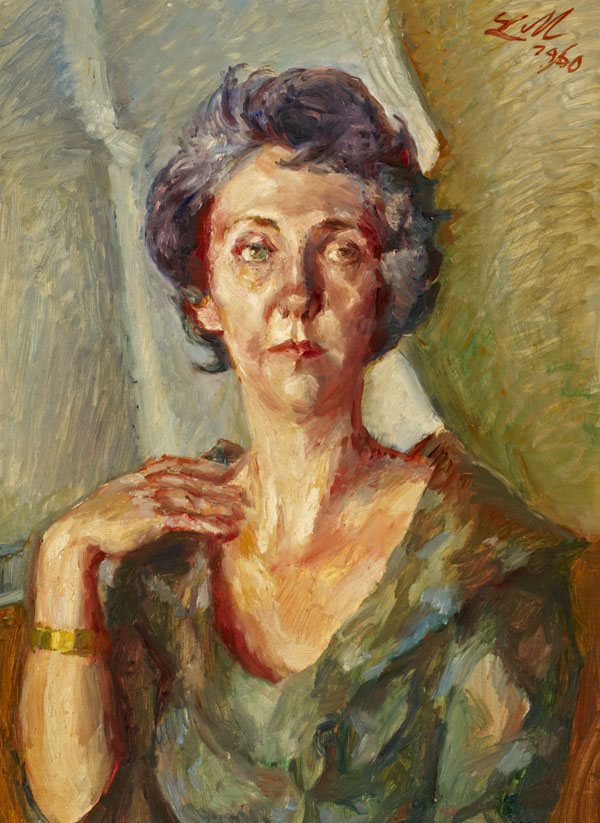
Portrait of Lilo Gwosdz
Artist information
Name Ludwig Meidner (1884-1966)
Born Bernstadt, Germany
Died Darmstadt, Germany
Find more work in the collection by this artist
Find out more about this artist
Ludwig Meidner was born into a Jewish family in Bernstadt, Germany (now Bierutów, Poland) on 18 April 1884 and studied in Breslau, Berlin and Paris. Apprenticed unsuccessfully as a stonemason, he then worked as a fashion illustrator. In 1912 he began the Apocalyptic Landscapes series anticipating the carnage and destruction of the First World War and exhibited with Die Pathetiker group in Herwarth Walden’s influential gallery, Der Sturm. An avowed pacifist following military service, Meidner painted Jewish religious and mystical works, Rembrandt-inspired self-portraits, and portraits of leading expressionists, Dada writers and poets. In 1934 four of his drawings - all entitled 'Jews Praying - were included in the 'Exhibition of German-Jewish Artists' Work: Painting, Sculpture, Architecture' (5-15 June 1934) organised at the Parsons Gallery, London by German-Jewish emigre dealer, Carl Braunschweig (later Charles Brunswick).
With rising anti-Semitism in Berlin, Meidner and his family moved to Cologne in 1935, where he worked as a drawing teacher at a Jewish school. In 1937 his work was included in the infamous ‘Degenerate Art’ exhibition mounted by the Nazis in Munich, and he subsequently participated in the 1938 Exhibition of Twentieth Century German Art at the New Burlington Galleries in London, organised as a riposte the following year. In August 1939 the Meidners fled to England and Ludwig was interned from 1940–41: first at Huyton Camp, Liverpool, and then in Hutchinson on the Isle of Man, known as the ‘artists’ camp’ for its cohort of notable artist-internees, 90% of whom were Jewish. Meidner found a safe, religiously tolerant and intellectually stimulating environment, and the means to continue drawing, during internment, and even petitioned to stay on. Postwar he remained in London, dependent on support from the émigré community, particularly art historian J. P. Hodin, and unsuccessfully attempted to establish a Jewish art society with fellow émigré Jankel Adler. Meidner also joined the Ohel Club in Gower Street for Jewish refugee intellectuals and artists including Jankel Adler, Josef Herman, Marek Szwarc, Martin Bloch and David Bomberg. Meidner also exhibited works including 'In a Concentration Camp' in the exhibition Subjects of Jewish Interest in December 1946. In late 1949 he held a joint Ben Uri show with his wife and fellow painter Else Meidner. Meidner finally returned alone to Germany in 1953 to renewed acclaim and awards.
Ludwig Meidner died in Darmstadt, Germany on 14 May 1966. A joint retrospective of work by both Meidners was held at Ben Uri in 2002. In the UK his work can be found in the Ben Uri Collection, the Fitzwilliam Museum and Leicester Museum & Art Gallery.
Object Details
Date 1960
Object type painting
Medium oil on board
Materials and techniques oil (medium) board (support)
Unframed 78 x 58.5 cm
Framed 93 x 73 cm
Signed and dated, (upper right): 'LM 1960'
Acquisition presented by Lilo Gwosdz 2007
Accession number 2007-2
Display status not on display
Lilo Gwosdz was an Austrian portraitist, who also had a celebrated career as a fashion and advertising photographer. Meidner’s typically free brush work can be seen in the background behind her and in the patchwork colouring that makes up her elegant dress.
Selected exhibition history
2018
Exodus: masterworks from the Ben Uri Collection
Bushey Museum
Literature
Oil Paintings in Public Ownership in Camden (London: The Public Catalogue Foundation, 2013), p. 30 (illus. included).
Hover mouse cursor over image to zoom (you can also use the mouse wheel).