Ben Uri Collection

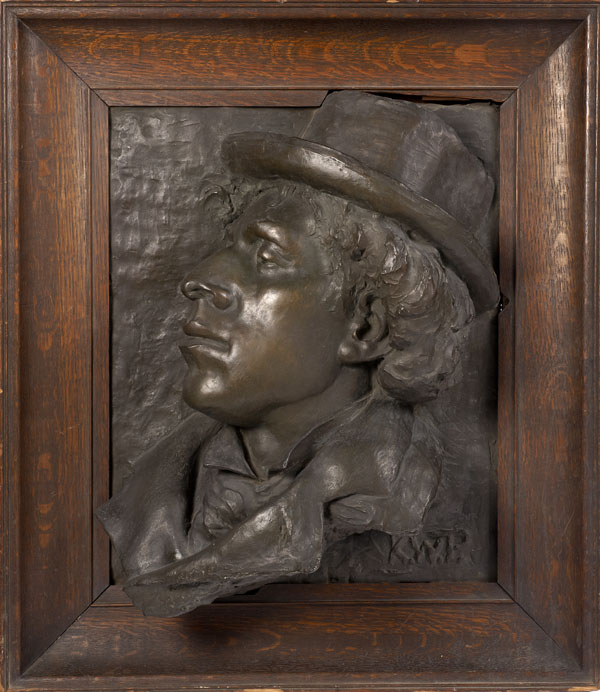
Portrait of Israel Zangwill
Artist information
Name Unknown
Find more work in the collection by this artist
Object Details
Object type sculpture
Medium bronze relief and wood
Materials and techniques bronze (medium) sculpture (technique)
Dimensions 69 x 60.5 x 7 cm
Signed monogram (lower right): 'KWP'
Acquisition presented by Mrs R. Cohen 1933
Accession number 1987-198
Display status not on display
British author Israel Zangwill (1864–1926), the son of Eastern-European Jewish immigrants, schooled in Spitalfields, became known as 'the Jewish Dickens' or 'the Dickens of the Ghetto'. His best-known novel 'Children of the Ghetto: A Study of a Peculiar People' (1892) was highly influential and his play 'The Melting Pot' popularised this term to describe the American absorption of multi-national immigrants and was praised by President Roosevelt.
Zangwill was the first President of the Ben Uri Society from 1921–24 and presided over the 'Grand Public Welcome' given for Glicenstein when he visited England the same year (his bronze of Zangwill was acquired for the Society in 1925). This plaque by an unidentified artist represents Zangwill in middle age (contrasting with portraits by Alfred Wolmark and Jacob Kramer in the Ben Uri Collection of the writer towards the end of his life); it is signed with the initials K. W. P. and was presented to the Collection by Mrs R. Cohen in 1933. In 1935 Ben Uri mounted an Israel Zangwill Memorial Exhibition in which this bronze was also included.
Selected exhibition history
1934
The Opening of the Ben Uri Jewish Art Gallery and an Exhibition of Works by Jewish Artists
Ben Uri Jewish Art Gallery
1935
Israel Zangwill Memorial Exhibition
Ben Uri Jewish Art Gallery
Literature
Walter Schwab and Julia Weiner, eds., Jewish Artists: the Ben Uri Collection - Paintings, Drawings, Prints and Sculpture (London: Ben Uri Art Society in association with Lund Humphries Publishers Ltd, 1994), p. 65.
Hover mouse cursor over image to zoom (you can also use the mouse wheel).
Related works
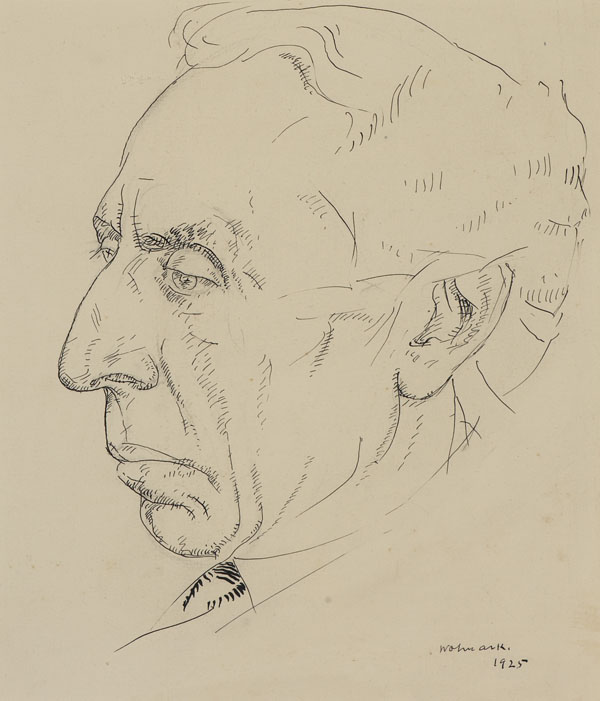
Portrait of Israel Zangwill
by Alfred Wolmark
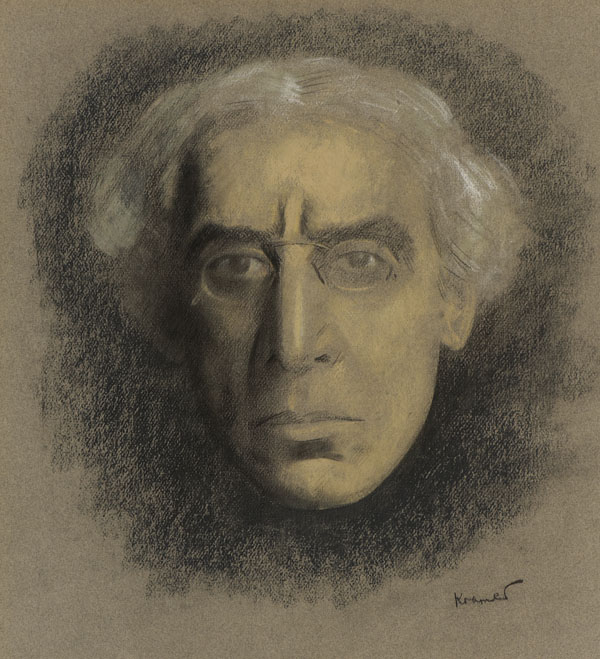
Portrait of Israel Zangwill
by Jacob Kramer

Portrait of Israel Zangwill
by Enrico Glicenstein