Ben Uri Pre-Eminent Collection

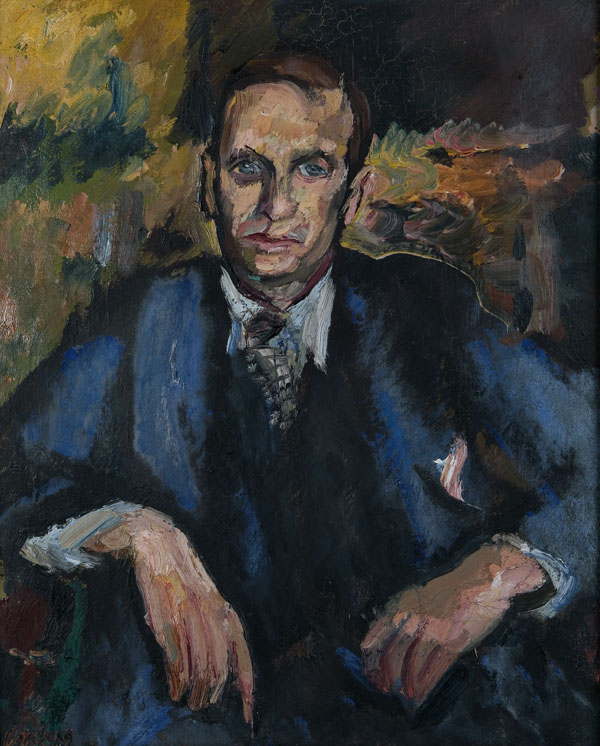
Portrait of John Rodker
Artist information
Name David Bomberg (1890-1957)
Born Birmingham, England
Died London, England
Find more work in the collection by this artist
Find out more about this artist
David Bomberg was born to Polish-Jewish parents in Birmingham, England on 12 May 1890. The family moved to Whitechapel in 1895, where he later became prominent among the ‘Whitechapel Boys’ - the term applied to a loose, informal group of young, Jewish, mainly immigrant artists who were either born, raised or worked in the East End in the first two decades of the 20th century, and who, both collectively, and individually, made an important contribution to British Modernism. Initially apprenticed as a chromolithographer, he attended night classes under Walter Sickert and also worked as an artist’s model before studying at the Slade School of Fine Art, where he was seen as a ‘disturbing influence’. In 1913 Bomberg visited Paris with Jacob Epstein, making contact with artists including Modigliani and Picasso. Bomberg’s harrowing service in the trenches during the First World War was compounded by a disastrous experience as a commissioned war artist, explored in a series of related drawings. His postwar disillusionment is most powerfully expressed in the masterly Ghetto Theatre (1920), purchased the same year for the Ben Uri Collection, initiating a lifelong relationship. Afterwards Bomberg made a series of peopled landscapes before travelling in 1923 to Jerusalem, where he began to work en plein air for the first time. Following expeditions to Jericho, Petra and Wadi Kelt, he produced a series of detailed, realistic landscapes, which evolved from tightly topographical treatments into a looser, characteristically expressionistic style, heralding the painterly achievements of his final years.
After a series of disappointments in the 1930s and 1940s Bomberg concentrated on portraits of friends and family, as well as a series of searching self-portraits. Although only reluctantly granted a Second World War commission to paint a bomb store in 1942, Bomberg produced many drawings and paintings on the subject, among them an impressive, large-scale study for a projected (but unrealised) mural. Following his visit to Spain in 1929, a renewed vigour resulted in a series of works based on the cathedral at Toledo, flowering on his second visit in 1934–35, into dramatic landscapes of the gorge at Ronda and flickering night-time processions during Holy Week. These experiments were curtailed by the onset of the Spanish Civil War, but over a decade later picked up and progressed in the west country, where his loosened handling verged on the abstract, and in Cyprus in 1948. His final works culminated in the fulfillment of his early promise after his return to Ronda, where he spent his last years. After becoming seriously ill, Bomberg travelled back to England, but died in London shortly after his return, on 19 August 1957. His work is represented in the UK in a number of important public collections including the Ben Uri Collection, the British Museum, the Imperial War Museum, the Tate, and the V&A. A posthumous touring exhibition (Pallant House, Chichester; Laing Art Gallery, Newcastle; Ben Uri Gallery, London), accompanied by a monograph, was organised by Ben Uri in 2017-18.
Object Details
Date c. 1931
Object type painting
Medium oil on canvas
Materials and techniques oil (medium) painting (technique) canvas (support)
Unframed 71.5 x 57 cm
Framed 91.5 x 78.4 cm
Signed (lower left): 'Bomberg'
Acquisition presented by Joan Rodker 2008
Accession number 2008-13
Display status On display in Gladys Hynes: Radical Lives, Charleston Lewes (until 11 October 2026)
This portrait depicts Bomberg’s close friend and fellow ‘Whitechapel Boy’, the modernist poet, essayist and publisher John Rodker (1894–1955). Bomberg designed a semi-abstract cover for the writer’s first collection of poems in 1914, based on studies of Rodker’s girlfriend Sonia Cohen performing a dance as a member of Margaret Morris’s famous troupe. Rodker reciprocated with reviews of Bomberg’s art, including one of Racehorses (1913) in The Dial Monthly in May 1914. During the First World War, Rodker went on the run, sheltering with the poet R. C. Trevelyan, but was eventually captured and imprisoned in Dartmoor. He later explored this experience in his account, Memoirs of Other Fronts, published anonymously in 1932. One of his many publishing projects included the short-lived Ovid Press (1919), which brought out work by the modernist poets T. S. Eliot, Wyndham Lewis and Ezra Pound.
Bomberg painted Rodker’s portrait during a period of critical neglect when he turned largely to himself, his family and close friends as subjects. It was donated to the Ben Uri Collection by the sitter’s daughter, Joan Rodker, in 2008. Bomberg’s realistic approach to Rodker’s portrait illustrates his move away from his earlier sharp-edged Vorticist treatment of the figure and towards a more painterly style. He uses broad, expressive brushstrokes and the pink and green flesh tones of the face, reminiscent of Cézanne, are offset by the rich blue of Rodker’s suit.
Bomberg’s correspondence from the early 1930s (University of Texas at Austin) reveals the enduringly close friendship of the two men, as well as Rodker’s later efforts to obtain financial assistance for Bomberg (including a 1954 reply from 10 Downing Street indicating that the artist had not been awarded a civil list pension). Despite support from a small number of collectors in Britain, Bomberg’s financial anxieties were acute. He remained a prominent member of The London Group, to whom he submitted a revolutionary set of proposals suggesting affiliation with the Anti-Fascist Allied Artists’ International Association (AIA), but this, like his subsequent plans to re-organise the Ben Uri, was emphatically rejected. ‘The Jewish artists are starving,’ he wrote in 1938,‘none of us can work, most of us receive one form of charity or another – we can make a market for ourselves if we organise’. A recently uncovered letter from Ben Uri’s treasurer Cyril J. Ross (24 June 1939) in Ben Uri’s Archive refers to a number of ‘upsetting letters’ from Bomberg. Ross subsequently offered to either make a studio space available for the impecunious artist or to pay (at his own expense) the rent on Bomberg’s existing studio. During the Second World War Bomberg was appointed an Official War Artist but only completed one commission, Underground Bomb Store (1942). Afterwards, he became a highly influential teacher, most notably at the Borough Polytechnic (1945–53), where he formed The Borough Group (1947–9), and the Borough Bottega (1953). Bomberg moved to Spain in 1954 and remained there until shortly before his death in 1957.
Selected exhibition history
2015
Out of Chaos – Ben Uri: 100 Years in London
Somerset House
2016
100 for 100: Ben Uri Past, Present & Future
Christie's South Kensington
2017
Bomberg: Touring Exhibition
Pallant House Gallery
2018
Bomberg
Ben Uri Gallery and Museum
2018
Acquisitions and Long-Term Loan Highlights Since 2001
Ben Uri Gallery
2018
Bomberg: Touring Exhibition
Laing Art Gallery
2019
Migrations: masterworks from the Ben Uri Collection
Gloucester Museum
2021
Becoming Gustav Metzger: Uncovering the Early Years, 1945-59
Ben Uri Gallery & Museum
2024
The Decorative Fair
Evolution London
2026
Gladys Hynes: Radical Lives
Charleston Lewes
Literature
Rachel Dickson and Sarah MacDougall, eds., Bomberg (London: Ben Uri Gallery, 2017) pp.146-153 (illus. included); Rachel Dickson and Sarah MacDougall, eds., 'Out of Chaos: Ben Uri; 100 Years in London' (London: Ben Uri Gallery, 2015) pp. 82-83; Oil Paintings in Public Ownership in Camden (London: The Public Catalogue Foundation, 2013), p.9 (illus. included).
Hover mouse cursor over image to zoom (you can also use the mouse wheel).
To license this image contact Bridgeman images
Related works
Portrait of Sonia
by Isaac Rosenberg