Ben Uri Collection

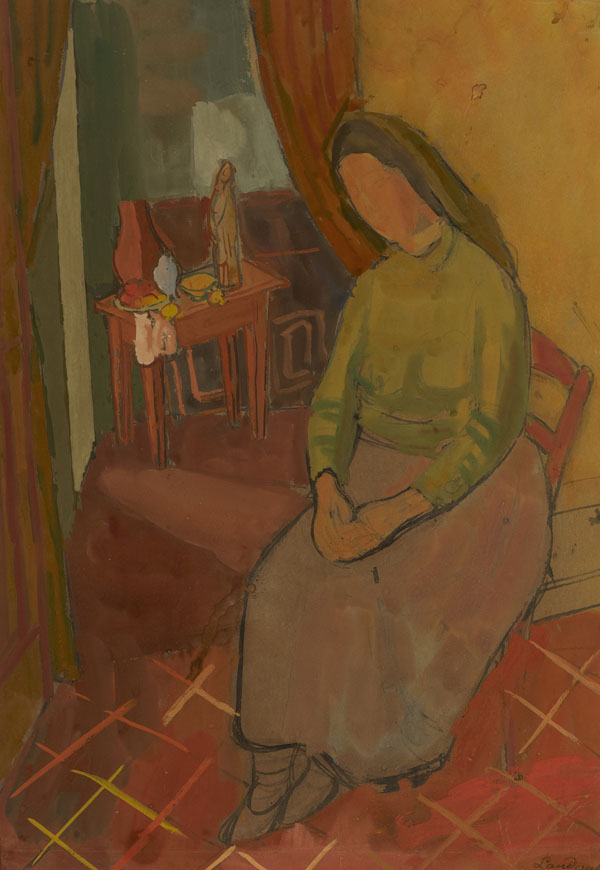
Interior
Artist information
Name Zygmund Landau (1898-1962)
Other name Zygmunt Landau
Born Lodz, Poland
Died Tel Aviv, Israel
Find more work in the collection by this artist
Find out more about this artist
Object Details
Object type painting
Medium gouache on paper
Materials and techniques gouache (medium) paper (support)
Unframed 65 x 49 cm
Framed 81 x 62.5 cm
Signed (lower right): Landau
Acquisition presented by Alexander Margulies 1987
Accession number 1987-202
Display status not on display
Landau’s ‘Interior’ was most probably painted in the south of France, around Saint-Tropez, where he lived during the 1930s and 1940s, as indicated by the traditional, tiled floor and the glimpse into a further room with a small array of still-life objects on a table including a small statue of Mary, indicating that his sitter is probably Catholic. The warm, rustic palette of soft oranges, yellows, greens and browns, coupled with the earthy, opaque quality of the paint evoke the colours and textures of the local landscape.
The typically modernist, flattened space and simplified female figure at the centre of the composition is reminiscent of the work of Bloomsbury artists such as Vanessa Bell and Roger Fry. Landau shared a flat in St Tropez with Fry who championed his work.
Selected exhibition history
2004
The Modern and the New: An Examination of the Permanent Collection alongside New Works by Invited British, European and American Jewish Artists
Ben Uri Gallery - The London Jewish Museum of Art
2009
Homeless & Hidden 1: World Class Collection Homeless & Hidden
Ben Uri Gallery
Literature
Walter Schwabe and Julia Weiner, eds., Jewish Artists: the Ben Uri Collection - Paintings, Drawings, Prints and Sculpture (London: Ben Uri Art Society in association with Lund Humphries Publishers Ltd, 1994), p. 66.
Hover mouse cursor over image to zoom (you can also use the mouse wheel).