Ben Uri Collection

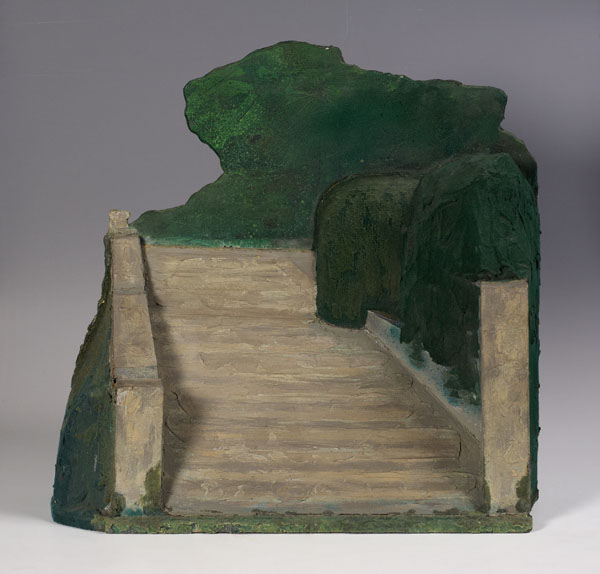
Garden Steps
Artist information
Name Ivor Abrahams (1935-2015)
Born Wigan, England
Died London, England
Find more work in the collection by this artist
Find out more about this artist
Sculptor Ivor Abrahams was born to Jewish parents in Wigan, Lancashire, England on 10 January 1935. Despite family opposition, he moved to London in 1952 to study at St Martin's School of Art (1952-3) and then Camberwell School of Art (1954-7). After completing his studies he travelled widely and taught. In the 1950s he worked as a display artist for Adel Rootsteine, retaining a fascination for advertising placards, which reflect his continuing exploration of surface texture and illusion. He also worked as an apprentice at the Fiorini Art Bronze Foundry (which cast some of his work) and gained international attention through an exhibition with Peter Blake in 1960. Abrahams’s early bronzes were shown as a group in his first solo exhibition at London’s Gallery One (1962). Following this he made a radical change to his practice, working directly in plaster and latex and adopting a ‘figure and ground’ format, which he attributed to an interest in de Chirico. He was elected to the Royal Academy in 1989.
Ivor Abrahams died in London, England on 6 January 2015. His work is represented in more than 30 national and international collections including the Arts Council, the British Council, the Royal Academy, Tate, the Cass Sculpture Foundation (Goodwood) and MoMA, New York. His many exhibitions include the Henry Moore Institute, Leeds (2007); the A P Gianini Gallery, San Francisco (2001); the Royal Academy of Arts (1999); Bernard Jacobson Gallery, London; Galeries Salis, Salzburg (1991), Miriam Shiell Fine Art, Toronto (1989) and Galerie Albrecht, Munich (1987).
Object Details
Date 1973
Object type sculpture
Medium flock and PVA on board
Materials and techniques flock | pva (medium) board (support)
Dimensions 63.5 x 63.5 x 20 cm
Acquisition presented by Brandler Galleries 2010
Accession number 2010-1
Display status not on display
Abrahams’ has commented of his garden imagery that it is ‘a collective image – a manifestation of a consensual desire – a public aesthetic given concrete form’. Nevertheless, his garden imagery is perhaps his best-known work and demonstrates his experimental approach to sculpture through uniting materials often used for painting, as well as elements of collage and two-dimensional printing.
Hover mouse cursor over image to zoom (you can also use the mouse wheel).