Ben Uri Collection

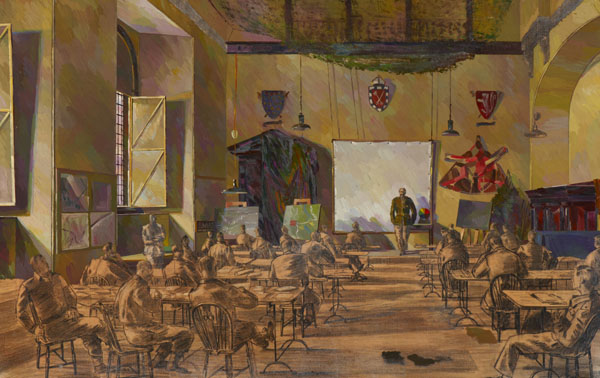
D-Day Preparations (Briefings)
Artist information
Name Barnett Freedman (1901-1958)
Born London, England
Died London, England
Find more work in the collection by this artist
Find out more about this artist
Barnett Freedman was born in London’s East End to Russian-Jewish immigrant parents. Between the ages of nine and thirteen, he was confined by ill health to the London Hospital and worked afterwards as a signwriter, stonemason’s assistant and architect’s assistant, latterly attending evening classes at St. Martin’s School of Art. Through the intervention of Sir William Rothenstein he won the London County Council Scholarship and studied at the Royal College of Art (1922–25) under Paul Nash, himself an Official War Artist during both wars. In 1928 Freedman became a still life instructor at the RCA and later taught at the Ruskin School of Art, Oxford, under Albert Rutherston (Rothenstein’s younger brother). He held his first exhibition at the Bloomsbury Bookshop in 1929 and his realist style in this period is linked to that of the Euston Road School. Freedman afterwards became well-known for his commercial illustration and poster work for notable clients, such as the London Underground, and carried out a number of commissions in this post including designing publicity for Shell, the BBC and the General Post Office and Ealing Films. In 1935 he designed the George V Silver Jubilee postage stamp.
Freedman also became a successful and prolific book illustrator and book jacket designer. His illustrations include work for Faber and Faber, such as Siegfried Sassoon’s Memoirs of an Infantry Officer (1931), The Folio Society, and the Baynard and Curwen Presses. Using pen and chalk for reproduction by line blocks for black and white and auto-lithography for colour, Freedman developed an immediately recognisable style. He also became a distinguished letterer and typographer.
Barnett Freedman died in London, England on 4 January 1958. His work can be found in UK collections including the Ben Uri Collection, the Imperial War Museum, Museums Sheffield, Nottingham City Museums & Galleries, Pallant House Gallery, Salford Museum & Art Gallery, and Tate. In 1958 an Arts Council retrospective was held at the Tate Gallery, followed by a further retrospective, 'Barnett Freedman: Designs for Modern Britain', at Pallant House Gallery in Chichester in 2020.Object Details
Date 1944
Object type painting
Medium oil on canvas
Materials and techniques oil (medium) canvas (support)
Unframed 59 x 90 cm
Framed 75 x 108.2 cm
Acquisition presented by the artist's son Vincent Freedman in 2010
Accession number 2010-2
Display status not on display
This unfinished painting was commissioned while Barnett Freedman was working as an Official War Artist during the Second World War and documents Allied preparations for D-Day in the War Room of the Portsmouth Army Base. He was made a War Artist in 1940, serving first with the British Expeditionary Force in France (alongside illustrators Edward Ardizzone and Edward Bawden), and then with the Admiralty until 1946, when he was awarded the CBE for his war work. This included large-scale paintings, portraits of entire ships’ crews and a lithograph of the 15-inch Gun Turret in HMS Repulse.
Keywords
interior | painting | soldier | war | World War Two
Selected exhibition history
2015
Out of Chaos – Ben Uri: 100 Years in London
Somerset House
2020
Barnett Freedman: Designs for Modern Britain
Pallant House Gallery
2023
The Second World War on the Home Front (supporting A Brush with Evil II: Laura Knight at the Nuremberg Trial)
Ben Uri Gallery
2025
Ben Uri 110/25: From Local to Global
Ben Uri Gallery
Literature
Barnett Freedman: Designs for Modern Britain (Chichester: Pallant House Gallery, 2020), p. 37 (illus); Rachel Dickson and Sarah MacDougall, eds., 'Out of Chaos: Ben Uri; 100 Years in London' (London: Ben Uri Gallery, 2015) pp. 98-99; Oil Paintings in Public Ownership in Camden (London: The Public Catalogue Foundation, 2013), p.14 (illus. included).
Hover mouse cursor over image to zoom (you can also use the mouse wheel).