Ben Uri Collection

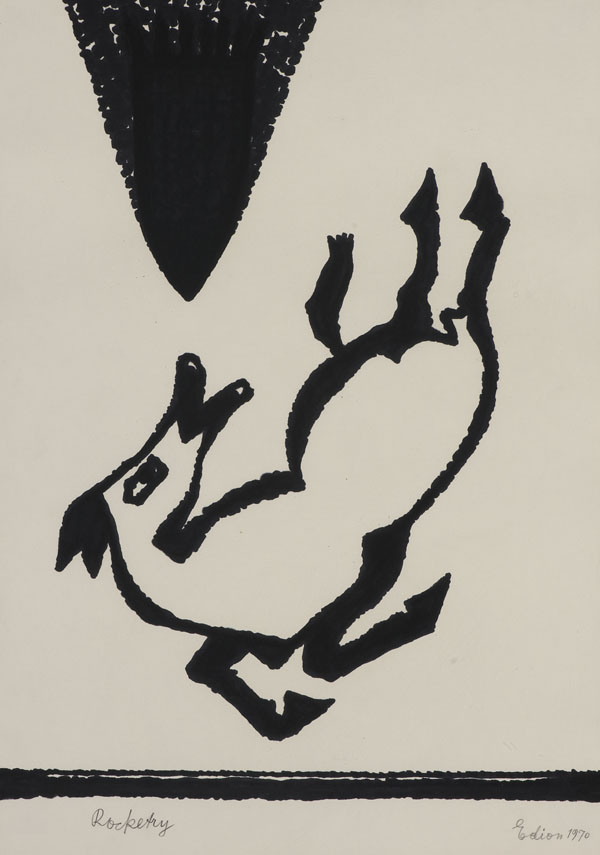
Rocketry
Artist information
Other name Heinrich Edelstein
Born Vienna, Austria
Died London, England
Find more work in the collection by this artist
Find out more about this artist
Artist Henry Edion (né Heinrich Edelstein) was born into a French-Jewish family in Vienna, Austria-Hungary (now Austria) in 1905. During the Second World War, he was captured by the Nazis in 1940 and held for four years in concentration camps in southwest France, where he was encouraged to paint by fellow prisoner and German Expressionist painter Gert Wollheim (his mother was deported to Thereseienstadt, where she perished).
After the war, Edion studied at L'Academie de la Grande Chaumiere (where a model was provided but no instruction) in Paris. He subsequently lived and worked in Australia, where he joined his older brother and earned a living painting portraits of Melbourne’s Jewish community until 1955. Afterwards he travelled in Indo-China, Italy, Canada, and America, before eventually moving to England in 1962, where he Anglicised his name to 'Henry' and held his first solo exhibition at Crane Kalman Gallery, who subsequently represented him. His work, much influenced by the threat of Nuclear War, was also exhibited by the Arts Council and Ben Uri Gallery.
Henry Edion died in London, England in 1987. In 1994 Ben Uri held a posthumous selling exhibition of Edion’s works on paper in order to fulfil his wish that his works should be sold to raise money to plant trees in Israel. Crane Kalman Gallery hosted two posthumous exhibitions: Henri Edion: Images of a Central European Misfit (1993) and Henri Edion: An Artist’s Life (1995). Edion’s work is represented in UK collections including the Arts Council Collection, the Ben Uri Collection, the British Museum and the V&A, as well as the National Gallery of Victoria and the National Gallery of Australia.
Object Details
Date 1970
Object type drawing
Medium pen and ink on paper
Materials and techniques ink | pen (medium) paper (support)
Unframed 50.5 x 35 cm
Framed 61 x 50 cm
Signed and dated (lower right): 'Edion 1970'
Acquisition presented by Paul and Mary Rees and Pat and Alex Gilmour
Accession number 2012-1993-51
Display status not on display
Edion's work which typically employed thick black lines, strong colours and a sense of humour, was strongly influenced by the threat of nuclear war; rockets were a common motif. Here, a horse is upended in surprise by the nose of a rocket apparently about to land.
Literature
Walter Schwab and Julia Weiner, eds., Jewish Artists: the Ben Uri Collection - Paintings, Drawings, Prints and Sculpture (London: Ben Uri Art Society in association with Lund Humphries Publishers Ltd, 1994), p. 121.
Hover mouse cursor over image to zoom (you can also use the mouse wheel).