Ben Uri Pre-Eminent Collection

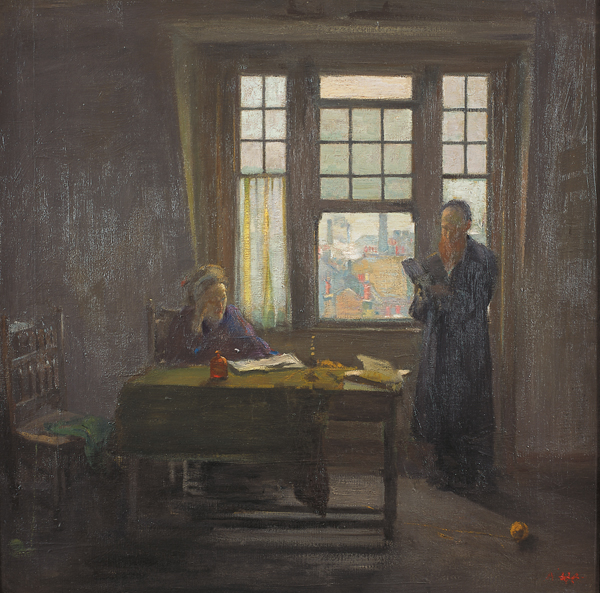
Sabbath Afternoon
Artist information
Name Alfred Wolmark (1877-1961)
Born Warsaw, Poland
Died London, England
Find more work in the collection by this artist
Find out more about this artist
Aaron Wolmark was born into a Jewish family in Warsaw, Poland on 28 December 1877, and moved to England with his family in 1883, first to Devon and then to the East End of London. He trained at the Royal Academy (from 1895), where he added the English 'Alfred' to his name, exhibiting there (1901–36), as well as with the Allied Artists Association (1908–16) and the International Society (1911–25). He had his first solo exhibition at Bruton Galleries in London (1905). Wolmark's teenage years in London’s East End and two lengthy stays in his native Poland between 1903–6, had a huge visual and spiritual, impact on his early Rembrandtesque work and Jewish subject matter.
In July 1911, after an artistic epiphany on honeymoon in Concarneau, Brittany, Wolmark jettisoned his early methods in favour of the ‘New Art’ and embarked upon the pioneering 'colourist' path that he followed for the next two decades of his working life. A pioneer as a painter of both the Jewish community in London’s East End and as an early modernist, Wolmark has been called the ‘father’ of the Whitechapel Boys. He was the only artist to be included in both the Whitechapel Art Gallery’s 1906 'Jewish Art and Antiquities Exhibition' and in David Bomberg and Jacob Epstein's 'Jewish Section' at the 1914 exhibition 'Twentieth-Century Art: A Review of Modern Movements'.
Wolmark exhibited regularly with the Ben Uri Art Society, as well as at the Grafton (1911, 1916, 1917) and Whitechapel Galleries (1910, 1914, 1927, 1956). In 1915 he co-founded the JAAS (Jewish Association of Arts and Sciences) with Adrian Alfred Woolfstein (Adrian Wolfe). Closely associated with the Ben Uri for many years: in 1925, together with Solomon J Solomon, Wolmark presided over the official opening of the Ben Uri’s first gallery in Great Russell Street, also acting as Vice-President from 1923–56, and as an adviser on purchasing policy. In the 1930s he introduced Cyril Ross and Ethel Solomon (Mrs Robert Solomon) to the Society. His oeuvre also included theatre designs for two Diaghilev ballets, pottery and stained-glass windows. Despite his success, Wolmark was rejected from both the London Group (1914) and the Royal Academy (1938). He died in London, England on 6 January 1961. His work is in many UK collections including the Arts Council Collection, the Ferens Art Gallery, the Government Art Collection, the Jerwood Collection, Middlesbrough Institute of Modern Art (MIMA), the National Portrait Gallery, Southampton City Art Gallery and The Stanley and Audrey Burton Gallery at the University of Leeds.
Object Details
Date c. 1909-10
Object type painting
Medium oil on canvas
Materials and techniques oil (medium) painting (technique) canvas (support)
Unframed 77.5 x 77.5 cm
Framed 91.1 x 91.2 cm
Signed (lower right: in red) 'A. W.'
Acquisition acquired in 2013 with the assistance of the HLF, the V&A Purchase Grant Fund and Art Fund
Accession number 2013-02
Display status not on display
'Sabbath Afternoon' is a key transitional work in Wolmark's oeuvre, marking his move away from his earlier Rembrandtesque style and towards modernism, as he experiments with a new handling of paint and touches of a lighter palette. Wolmark was familiar with Polish painter Samuel Hirszenberg's oil 'Sabbath Rest' (1894, Ben Uri Collection), set in Warsaw, but significantly chose to transpose his subjects to a typical London East End setting in a journey much like his own from East to West. To underline their Orthodoxy, Wolmark shows his couple absorbed in their Sabbath studies, including important details of Jewish religious observance, such as the Bessamim (ceremonial spice tower), containing spices that will be smelled at the end of the Sabbath, and possibly a schtender (book stand) on the end of the table. The man wears a yarmulke (skull cap) and standard Jewish religious clothing that suggests he is Hassidic. Possibly he is undertaking afternoon prayers, standing with his feet together and facing Jerusalem.
Yet the focus at the centre point of the composition shifts from interior to exterior and from domestic to industrial, as the city’s smoking chimneys are glimpsed through the window behind. It is not the interior or its inhabitants but the brilliantly lit, urban townscape beyond which identifies Wolmark with a modernist motif typical of his Camden Town contemporaries.
Keywords
afternoon | bessamim | Camden Town group | East End | idenity | interior | Jewish | Judaic | Judaism | London | migration
Selected exhibition history
1948
Exhibition of Jewish Art
North Western Reform Synagogue
2001
The Ben Uri Story: from Art Society to Museum
Phillips
2004
Rediscovering Wolmark: a Pioneer of British Modernism
Ben Uri Gallery - The London Jewish Museum of Art
2013
Selected Highlights from over 200 works acquired during 2003-2013
Ben Uri Art Gallery
2015
Out of Chaos – Ben Uri: 100 Years in London
Somerset House
2018
Acquisitions and Long-Term Loan Highlights Since 2001
Ben Uri Gallery
2019
Migrations: masterworks from the Ben Uri Collection
Gloucester Museum
2025
Ben Uri 110/25: From Local to Global
Ben Uri Gallery
Literature
Rachel Dickson and Sarah MacDougall, eds., Out of Chaos: Ben Uri; 100 Years in London (London: Ben Uri Gallery, 2015), pp. 34-35; Selected Highlights from over 200 works acquired during 2003-2013 (London: Ben Uri Gallery, 2013), illus; Sarah MacDougall, From Warsaw to Whitechapel: an exploration of cultural and artistic identity in the early work of Alfred Aaron Wolmark (c. 1876-1961), in eds., Jerzy Malinowski, Renata Piatkowska, Tamara Sztyma-Knasiecka (Warsaw: Jewish Artists and Central-Eastern Europe, Conferences of the Polish Society of Oriental Art, Vol. III), pp. 231-240; Rachel Dickson and Sarah MacDougall, eds., Rediscovering Wolmark: a pioneer of British modernism (London: Ben Uri Gallery, 2004), pp. 22-23, illus.
Hover mouse cursor over image to zoom (you can also use the mouse wheel).
To license this image contact Bridgeman images
Related works
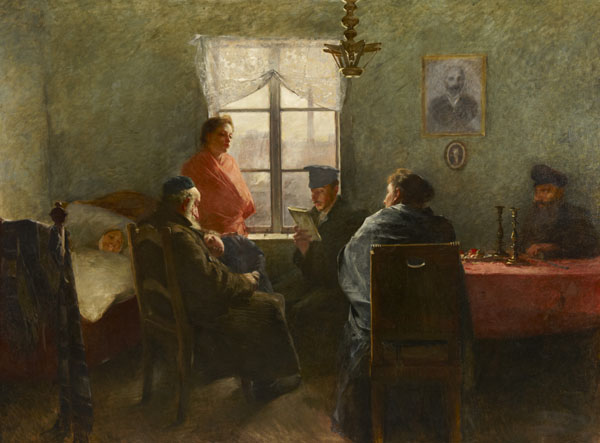
Sabbath Rest
by Samuel Hirszenberg