Ben Uri Pre-Eminent Collection

Internment in Douglas
Artist information
Name Ernst Eisenmayer (1920-2018)
Born Vienna, Austria
Died Vienna, Austria
Find more work in the collection by this artist
Find out more about this artist
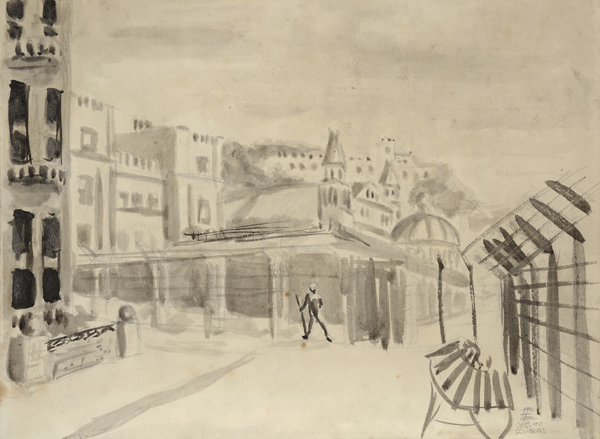
Painter and sculptor Ernst Eisenmayer was born into a Jewish family of Austro-Hungarian descent in Vienna, Austria on 18 September 1920. Following Hitler's accession to the Chancellorship in Germany in 1933 and the rise of increasingly anti-Semitic legislation, followed by the Anschluss (annexation of Austria) in 1938, Eisenmayer was imprisoned, aged 18, in Dachau Concentration Camp, where he witnessed many atrocities and made a series of drawings. In 1939 he managed to escape to England (as he later narrated in his memoir, 'A Strange Haircut'), but following the introduction of internment for so-called ‘enemy aliens’ in June 1940, he was interned on the Isle of Man from October 1940 until August 1941, first in Central (situated around a promenade in Douglas), until February 1941, then Onchan (a village north of Douglas, enclosed by barbed wire), and finally at Mooragh Camp in Ramsey. He made art throughout internment, often using improvised materials, sketching portraits of fellow internees, landscapes, camp views and everyday scenes, including a drawing entitled 'Internment in Douglas' (1940, now Ben Uri Collection); he also participated in the Onchan camp art exhibition, organised in April 1941, and one of his drawings was reproduced in the camp magazine, 'The Onchan Pioneer'. After release, he joined the Young Austria movement, where he met fellow refugee artists Erich Deutsch (Eric Doitch) and Heinz Inländer (Henry Inlander) who became close friends, and with whom he afterwards studied at Camberwell School of Art (1946–47). In 1944 his work was included in an exhibition of Austrian art in exile.
Postwar Eisenmayer initially worked for a small London firm designing and making jewellery, but as his reputation grew he decided to become a full-time artist in 1962. He held solo exhibitions in several cities including London, Osaka, and his birthplace, Vienna. In 1962 he held a solo exhibition at Ben Uri's Berners Street Gallery and ten years later, he became a member of the Ben Uri Arts Committee. Between 1974 and 1988 he lived in Italy, then spent eight years in Amsterdam, before eventually returning to his native Vienna in 1996. In the same year his work was included in a Ben Uri loan exhibition, 'Paintings Drawings and Sculpture by Austrian Artists Whose Lives Were Disrupted by the Holocaust'. He died in Vienna, Austria on 27 March 2018.
Eisenmayer's work later underwent a critical reassessment. In 2002 the exhibition 'About the Dignity of Man: Ernst Eisenmayer – Life and Work' was held at the Jewish Museum, Vienna and in 2010 his painting 'Strip Poker' closed Ben Uri’s 2010 exhibition 'Forced Journeys', which toured to Douglas on the Isle of Man and Birkenhead, to mark the 70th anniversary of the establishment of the Manx internment camps, followed by a solo exhibition 'Art Beyond Exile' curated by Prof Fran Lloyd at the Austrian Cultural Forum in London, and the Sayle Gallery, Douglas, Isle of Man in 2012. Eisenmayer's work is held in UK collections including the Ben Uri Collection, Kings Lynn Museums, Peterborough Museum & Art Gallery and Southlands College at the University of Roehampton.
Object Details
Date 1940
Object type drawing
Medium watercolour, graphite and pen and ink on paper and board
Materials and techniques ink | pen (medium) drawing (technique) board | paper (support)
Unframed 21.1 x 29.4 cm
Framed 40.7 x 53.1 x 2 cm
Signed and dated (lower right): 'E Dec 40'
Acquisition purchased and presented by David and Eva Wertheim, 2013
Accession number 2013-06
Display status not on display
This drawing looks north along the Promenade towards Castle Mona at Central camp on the Isle of Man, where Eisenmayer was first held as a so-called ‘enemy alien’ in October 1940, before moving to Onchan camp, and finally Mooragh camp (Ramsey), where he was held until his release in September 1941.
After having been held in Dachau concentration camp between 1938 and 1939, where he witnessed appalling atrocities, Ernst Eisenmayer recalled that captivity in British hands was 'at times, a bit of a lark', with trips to the cinema, football matches, a choir and a camp 'university' offering art classes. Yet despite his affirmation: 'I don't go along with the presentation by some artists of the cliched barbed wire [.] We were bloody lucky on the Isle of Man, unlike the millions in German concentration camps', this drawing nevertheless foregrounds the barbed wire with an armed soldier guarding the camp.
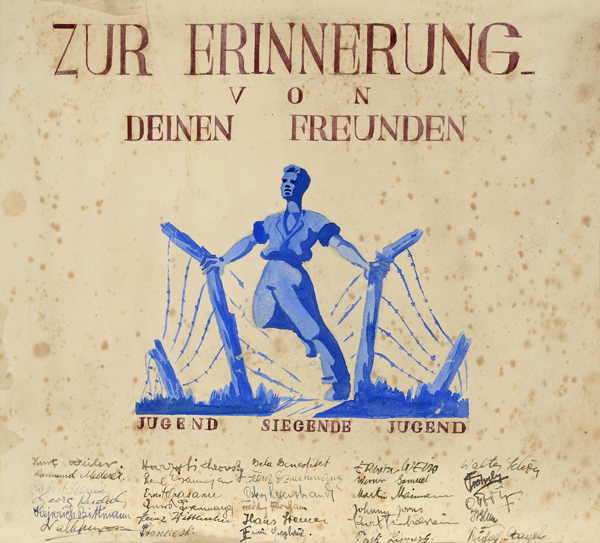
A companion drawing by an unknown artist, accompanied by 29 internees' signatures including Eisenmayer's, commemorates camp friendships and clearly depicts the wire being torn apart by a youth, beneath which appear the words 'Jungend Siegende Jungend' ('Youth Victorious Youth').
Keywords
Selected exhibition history
2016
Out of Chaos: Touring exhibition
Laing Art Gallery
2018
Out of Austria: Austrian emigre artists to the UK
Ben Uri Gallery and Museum
2019
Art-exit: 1939 - A Very Different Europe
12 Star Gallery
2019
Migrations: masterworks from the Ben Uri Collection
Gloucester Museum
2020
Internment: In Memory of Eva Aldbrook
Ben Uri Gallery
2024
The Decorative Fair
Evolution London
2024
US: From There to Here - Britain's Gain
Ben Uri Gallery and Museum
2025
Ben Uri 110/25: From Local to Global
Ben Uri Gallery
Literature
Sarah MacDougall (foreword), Important Additions to the Collection since 2000 (London: Ben Uri Gallery and Museum, 2025), p. 8, illus., p. 51; Rachel Dickson and Sarah MacDougall, eds., Out of Chaos: Ben Uri - 100 Years in London (London: Ben Uri Gallery, 2015), pp. 90-91.
Hover mouse cursor over image to zoom (you can also use the mouse wheel).
To license this image contact Bridgeman images
Related works
Commemorative piece with 29 signatures
by Unknown

Douglas, Isle of Man
by Kurt Schwitters