Ben Uri Collection

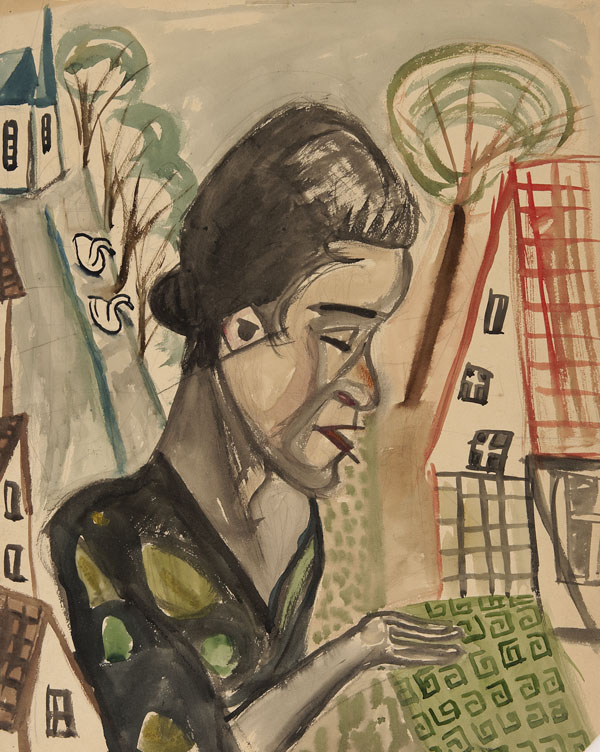
Woman in Profile with Swans and Houses
Artist information
Name Alfred Lomnitz (1892-1953)
Other name Lom
Born Hessen, Germany
Died London, England
Find more work in the collection by this artist
Find out more about this artist
Graphic artist Alfred Lomnitz, also known as 'Lom', was born into a Jewish family in Eschwege, Germany on 30 September 1892 and trained at the Weimar School of Applied Arts under Henri Van de Velde, although he was most strongly influenced by Paul Klee, who also taught there. After military service during the First World War, he moved to Berlin, where he held his first solo exhibition at the Neumann Gallery in 1919, showcasing his woodcuts and first signing his work 'LOM’. He also exhibited with the progressive Novembergruppe and the Free Secession. During the 1920s and 1930s he ran the Litz design studios for painting, graphics and design.
Following Hitler's accession to the Chancellorship in 1933, Lomnitz left Germany for England, where he continued his dual career. In June 1934 seven of his works on paper were included in the 'Exhibition of German-Jewish Artists' Work: Painting, Sculpture, Architecture' at the Parsons Gallery, London, organised by German-Jewish émigré dealer, Carl Braunschweig (later Charles Brunswick), which included in total 220 artworks by 86 artists suffering persecution under the Nazi regime and in the same year, Lomnitz held a solo exhibition at the Ryman Gallery, Oxford. In summer 1940 he was one of many German-speaking refugees, reclassified as ‘enemy aliens’ and was interned at Huyton camp, a recently completed housing estate outside Liverpool, alongside fellow refugee artists including Martin Bloch, Hugo Dachinger, Walter Nessler and Samson Schames. He described Huyton as a place where ‘every corner of the camp is a potential picture’ and produced watercolours and sketches of daily life, among them Girl Behind Barbed Wire and Suburban Scene (Huyton Camp) (both Ben Uri Collection). Shortly after his release, he published an autobiographical account of his internment, under the title 'Never Mind, Mr Lom' (Macmillan, 1941), with a cover design of a figure silhouetted against coils of barbed wire.
Less is known of Lomnitz's career post-internment, although the onset of Parkinson’s curtailed his artistic activities. He exhibited at Ben Uri Gallery in group exhibitions in 1944 and 1949, alongside Cyril J. Ross, Ben Uri’s treasurer, who provided studio space and employment within his furrier business, Swears & Wells. Alfred Lomnitz died in London, England on 23 November 1953. Ben Uri held a retrospective in 1954, and Ross bequeathed a number of works to the Collection, but outside Ben Uri, Lom’s reputation was largely ignored until the 1980s when the dealer John Denham mounted a solo exhibition of his paintings, drawing and prints and also included his work within a group show. In the same year, his work was included in the survey exhibition Art in Exile in Great Britain 1933–45 at the Camden Art Centre. His work has also been shown posthumously in numerous Ben Uri exhibitions including picture fairs and in the touring exhibition 'Forced Journeys' (2009-10). In the UK his work is held in the Ben Uri Collection and the British Museum.
Object Details
Object type painting
Medium watercolour on paper
Materials and techniques watercolour (medium) paper (support)
Unframed 52.5 x 41 cm
Acquisition presented by Cyril J. Ross
Accession number 1987-245
Display status not on display
In June 1940 Lom was one of many German-speaking refugees, reclassified as enemy aliens and interned at Huyton, a recently completed housing estate outside Liverpool. Lom’s fellow internees included emigre artists Hugo Dachinger, Walter Nessler and Samson Schames, who all also produced works within the camp. Shortly after his release, Lom published an illustrated autobiographical account of his internment, 'Never Mind, Mr Lom' (Macmillan, 1941) with a cover design of a figure silhouetted against coils of barbed wire. Given a room to paint in, Lom describes making a collapsible easel from salvaged wooden posts and door hinges, using a piece of slate as a palette and, at least initially, working with watercolours and cartridge paper brought from home. When the paper ran out, he used newspapers to paint on, describing the satisfying effect of applying watercolour over type and images. Number 10 in a portfolio of 24 loose works.
Keywords
genre scene | painting | swan | woman
Selected exhibition history
2012
The Inspiration of Decadence Dodo Rediscovered: Berlin - London (1907-1998)
Ben Uri Gallery
Literature
Walter Schwab and Julia Weiner, eds., Jewish Artists: the Ben Uri Collection - Paintings, Drawings, Prints and Sculpture (London: Ben Uri Art Society in association with Lund Humphries Publishers Ltd, 1994), p. 73.
Hover mouse cursor over image to zoom (you can also use the mouse wheel).