Ben Uri Collection

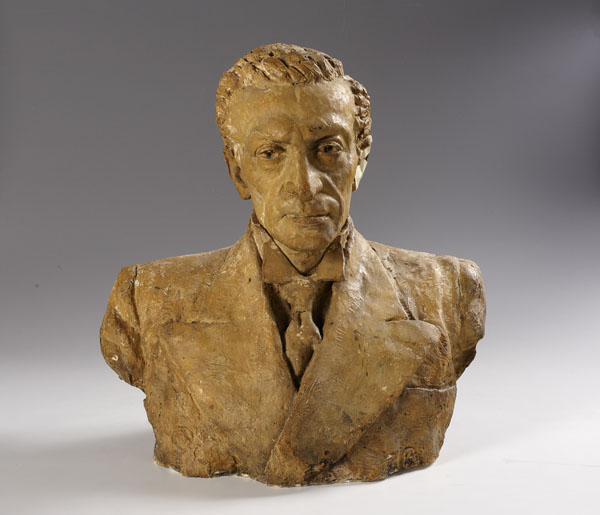
Portrait of A. Cherne
Artist information
Other name Mordka Ajzik
Born Warsaw, Poland
Died London, England
Find more work in the collection by this artist
Find out more about this artist
Painter and sculptor Max Sokol (né Mordka Ajzik) was born into a Jewish family in Warsaw, Poland on 2 April 1895 and studied art in Stettin and Berlin under Prof Hugo Lederer. Following Hitler's rise to power, he was forced to flee Germany for England in 1937, settling in the north-west London area, so densely populated by German-speaking refugees that it was known locally as ‘Finchleystrasse’. In the same year, he first showed work at Ben Uri Gallery in the 'Annual Exhibition of Works by Jewish Artists', where a special section dedicated to his work showcased eleven of his sculptures including a bronze portrait of Chairman Adolph Michaelson, the symbolic bronze ‘Mother and Child in Storm’ (New College, Oxford), and a large wood carving, ‘Devotion’, depicting a Jewish figure in prayer but also likely referencing Ernst Barlach's 'Das Schlimme Jahr, 1937' (The Terrible Year, 1937), responding to the so-called 'Degenerate' Art exhibition, mounted in Munich, the fate of the German nation and those persecuted by the Nazis. It was purchased by member subscription for the Ben Uri Collection in 1948. He went on to participate in a further 15 Ben Uri exhibitions during his lifetime. In 1938, Sokol exhibited a bronze, ‘Reclining Nude’ (possibly shown at Ben Uri as ‘Reclining Woman’ the previous year) in the important exhibition of 'Twentieth Century German Art' at New Burlington Galleries, London, intended as a riposte to the 1937 Nazi ‘Degenerate Art’ exhibition.
Sokol was also a member of the cultural refugee organisation, the Free German League of Culture (FGLC), founded in 1939 in Downshire Hill, and his work was included in FGLC exhibitions including ‘Artists Aid Jewry’ (1943) at the Whitechapel Art Gallery. In the same year, his portrait bust of A. Cherne (presented to the Ben Uri Collection) was exhibited at the Royal Glasgow Institute of Fine Arts 82nd Annual Exhibition, and then at Ben Uri Gallery in 1945. He also exhibited with the AIA (Artists' International Association), including in the the AIA and FGLC Exhibition of Sculpture and Drawings (1941). He maintained a close friendship with artist Alfred Wolmark (Ben Uri's Vice-President 1923–56), creating a portrait bust of him, and another of Joseph Leftwich (also closely associated with Ben Uri); the latter was exhibited at the Royal Academy in 1945 and both were purchased for the Ben Uri Collection. Sokol also served as a member of Ben Uri's Arts Committee between 1949 and 1968 and fellow member Hungarian émigré Kalman Kemeny executed a portrait of him in his later years. In 1955 Sokol had a joint exhibition with German-Jewish émigré Henry Sanders, a Ben Uri Studio Group Committee member, at Stoke Newington Library Hall, in north London.
Max Sokol died in London, England on 21 June 1973. His sculpture is in public collections including the Ben Uri Collection, Hackney Museum and New College, Oxford; further, a large collection of works – including a self-portrait, two portraits of his daughter and several symbolic figurative works including ‘Return from Captivity (Reunion)’, were presented to St. Anne's College, University of Oxford by his daughter, Professor Diana Deutsch, a former graduate of the college.
Object Details
Date 1943
Object type sculpture
Medium plaster
Materials and techniques sculpture (technique) plaster (support)
Dimensions 51 x 49 x 30 cm
Acquisition presented to Ben Uri by Ethel Solomon
Accession number 1987-260
Display status not on display
The Ben Uri records contain no clue to the identity of the sitter in this portrait bust, identified only as ‘A. Cherne’, however, he may be the Russian-Jewish businessman Abraham Cherne (c. 1888–1950), who is listed in the ‘naturalization [sic]’ section of The London Gazette (7 Aug 1931) at 152 Melrose Avenue, Cricklewood – an area densely settled by Jewish émigrés.
Sokol exhibited this work three times in 1943: firstly, at the important 'Artists Aid Jewry' (2-18 Feb) exhibition at the Whitechapel Art Gallery, jointly organised by the Jewish Cultural Club, the Free Austrian Movement and The Free German League of Culture, where it was listed as ‘no. 114, Portrait of Mr. Charne [sic]’; secondly, at the Royal Academy, as ‘no. 970, A Charne, Esq., head’; and thirdly, at The Royal Glasgow Institute of the Fine Arts Eighty-Second Annual Exhibition (2 Oct 1943–15 Jan 1944), as ‘A. Cherne, Esq., priced £80’. It was also shown at three Ben Uri exhibitions in 1945: the first of Contemporary Jewish Artists; the second of portraits, where it was correctly titled and attributed; at the third exhibition, commemorating Alfred Wolmark however, the bust was mistakenly attributed to Abraham Lozoff. This misattribution continued at the ‘Ben Uri Collection Exhibition of Paintings, Sculpture and Drawings’ in 1946 and the work was subsequently catalogued as by Lozoff in the 1994 catalogue, Jewish Artists: the Ben Uri Collection; it has only recently been re-attributed to Sokol following the unearthing of the earlier archival evidence.
Keywords
Selected exhibition history
1943
Artists Aid Jewry Exhibition
Whitechapel Art Gallery
1943
The Royal Glasgow Institute of the Fine Arts Eighty-Second Annual Exhibition
The Royal Glasgow Institute of the Fine Arts
1943
Royal Academy Summer exhibition
Royal Academy of Arts
1944
Opening Exhibition
Ben Uri Art Gallery
1945
Exhibition of Paintings by A. A Wolmark (Konstam Collection), Dobrinsky Paris, and a selection of work from the Ben Uri Collection
Ben Uri Art Gallery
1945
Exhibition of Portraits by Contemporary Jewish Artists
Ben Uri Art Gallery
1946
Selections from the Ben Uri Permanent Collection of Paintings, Sculpture & Drawings
Ben Uri Art Gallery
Literature
Walter Schwabe and Julia Weiner, eds., Jewish Artists: the Ben Uri Collection - Paintings, Drawings, Prints and Sculpture (London: Ben Uri Art Society in association with Lund Humphries Publishers Ltd, 1994), p. 74, no. 260 (mistakenly attributed to Abraham Lozoff).