Ben Uri Collection

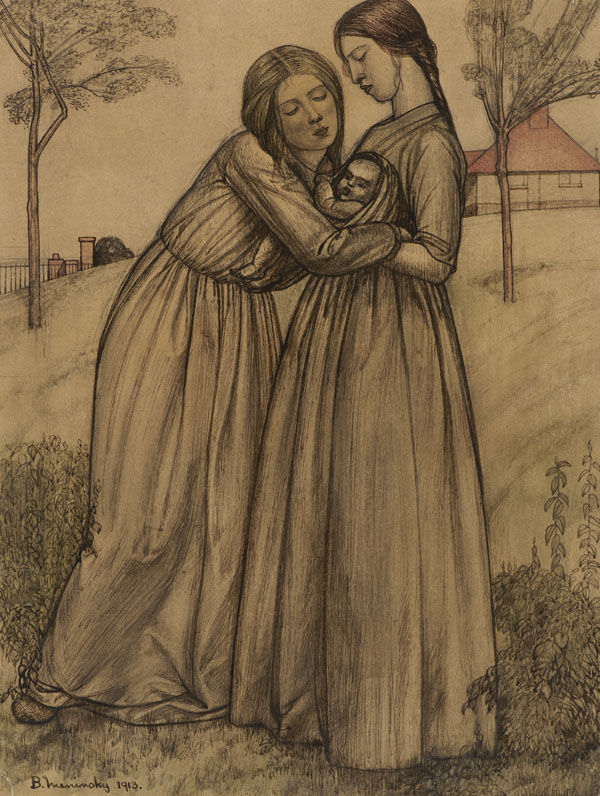
Two Women and Child
Artist information
Name Bernard Meninsky (1891-1950)
Other name Menushkin
Born Konotop, Russian Empire (now Ukraine)
Died London, England
Find more work in the collection by this artist
Find out more about this artist
Bernard Meninsky (née Menushkin) was born into a Jewish family in Konotop, then within the Russian Empire (now Ukraine) on 25 July 1891 and brought to England by his parents when he was six weeks old, settling in Liverpool. After leaving school in 1902 he took evening classes in art and in 1906 won a scholarship to the Liverpool School of Art, also taking summer courses at the Royal College of Art (1909 and 1910). In 1911 he won a travel scholarship to study for three months at the Académie Julian in Paris and left Liverpool with the King’s medal. The following year he entered London’s Slade School of Fine Art on a one-year scholarship, meeting several 'Whitechapel Boys' including David Bomberg and Mark Gertler. Afterwards he briefly taught drawing in Italy in 1913, then returned to London to teach at the Central School of Arts and Crafts (where his pupils included Clara Klinghoffer), also joining the London Group the same year. In May 1914 Bomberg and Jacob Epstein included four Meninskys in the so-called ‘Jewish section’ in a wider show of modern art at the Whitechapel Art Gallery. In August, following the outbreak of the First World War, he enlisted, joining the Royal Fusiliers; he was posted in England as a clerk but in 1918 suffered a nervous breakdown, was discharged on medical grounds and held a six-month war artist’s appointment with the Ministry of Information.
In 1919 Meninsky returned to teaching at the Central, was elected to the London Group, and held his first solo exhibition of Mother and Child Drawings at the Goupil Gallery London; the following year he also began to teach life drawing evening classes at the Westminster School of Art. He was elected to the New English Art Club in 1923 and held further solo London shows at: the Mayor Gallery (1926), Lefevre (1926), St George’s (1930), Zwemmer’s (1934, 1936) and Leger (1945, 1948). He favoured the mother and child theme, also painting portraits, figures – latterly in a monumental, neo-classical style - and landscapes, which became dark and atmospheric in the 1920s and 1930s. He suffered several breakdowns in his mental health between 1931 and 1934. During the Second World War he moved to Oxford and taught at the City School of Art, returning to London and the Central in 1945. His illustrations to Milton's L’Allegro and I Penseroso were published in 1946. He suffered a further breakdown in 1949 and committed suicide in London, England on 12 February 1950. A memorial exhibition was held by the Arts Council in 1950 and further solo shows were held posthumously at Ben Uri Gallery (1957, 2001) and many other galleries; a touring retrospective was held in Oxford, Coventry, and London in 1981. His work is represented in numerous UK Collections including the Arts Council Collection, the Imperial War Museum, Victoria Gallery and Museum at the University of Liverpool and Tate.
Object Details
Date 1913
Object type drawing
Medium coloured pencil on paper
Materials and techniques pencil (medium) paper (support)
Unframed 31.5 x 24 cm
Framed 51.5 x 43.5 cm
Signed and dated (lower left): B. Meninsky 1913
Acquisition presented by Mary Cohen 1948
Accession number 1987-289
Display status not on display
This finely executed drawing was completed towards the end of Meninsky's one year scholarship studying at the Slade School of Fine Art, where his contemporaries included David Bomberg and Jacob Kramer, and is likely to have been an entry for a Slade summer composition. Kramer and Clare Winsten (who left the Slade in 1912) both completed similar compositions on the mother and child theme.
The subject of maternity inspired many of Meninsky's works c. 1918-20, particularly following the birth of his first son, David, in 1918, after which the artist became almost obsessed with the image of motherhood. ‘Mother & Child Drawings’ was the title of his first solo show at the Goupil Gallery in 1919 and in 1920 he published ‘Mother and Child: 28 Drawings by Bernard Meninsky’, with a text by Jan Gordon.
The background of the drawing - with house, railings and trees - relates to an undated landscape (private collection), possibly executed prior to the drawing and likely sited in Liverpool.
Selected exhibition history
1951
Festival of Britain, Anglo-Jewish Exhibition 1851-1951
Ben Uri Art Gallery
1989
Prints and Drawings from the Permanent Collection
Ben Uri Art Gallery
2001
Bernard Meninsky: A Singular Vision
Ben Uri Art Society
2003
Director's Choice: Highlights from the Ben Uri Permanent Collection
Ben Uri Gallery - The London Jewish Museum of Art
2009
Homeless & Hidden 1: World Class Collection Homeless & Hidden
Ben Uri Gallery
2010
Apocalypse: unveiling a lost masterpiece by Marc Chagall and 50 selected masterworks from the Ben Uri Collection
Osborne Samuel
2016
100 for 100: Ben Uri Past, Present & Future
Christie's South Kensington
2019
Mark Gertler: Paintings from the Luke Gertler Bequest & Selected Important UK Collections
Ben Uri Gallery
Literature
Rachel Dickson and Sarah MacDougall, eds., Ben Uri: 100 Years in London - Art, Identity, Migration (London: Ben Uri Gallery, 2015), p. 59 (illus.); Apocalypse: Unveiling a lost masterpiece by Marc Chagall (London: Ben Uri Gallery, 2010); Walter Schwab and Julia Weiner, eds., Jewish Artists: the Ben Uri Collection - Paintings, Drawings, Prints and Sculpture (London: Ben Uri Art Society in association with Lund Humphries Publishers Ltd, 1994), p. 79.
Hover mouse cursor over image to zoom (you can also use the mouse wheel).