Ben Uri Collection

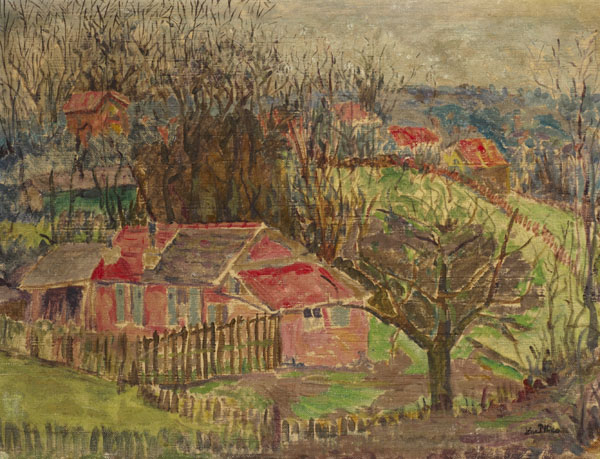
Cottages in the Country (aka Outhouses)
Artist information
Other name Salomea Lean Goldmann, Salomea Lean Pillico, Madame Pillico, Lena Pilichowska, Lena Pilichowski
Born Łódź, Congress Kingdom of Poland, Russian Empire (now Poland)
Died London, England
Find more work in the collection by this artist
Find out more about this artist
Painter and textile designer Lena Pillico (Salomea Lean Goldmann) was born into a Jewish family in Łódź, Congress Kingdom of Poland, Russian Empire (now Poland) in 1884. She married Leopold Pilichowski (1869-1934), the well-known Polish-Jewish realist painter, predominantly of Jewish subjects, with whom she moved to Paris, France in 1904, probably first adopting there the shortened version of her name, Mme Lena Pillico for her work. In 1908 both participated in the first London Salon of the Allied Artists' Association in the Royal Albert Hall, London, with Pillico showing 5 works. In 1913 the couple moved with their three children to London, England, where Pilichowski went on to become President of the Ben Uri Art Society (1926-32) and she became the first woman artist to exhibit under Ben Uri’s auspices, arranging an exhibition in 1927 for the ‘Jewish Art & Literary Society Ben Uri’ in her St John’s Wood studio. Prior to this she studied at the Slade School of Fine Art in London. In 1921 she designed a bookplate to record donors of books to the Jerusalem University Library and in 1923 she exhibited three works in the exhibition of Jewish Artists, organised by the shortlived Society of Jewish Artists at the Whitechapel Art Gallery. She exhibited extensively with the Women's International Art Club (WIAC) from 1915 for a decade (except in 1918), as a non-exhibiting member 1926-27, and served on the executive committee in 1923. In the same period, she was also one of the first women to exhibit with the progressive Seven & Five Society between 1923 and 1927, in its most radical period under Ben Nicholson’s leadership, including in the 1927 exhibition at the Beaux Arts Gallery in London. Her paintings included landscapes, street scenes and portraits. She was a pioneer in the use of silk screen fabric printing for the creation of decorative silk squares. Her decorative designs included both figurative and abstract motifs.
A contemporary reviewer in the Jewish Chronicle described her designs as ‘decorative’ and ‘in the modern spirit’, while Pilichowski, by comparison, was seen as ‘considerably more academic and [...] well known in Europe for his portraits and Jewish type pictures’. A fabric pattern designed by Pillico for W. Foxton Ltd. is illustrated in Artwork (October-December 1925) and Maurice Fort in Artwork (January-March 1926) described her 'hot-coloured exuberant fantasies', noting that 'her more complicated compositions are not always good, but her simpler work - for example the painting of embracing figures shown in the last exhibition of the Seven and Five Society - shows that she is developing on her own lines, which is certainly more worthy of praise than imitations, however good, of Matisse and Picasso'. In 1928 she was among 16 artists who exhibited work at the Brooklyn Museum exhibition of Paintings, Sculpture and Drawings by American and European Artists, showing 29 paintings (including five designs) to 17 by her husband. After Leopold Pilichowski died in 1934, Lena Pillico remained in London, where in 1936 she had a solo exhibition of 57 recent paintings of Spain and Morocco at Lucy Wertheim's London Gallery. After the Second World War, she retained her London studio at 7 Hill Road in St John's Wood (later a studio for her architect son Amnon Vivien Pilley).
Lena Pillico died in London, England in 1947. Her work was included posthumously in Michael Parkin's touring exhibition on The Seven and Five Society, 1920-35 (1979-80) at Atkinson Art Galleries, Southport; the Minories, Colchester; the National Museum of Wales, Cardiff; and Newlyn Orion Gallery, Penzance. Her work is held in the Ben Uri Collection and Salford Museum & Art Gallery.
Object Details
Object type painting
Medium oil on canvas
Materials and techniques oil (medium) painting (technique) canvas (support)
Unframed 50.5 x 65 cm
Framed 57 x 71 cm
Signed (lower right): Lena Pillico
Acquisition presented 1946
Accession number 1987-318
Display status not on display
Lena Pillico's ouevre included landscapes, peopled street scenes and portraiture, as well as decorative designs. This rural landscape is from mid-way through her career during her membership of the Seven and Fine Society. Peter Wakelin (Refuge and Renewal: Migration and British Art, 2019) has observed: 'This could almost be a Russian landscape but it has shared qualities with the faux-naive idiom of the other 7&5 artists in the 1920s, such as Christopher Wood, Cedric Morris and Winifred Nicholson'.
Selected exhibition history
1946
Recent Additions to the Permanent Collection and Works by Pissarro, Liebermann, Epstein, Modigliani, Chagall
Ben Uri Art Gallery
2017
Art Out of the Bloodlands: A Century of Polish Artists in Britain
Ben Uri Gallery
2019
Refuge and Renewal: Migration and British Art
Royal West of England Academy
2020
Refuge and Renewal: Touring exhibition
MoMA Machynlleth Galleries
Literature
Peter Wakelin, Refuge and Renewal: Migration and British Art (Bristol: Sansom & Co, 2019); Rachel Dickson, ed., From Adler to Zuławski: A Century of Polish Artists in Britain (London: Ben Uri Research Unit, 2020), pp. 50-51, illus.; Oil Paintings in Public Ownership in Camden (London: The Public Catalogue Foundation, 2013), p. 32, illus.; Walter Schwab and Julia Weiner, eds., Jewish Artists: the Ben Uri Collection - Paintings, Drawings, Prints and Sculpture (London: Ben Uri Art Society in association with Lund Humphries Publishers Ltd, 1994), p. 85.
Hover mouse cursor over image to zoom (you can also use the mouse wheel).