Ben Uri Collection

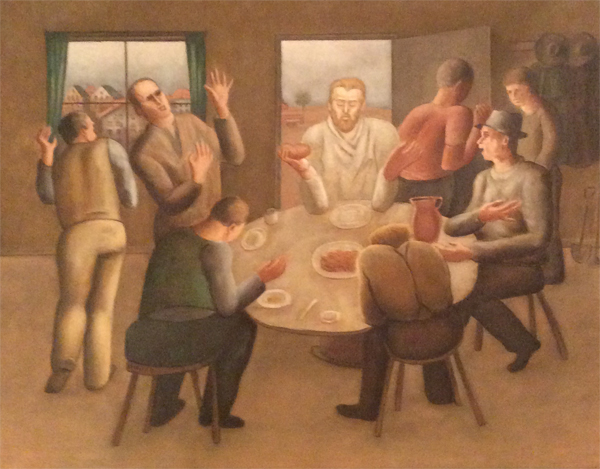
Supper at Emmaus
Artist information
Name Horace Brodzky (1885-1969)
Born Melbourne, Australia
Died London, England
Find more work in the collection by this artist
Find out more about this artist
Painter, draughtsman and printmaker Horace Brodzky was born into a Jewish family in Melbourne, Australia on 30 January 1885. He attended the Australian National Gallery School before travelling to San Francisco in 1905, then New York. In 1908 he moved to London, where in 1911 he enrolled at the City and Guilds Art School in Kensington, also making a painting trip to Italy, with John Gould Fletcher and discovering Piero della Francesca; in the same year he held his first solo exhibition of paintings and sketches of Italian scenes in his Chelsea studio.
In 1912 he met sculptor Henri Gaudier-Brzeska, initiating a close friendship and sat to him for his bust in 1913. From 1914 Brodzky was involved with the New English Art Club and the London Group, gradually developing a loose amalgam of Fauve and Post-Impressionist techniques. He associated with fellow Jewish artists among the 'Whitechapel boys', including Mark Gertler and David Bomberg. The latter included six of Brodzky's works in the so-called 'Jewish Section' in the exhibition survey of Modern Movements at the Whitechapel Art Gallery in 1914. An active member of the London Group, Brodzky also served on the group's hanging committee.
In 1915 Brodzky left London for New York with an introduction to the collector John Quinn, who introduced him to Jules Pascin. Brodzky was also associated with the Vorticists and acted as clerk of works for their New York exhibition held at the Penguin Club in 1917. In the same year, he also exhibited in a mixed exhibition of international contemporary masters in New York including Gaudier, Marie Laurencin, Picasso and Pascin. Brodzky returned to London in 1923, where he continued to paint, supplemented by other activities, until his death, exhibiting at the London Group Retrospective in 1928 and the First Exhibition of British Linocuts in 1929. In 1935 Heinemann published a book of ‘Forty Drawings by Horace Brodzky’; he exhibited with Bomberg and Margarete Hammerschlag in 1937 and published biographies of Gaudier-Brzeska in 1933 and Pascin in 1946. In the 1960s retrospectives were held at Ben Uri Gallery, and the Oxford Union (1965), Mercury Gallery, London (1966) and Macy’s Gallery, New York (1967).
Horace Brodzky died in London, England on 11 February 1969. His work is in UK collections including the Ben Uri Collection, Danum Gallery, Library and Museum, Manchester Art Gallery and the National Galleries of Scotland. Posthumous retrospectives were held at the Fieldborne Gallery, London (1973), Michael Park in Gallery, London (1974), the Belgrave Gallery, London (1976) and the Fieldborne Gallery (1977).
Object Details
Date 1959
Object type painting
Medium oil
Materials and techniques oil (medium) painting (technique) canvas (support)
Unframed 48.4 x 59.2 cm
Framed 60.8 x 70.9 x 4.8 cm
Signed (within image, on stool) Horace Brodzky 1959
Acquisition presented by the Estate of Victoria Sternfield 2014
Accession number 2014-11
Display status not on display
Brodzky depicts the episode from the Gospel of Luke in which on the third day after the Crucifixion the resurrected Jesus appears to two disciples whom he had previously encountered on the road to Emmaus and accepts an invitation to join them for supper. As in Caravaggio's celebrated version of the story (1601, National Gallery), the disciples fail to recognise him until he takes, blesses and breaks the bread, when they react with astonishment. Brodzky transposes the scene to a modern-day setting with a round table, instead of the traditional rectangular one. The bearded Christ, dressed in white and framed within the open doorway at the centre of the composition, holds a loaf of bread in one hand and blesses it with the other. Three men, whose informal, everyday clothes identify them as ordinary, working men, are seated with him. Two have bowed heads; the third holds one hand across his heart in consternation, while two men standing beside the table raises their own hands to express surprise. Yet a couple in the background remain outside the drama.
Brodzky's typically stylised figures, as well as the Biblical setting, invite comparison with the work of British modernists such as Stanley Spencer or Gladys Hynes. In his late period, Brodzky was particularly inspired by Piero della Francesca and favoured multi-figure compositions executed in a subdued and softened palette.
Selected exhibition history
2024
US: From There to Here - Britain's Gain
Ben Uri Gallery and Museum
Hover mouse cursor over image to zoom (you can also use the mouse wheel).