Ben Uri Collection

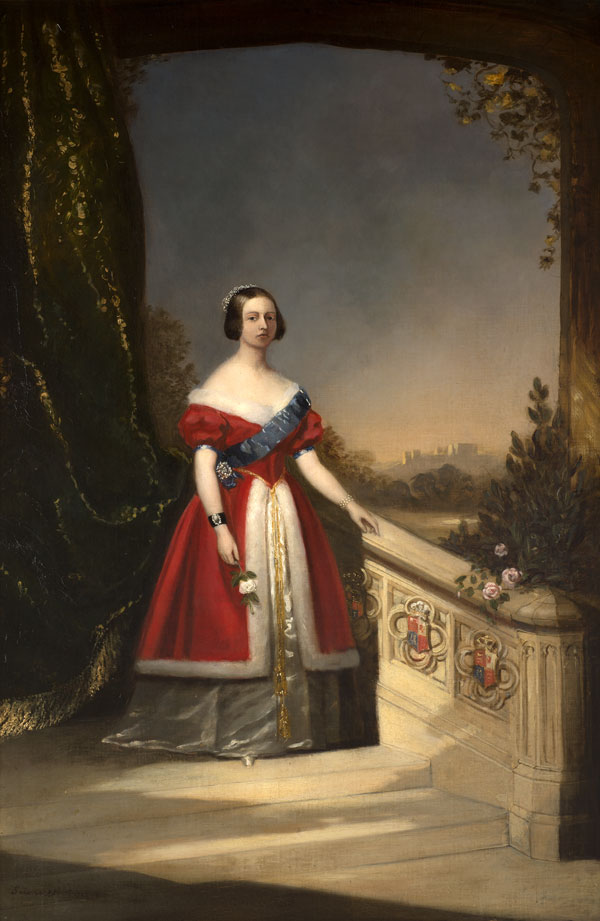
Portrait of Queen Victoria
Artist information
Name Solomon Alexander Hart (1806-1881)
Born Plymouth, England
Died London, England
Find more work in the collection by this artist
Find out more about this artist
Historical genre painter Solomon Alexander Hart was born into a Jewish family in Plymouth, England in 1806 and has been called ‘the first important Anglo-Jewish artist’; his father, Samuel (fl. 1785-1830), and younger brother, Mordecai (1808-1841), were well-known engravers. Barred from the local Grammar School because of his Jewish origins, Hart was taught by a Unitarian minister and, unable to afford an apprenticeship premium, learned to draw by copying ancient sculptures at the British Museum. In 1823 he entered the Royal Academy (RA) to study painting, supporting himself by making copies and colouring theatrical prints. James Northcote, R.A. (also from Plymouth) befriended and assisted both Samuel Hart (and later Solomon J. Solomon (1860-1927), who became only the second Jewish Royal Academician, in 1906) at the Royal Academy Schools. Hart’s earliest painting, a portrait miniature of his father, was shown at Somerset House in 1826, the year he also began exhibiting at the RA; he showed his first oil painting, 'Instruction', there in 1828. In 1830 he showed his first works on Jewish subjects, 'The Elevation of the Law' (Suffolk Street Gallery) and 'Polish Synagogue' at the Society of British Artists – the latter was well received and brought him many commissions. His 'Conference between Manasseh ben Israel and Oliver Cromwell', bought by F. D. Mocatta, was presented to Jews’ College London but later lost during the Blitz in 1940-41.
Hart was elected an Associate Royal Academician in 1835 and became the first Jewish Royal Academician in 1840, Professor of Painting (1854–63), and finally, librarian in 1864; he was also an active member of the Athenaeum. Celebrated as a painter of historical scenes, he visited Italy, c.1841–42, making an elaborate series of drawings later used for works on Italian themes. An influential figure, Hart was also curator of the Painted Hall, Greenwich, and an adviser to the British and South Kensington museums. Hart was a member of the Western Synagogue. Among his friends were J. M. W. Turner and Sir William Collins, who is said to have introduced him to his children saying: ‘This is Mr Hart, whom we have just elected Academician [...] Mr Hart is a Jew, and the Jews crucified our saviour, but he is a very good man for all that, and we shall see something more of him now’.
Solomon Alexander Hart died in London, England on 11 June 1881 and is buried, like his father, at the Brompton Cemetery in London. At the time of his death, he was the longest-lived of the Royal Academicians. His memoirs were edited by his Athenaeum colleague Alexander Brodie and published posthumously in 1882 as ‘The Reminiscences’. His work is held in UK collections including the Ben Uri Collection, the Jewish Museum London, the Laing Art Gallery, The Royal Academy of Arts and the V&A. n 1956 he was included in the Whitechapel Art Gallery's Tercentenary Exhibition of Jewish Artists in England 1656-1956.
Object Details
Date 1842
Object type painting
Medium oil on canvas
Materials and techniques oil (medium) painting (technique) canvas (support)
Unframed 119.5 x 77.5 cm
Signed and dated (lower left) 'Solomon Hart 1842'
Acquisition on long term loan to the Ben Uri Collection
Accession number 2015-16
Display status not on display
This is one of two extant versions of this 'Portrait of Queen Victoria', both dating to 1842: one hangs in the Royal Albert Hall and is by the Irish artist Frederick Newenham (1807-1859), who was commissioned in that year by the Junior United Service Club to paint a portrait of the Queen, which he exhibited at the Royal Academy in 1844 (the year in which he painted a second portrait of the young Queen).
The second is this version by Solomon Alexander Hart, almost certainly a copy after Newenham. The Queen is portrayed in full-length, wearing the badge of her office (the Order of the Garter), which emphasises both her youth and her imperial authority. A little stiffness to the figure perhaps indicates that this is not Hart's usual subject matter. Painted five years into Victoria’s reign and two years into Hart’s Academicianship, it conveys his social and artistic integration with Britain, and as the first Jewish Royal Academician, identifies him with the ultimate symbol of the establishment. It can also be seen as a self-portrait – the outsider as insider – signifying Hart’s achievements as a painter and perhaps satisfying his aspirations of belonging to the British establishment and the artistic elite.
Keywords
Selected exhibition history
2015
Out of Chaos – Ben Uri: 100 Years in London
Somerset House
Literature
Rachel Dickson and Sarah MacDougall, eds., 'Out of Chaos: Ben Uri; 100 Years in London' (London: Ben Uri Gallery, 2015) pp. 24-25,