Ben Uri Collection

Naomi and her Daughters-in-Law
Series: Five Stories from the Old Testament
Artist information
Name Hans Feibusch (1898-1998)
Born Frankfurt, Germany
Died London, England
Find more work in the collection by this artist
Find out more about this artist
Painter, illustrator, lithographer, author, muralist and sculptor Hans Feibusch was born into a Jewish family in Frankfurt, Germany on 15 August 1898. After serving in the First World War, he settled in Berlin in 1920 to study painting, where he won the Prix de Rome and travelled to Italy, encountering and admiring Italian Renaissance mural paintings, before completing his studies in Paris. Upon his return to Germany, as a member of the Frankfurt Künstlerbund, he was tasked with his fellow members with designing a set of murals and undertook to teach himself the necessary techniques and procedures. After winning the Prussian State Prize for Painting in 1930 however, he aroused Nazi antagonism. After his pictures were publicly burned, and he was forbidden to paint he found refuge in Britain in 1933, joining his British fiancée in London.
In 1934 Feibusch first exhibited with the Ben Uri Gallery in May-June, showing concurrently in the 'Exhibition of German-Jewish Artists' Work’ at the Parsons Gallery, London, organised by German-Jewish émigré dealer Carl Braunschweig (Charles Brunswick) to highlight artists suffering persecution under the Nazi regime. Later that year, Feibusch held the first of five solo shows at the Lefevre Galleries, London, and also began to exhibit regularly with the London Group (until 1939), where his work attracted attention. In 1937 his work was included in the notorious touring Nazi 'degenerate' art show, first mounted in Munich, and in 1938 it also featured in the important exhibition of ‘Twentieth-century German Art’ at the New Burlington Galleries in London, intended as a riposte to the Nazi show. In spring 1943 Feibusch also participated in the AIA 'For Liberty' exhibition in the basement of John Lewis’ department store in Oxford Street.
Following his first public mural in England, ‘The Footwashing’, for the Methodist Chapel in Colliers Wood, commissioned by Edward D. Mills in 1937, Feibusch was championed by Dr George Bell, the Bishop of Chichester, and commissioned to paint a chapel in Brighton, which led to many other Church of England commissions, including for Chichester Cathedral. Feibusch went on to become Britain’s most prolific muralist, creating work in some 35 Anglican churches and cathedrals, among them St. John's Waterloo, as well as five panels for the Stern Hall at West London Synagogue (now in the Ben Uri Collection), and two town halls; he published his book on mural painting in 1946. He featured in the 1951 Festival of Britain as both a painter and a muralist and post-war served on the Ben Uri Arts Committee.
Feibusch exhibited widely including with the AIA (Artists' International Association), including the For Liberty exhibition (1943), at the Royal Academy (from 1944), the Ben Uri Gallery, including solo exhibitions in 1970 and 1977, and at Pallant House Gallery, Chichester in 1995 (subsequently touring to Ben Uri and other venues). In the 1970s Feibusch was forced to abandon painting after his eyesight began to fail and he took up sculpture. Although he had converted to Anglicanism in the 1960s, in his later years he reverted to his Jewish faith. He died in London, England on 18 July 1998 and his estate bequeathed the entire contents of his studio to Pallant House Gallery in Chichester. His work is also held in other UK collections including the Tate.
Object Details
Date 1973
Object type painting
Medium oil on canvas
Materials and techniques oil (medium) canvas (support)
Unframed 365 x 161 cm
Acquisition acquired from West London Synagogue
Accession number 2013-f2
Display status On loan to St. Bonifatius Church, 47 Adler Street, London E1
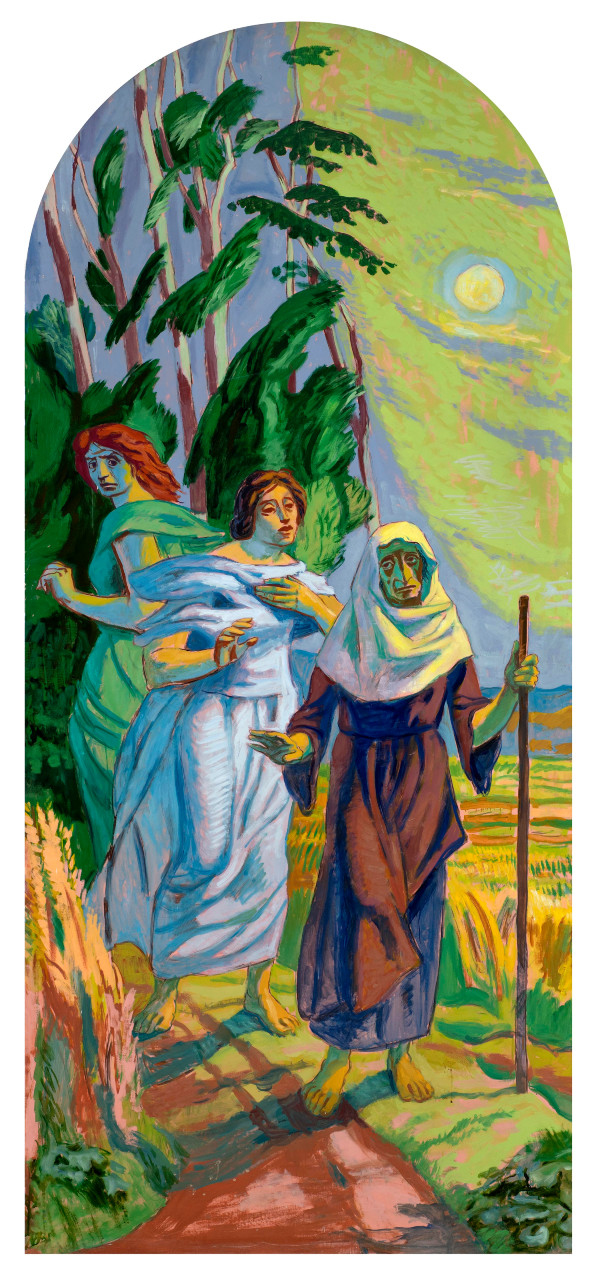
This work is one of a series of five oil paintings on canvas on Old Testament subjects that together explore issues of faith, sacrifice, courage, love, and redemption, originally commissioned directly from the artist by Czechoslovakian-born Rabbi Hugo Gryn, a Holocaust survivor, for the Stern Hall of the West London Synagogue in 1973. The scene is from the biblical Book of Ruth in which Ruth and Orpah, two women of Moab, had married the two sons of Elimelech and Naomi, Judeans who had settled in Moab to escape a famine in Judah. After the death of Elimelech, and then the husbands of both younger women, Naomi plans to return to her native Bethlehem and urges her daughters-in-law to return to their families and re-marry. Orpah reluctantly departs but Ruth begs to stay with Naomi and share her fate. They travel to Bethlehem and Ruth looks after Naomi by collecting the gleanings of the field belonging to a wealthy landowner named Boaz, whom she eventually marries, becoming great-grandmother to King David.
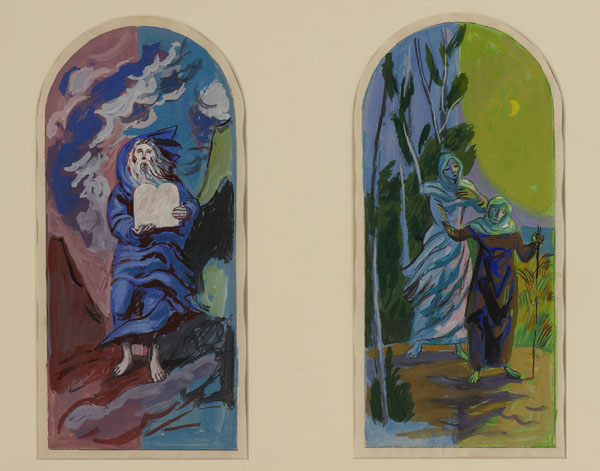
In this painting, set during the day when the sun is high, Feibusch shows the scene of Orpah's leave-taking and Naomi imploring Ruth to be allowed to join her as she departs. In the corresponding watercolour, he chooses to show the two women departing by moonlight.
In Judaism, the Book of Ruth is part of the biblical canon called Ketuvim, or Writings. Ruth's story is celebrated during the Jewish festival of Shavuot, the Feast of Weeks, 50 days after Passover.
All of Feibusch’s works on religious subjects employ a fresh and vibrant palette. In his Times obituary (21 July 1998), it was noted how Feibusch’s religious works exhibited ‘brilliant colour and a composition which is generally suave and classical, often lyrical: he was a man who valued warmth and passions in religion, knew how to project joy and sorrow in his painting, sorrow for European conflict being for many decades a keenly felt emotion’.
Hover mouse cursor over image to zoom (you can also use the mouse wheel).
Related works
Naomi and Ruth
by Hans Feibusch
David and Goliath
by Hans Feibusch
Jacob Wrestling with the Angel
by Hans Feibusch
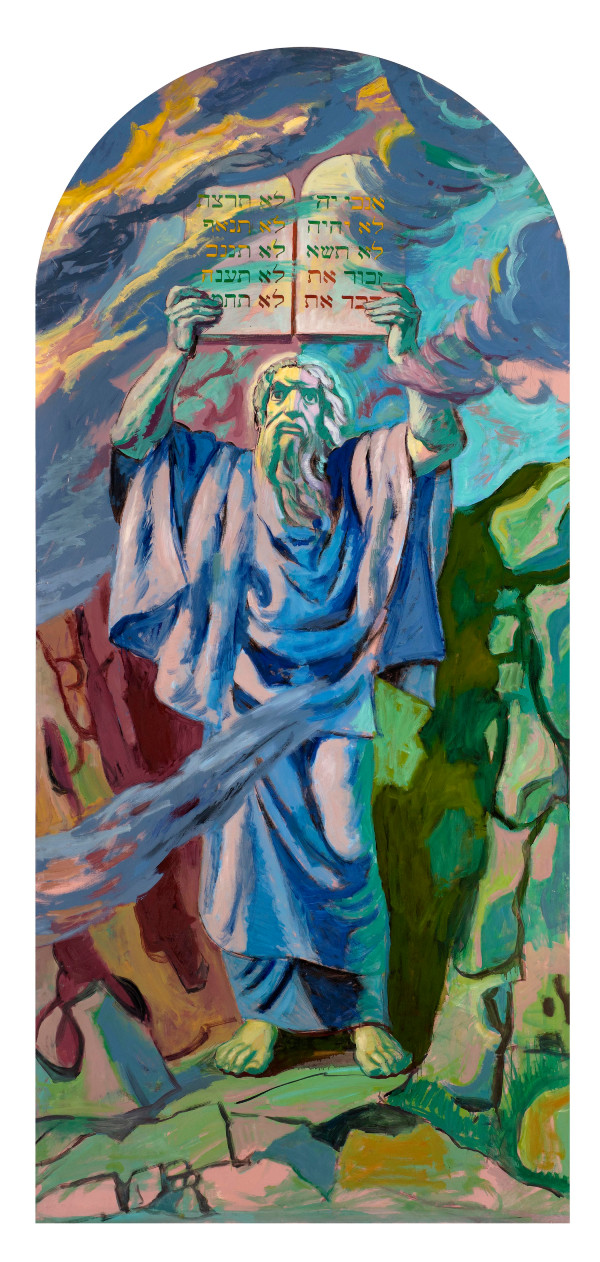
Moses with the Tablets of the Law
by Hans Feibusch
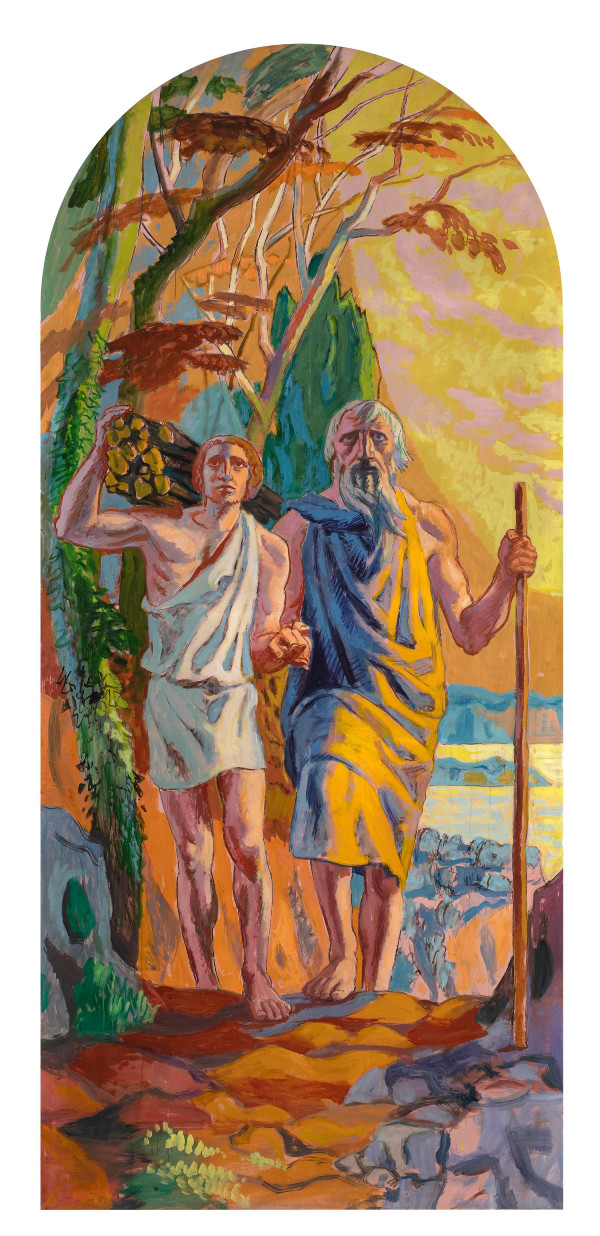
Isaac with Abraham Carrying Wood for the Altar Fire
by Hans Feibusch
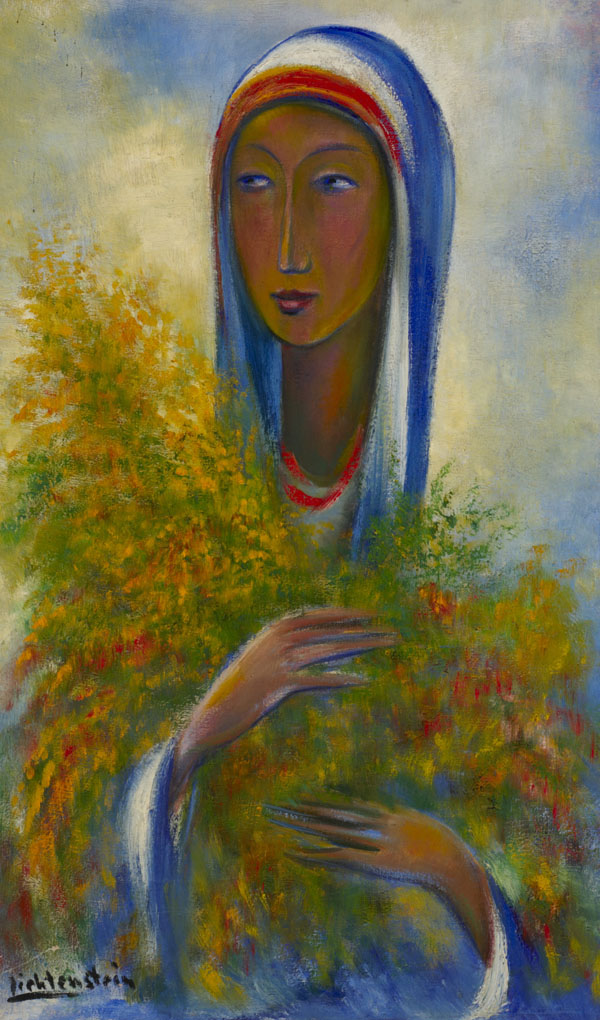
Ruth II
by Isaac Lichtenstein