Ben Uri Pre-Eminent Collection

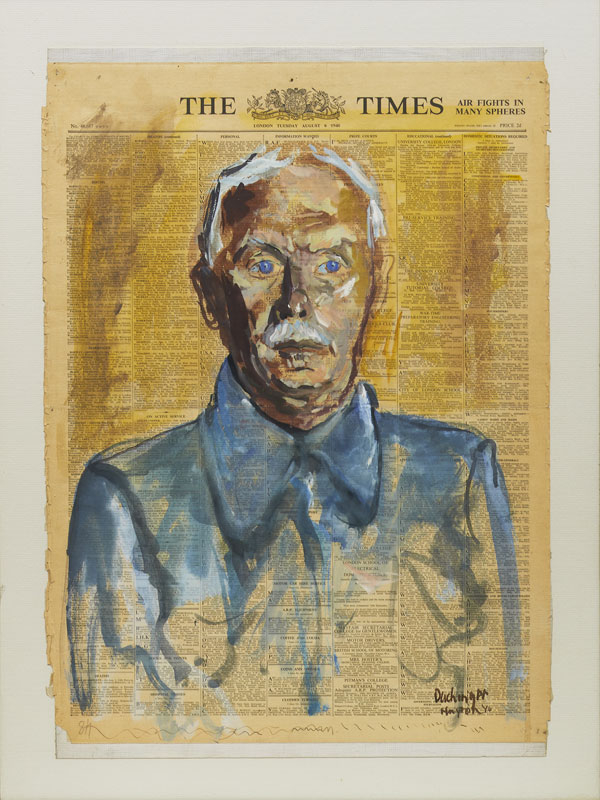
Portrait of a Man: Wilhelm Hollitscher (Huyton Internment Camp, Liverpool)
Artist information
Name Hugo Dachinger (1908-1995)
Other name Puck
Born Gmunden, Austria
Died London, England
Find more work in the collection by this artist
Find out more about this artist
Object Details
Date 1940
Object type painting
Medium watercolour and gouache on newsprint
Materials and techniques gouache (medium) painting (technique) paper (support)
Unframed 61.5 x 46 cm
Framed 82 x 64 x 1.8 cm
Signed (lower right): 'Dachinger', inscribed 'Huyton' and dated '[19]40'
Acquisition Purchased 2016
Accession number 2016-18
Display status not on display
This head-and-shoulders portrait of a white-haired man with startlingly blue eyes, painted in the third month of the artist's internment at Huyton internment camp in Liverpool in August 1940, has been identified by the sitter's family as fellow internee Wilhelm Hollitscher (1873-1943), former Chief Engineer of the Danube Shipping Company and President of the Vienna Singer Academy. Hollitscher, who kept detailed diaries of the experience, was among the circle of middle-class refugee intellectuals, writers and artists with whom Dachinger mixed in camp. He recorded his first sitting on 5th August and his last on the 8th, followed by a second portrait made on the 10th, a third on the 14th and a fourth and final portrait on the 21st.
In June 1940, following Churchill's directive to 'Collar the lot!', Dachinger had been swept up in the mass internment of around 27,000 so-called 'enemy aliens', mostly Jewish refugees fleeing Nazi persecution, who were interned in hastily adapted camps all over the country. Dachinger spent five months at Huyton Camp, Liverpool within the recently built Woolfall Heath Estate, surrounded by an eight-metre high barbed wire fence.
Despite the poor conditions and overcrowding at Huyton, Dachinger's artistic output was prolific and included landscapes, scenes of everyday life, posters and even nudes, as well as vivid, often highly coloured portraits. The blue and yellow palette can be found in other Huyton portraits (one dated only three days earlier). Hollitscher's overcoat has a military feel, perhaps further suggested by the visible headline 'Air Fights in Many Spheres', but carries no insignia, and he may be wearing an 'overall suit', sent to him in late July. Dachinger's warm treatment of his subject contrasts with his sharply satirical, sometimes cartoonish works featuring camp officers.
With traditional art materials in short supply, Dachinger and fellow artists (who included Martin Bloch and Walter Nessler) executed works in a variety of accessible media, often using discarded newspapers (The Times was considered the best) as supports. These could be primed with gelatine collected from boiled-down bones mixed with flour, a method leaving stories of war tantalisingly visible beneath, and which Dachinger, a former designer, often included to great effect (the visible righthand column of 'Domestic Situations Wanted' is a reminder that this was the only hope of passage for many female refugees). Twigs were also burnt to create charcoal and paints made from brick dust or food ground with linseed oil or olive oil from sardine cans, though here Dachinger appears to have used thinned watercolours perhaps mixed with toothpaste (particularly in the hair) to make the pigments less transparent.
Following Huyton, Dachinger was sent in October 1940 until his release in January 1941, to Mooragh Camp, Ramsey on the Isle of Man, where he continued to produce arresting works. In November he held an exhibition of his internment drawings entitled Art Behind Barbed Wire, advertised with a striking poster of his own design, and later exhibited at London's Redfern Gallery in April 1941.
Keywords
Huyton Camp | internment | Liverpool | man | Mooragh Camp | moustache
Selected exhibition history
2016
Out of Chaos: Touring exhibition
Laing Art Gallery
2018
Out of Austria: Austrian emigre artists to the UK
Ben Uri Gallery and Museum
2018
Acquisitions and Long-Term Loan Highlights Since 2001
Ben Uri Gallery
2019
Art-exit: 1939 - A Very Different Europe
12 Star Gallery
2019
Migrations: masterworks from the Ben Uri Collection
Gloucester Museum
2022
Refugees from National Socialism in Wales
Aberystwyth Arts Centre
2023
Refugees from National Socialism in Wales: Learning from the Past for the Future
Senedd Cymru
2024
The Decorative Fair
Evolution London
2024
US: From There to Here - Britain's Gain
Ben Uri Gallery and Museum
2025
Ben Uri 110/25: From Local to Global
Ben Uri Gallery
2026
Disruptors: Fractured Images and Migrant Wordl
Ben Uri Gallery
Literature
Sarah MacDougall (foreword), Important Additions to the Collection since 2000 (London: Ben Uri Gallery and Museum, 2025), p. 8, illus., p. 45; Ines Newman, with Charmian Brinson and Rachel Dickson, Internment in Britain in 1940: Life and Art Behind the Wire (Valentine Mitchell, 2019); Anthony Grenville, Encounters with Albion: Britain and the British in Texts by Jewish Refugees from Nazism, Germanic Literatures 17 (Cambridge: Legenda, 2018).
Hover mouse cursor over image to zoom (you can also use the mouse wheel).