Ben Uri Collection

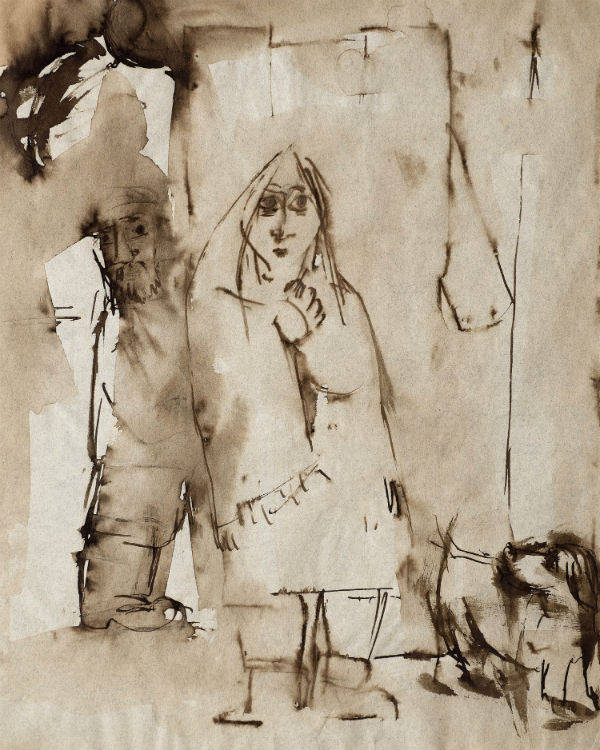
Couple
Series: A Memory of Memories
Artist information
Born Warsaw, Poland
Died London, England
Find more work in the collection by this artist
Find out more about this artist
Painter and draughtsman Josef Herman was born into a Jewish, working-class family in Warsaw, Poland on 3 January 1911. He studied at the Warsaw School of Art and Decoration (1930-31), and first exhibited in his native city in 1932. Following increasing anti-Semitism, he left Poland for Brussels in 1938, where he was inspired by the Belgian Expressionists. With the onset of the Second World War, he was forced to flee via southern France and arrived in Glasgow in 1940, where he was reunited with fellow Polish artist Jankel Adler, whom he had known briefly in Warsaw. Together the two artists contributed, together with Scottish Colourist J D Fergusson, to a resurgence of the Scottish arts scene during this period. Herman moved briefly to London in 1943, exhibiting at the Lefevre Galleries, London (with L S Lowry, 1943) prior to his relocation to the Welsh mining village of Ystradgynlais (1944-55), which gave rise to his best-known body of work focusing on the Welsh miners and their community. In 1951 he was included in the South Bank Festival of Britain Exhibition and continued to exhibit widely including with the émigré art dealers Roland, Browse & Delbanco (1946, 1948, 1952, then regularly until 1975), in London, with Ben Uri (including alongside Martin Bloch in 1949), at the Geffrye Museum (with Henry Moore, 1954), the Whitechapel Art Gallery (1956) and Camden Arts Centre (1980), as well as at the National Museum of Wales, Cardiff (1989), Abbot Hall, Kendal (2005), and many further exhibitions with Flowers and Flowers East Galleries, who represented him for many years.
Josef Herman died in London, England on 19 February 2000. His work is represented in numerous UK public collections including London (Tate, V&A), Wales (National Museum), Scotland (Scottish National Gallery of Modern Art); as well as in Canada, Australia, Israel, South Africa and New Zealand. An exhibition exploring his early years in Warsaw, Brussels, Glasgow and London, 1938-43 was held at Ben Uri Gallery in 2011.
Object Details
Date c. 1940-43
Object type drawing
Medium pen and ink and wash on paper
Materials and techniques pen and ink | wash (medium) paper (support)
Unframed 22.5 x 18 cm
Framed 45 x 40 cm
Acquisition Given in loving memory of Eli and Atara Rozik-Rosen (1932-2018). Prof. Eli Rozik-Rosen served as the Israeli Cultural Attaché in London (1983-86) and supported the Ben Uri Gallery in this role. Eli and Atara were close friends of the artist Josef Herman. This work is donated to the museum in memory of their friendship.
Accession number 2018-24
Display status not on display
Following increasing anti-Semitism in his native Poland, Herman left for Brussels in 1938, from where, following the outbreak of the Second World War, and then the German Occupation of Brussels in May 1940, he was forced to flee via southern France. He arrived in Glasgow in 1940, where he began a series of nostalgic drawings, at first often light-hearted and humorous, variously depicting family life, Jewish customs and the everyday street life of his native city, as an evocation of a lost Warsaw. After receiving the news that his entire family had perished in the Warsaw Ghetto, however, the series darkened to include images of pogroms - cycles of destruction, loss and grief.
This work is reminiscent of earlier depictions of the artist's parents. The family connection is further suggested by Herman's moving inscription of the drawing as a birthday gift to his friend, when he labelled it as 'a fragment of myself'.
Selected exhibition history
2018
Acquisitions and Long-Term Loan Highlights Since 2001
Ben Uri Gallery
2023
Josef Herman: Artistiaid Ffoadur Cymru - Refugee Artists
Hay Castle
2024
Drawing the Unspeakable, Curated by David Dimbleby & Liza Dimbleby
Towner Eastbourne
Hover mouse cursor over image to zoom (you can also use the mouse wheel).
Related works
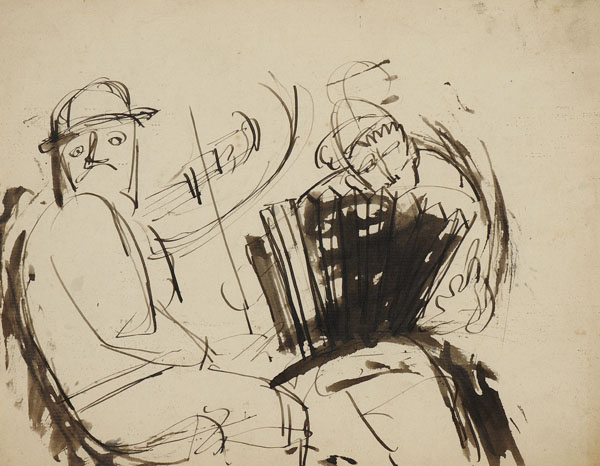
Musicians
by Josef Herman