Ben Uri Pre-Eminent Collection

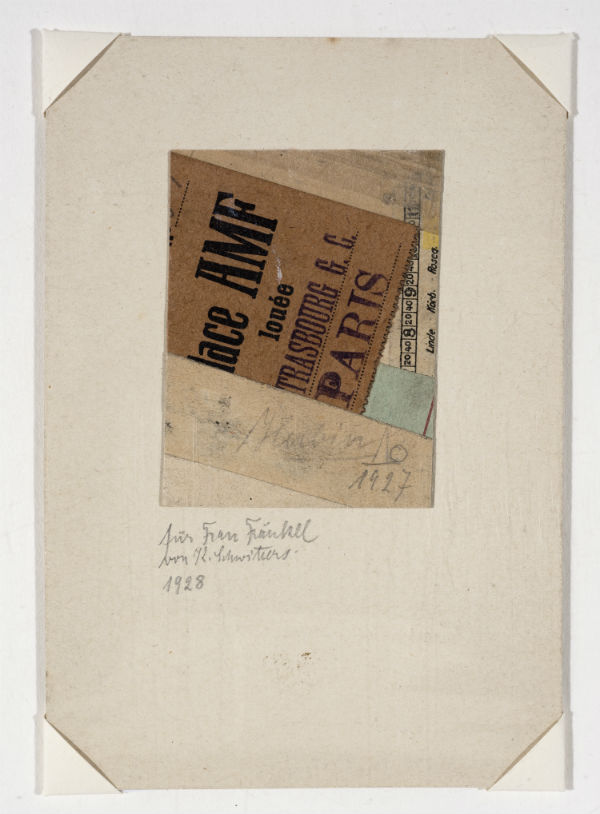
Untitled: für Frau Fränkel
Artist information
Name Kurt Schwitters (1887-1948)
Born Hanover, Germany
Died Kendal, Lake District, England
Find more work in the collection by this artist
Find out more about this artist
Installation artist, painter and poet, Kurt Schwitters was born into an affluent family in Hanover, Germany on 20 June 1887 and studied art in Hanover and Dresden. He produced his first abstract paintings in 1917, associated with avant-garde circles and exhibited regularly at Galerie Der Sturm between 1918 and 1928. Partly influenced by the Dadaists, in 1919 he created his own idiosyncratic form of art: 'Merz' – a term derived from the name 'Kommerz-und-Privatbank' which appeared on a scrap of newspaper – uniting all aspects of his prolific output: painting, collage, sculpture, architecture, poetry, drama, typography and happenings. From 1923 his home in Hanover became his most complete Merzbau installation, its rooms filled with the detritus of everyday life alongside larger-scale architectural elements. In 1930 he exhibited with Cercle et Carré in Paris and in 1931 joined the group Abstraction-Création.
In January 1937 Schwitters fled to Norway, joining his son Ernst, and in December began a second Merzbau in Lysaker (destroyed by fire in 1951). In July in Munich the Nazis mounted the Entartete Kunst (Degenerate Art) exhibition, including four of Schwitters' works previously confiscated from German museums and the following year his work was also included in the Exhibition of Twentieth Century German Art at the New Burlington Galleries in London, organised as a riposte to the Nazi show. In April 1940 Schwitters and Ernst fled for Britain, where they were moved between internment camps in Scotland and England before arriving in Hutchinson Camp (known as the 'artists' camp' due to the high number of artist internees) on the Isle of Man in mid July 1940. Schwitters painted portraits and landscapes, performed his poetry, created ephemeral Merz and participated in a camp exhibition (November 1940), also contributing drawing and short stories to the camp's newspaper, The Camp Almanac. After his release in late November 1941, Schwitters remained in London and contributed works to mixed exhibitions at Jack Bilbo's Modern Art Gallery in London (1942 and 1944), also holding there his only solo exhibition in England in December 1944, with a catalogue introduction by Herbert Read. He also exhibited with the Artists' International Association and at exhibitions supporting aid to Russia and to China. A solo exhibition of 19 of his works was held at the Kunstmuseum, Bern in early 1945; in June that year he moved to the Lake District, where he lived until his death, participating in Artists' Society exhibitions in Grasmere. With the original Hannover Merzbau destroyed by allied bombing in 1943, Schwitters created a new Merzbau on a barn wall in Ambleside, funded by the Museum of Modern Art in New York.
Kurt Schwitters died in Kendal, Lake District, England on 8 January 1948. His work is now represented in many major European and international collections including the Ben Uri Collection, Tate, and MoMA, New York. The Sprengel Museum, Hanover holds the Schwitters archive, and the most comprehensive documentation of his work and the Ambleside Merzbau has now been recreated by the Hatton Gallery, Newcastle University.
Object Details
Date 1928
Object type collage
Medium collage
Materials and techniques card (support)
Unframed 7.6 x 5 cm
Framed 40 x 34 x 3.9 cm
Signed inscribed 'für Frau Fränkel von Kurt Schwitters, 1928'
Acquisition Purchased from the family of Else Fraenkel 2019 with reallocated proceeds from the sale of a deaccessioned work by David Bomberg previously purchased by Ben Uri
Accession number 2019-08
Display status not on display
This tiny work, listed as no. 1515a in the Schwitters Catalogue Raisonné, exemplifies Schwitters' highly individual way of working, fusing his interest in the avant garde group Dada - which saw the modern world as meaningless - with a collage technique. It was acquired directly from the family of the sculptor Elsa Fraenkel in June 2019 and provides a fascinating link between these two refugees from Nazism, whose earlier friendship was rekindled in England. The inclusion of the word 'Paris' references Schwitters' visit to Paris in 1927, as well as Fraenkel's own trips there in the 1920s.
Keywords
collage | friendship | Nazism | Paris | refuge
Selected exhibition history
2013
Schwitters in Britain (tour)
Sprengel Museum Hannover
2013
Schwitters in Britain
Tate Britain
2019
Art-exit: 1939 - A Very Different Europe
12 Star Gallery
2020
New Acquisitions and Long-term Loans
Ben Uri Gallery
2020
Internment: In Memory of Eva Aldbrook
Ben Uri Gallery
2021
Becoming Gustav Metzger: Uncovering the Early Years, 1945-59
Ben Uri Gallery & Museum
2023
Art, Identity, Migration - Ben Uri at the London Art Fair
Business Design Centre
2024
US: From There to Here - Britain's Gain
Ben Uri Gallery and Museum
2024
Cosmopolis: The Impact of Refugee Art Dealers in London
Ben Uri Gallery
2025
Ben Uri 110/25: From Local to Global
Ben Uri Gallery
2026
Disruptors: Fractured Images and Migrant Wordl
Ben Uri Gallery
Literature
Sarah MacDougall (foreword), Important Additions to the Collection since 2000 (London: Ben Uri Gallery and Museum, 2025), p. 9, illus., p. 38; Karin Orchard and Susanne Meyer-Büser, eds., Kurt Schwitters: Catalogue Raisonné, Vol. 1, 1923-36 (Hanover: Hatje Cantz Verlag, 2000), cat. no. 1515a; Schwitters in Britain (London: Tate Publishing, 2013), p. 154; Nicola Baird, ed., Becoming Gustav Metzger: Uncovering the Early Years 1945-59 (London: Ben Uri Research Unit, 2021) p. 89.
Hover mouse cursor over image to zoom (you can also use the mouse wheel).
Related works
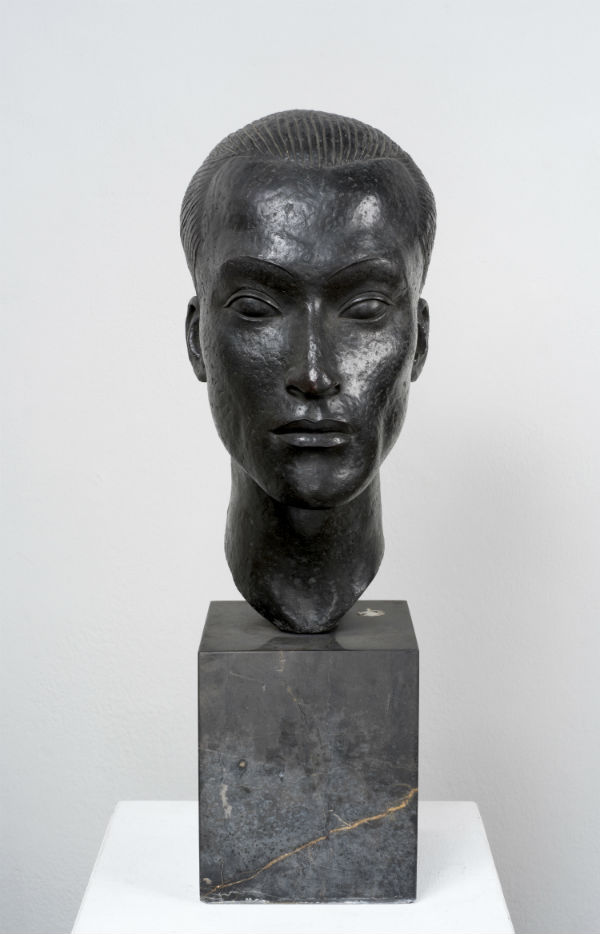
Head of Chungsen Chou
by Elsa Fraenkel