Ben Uri Collection

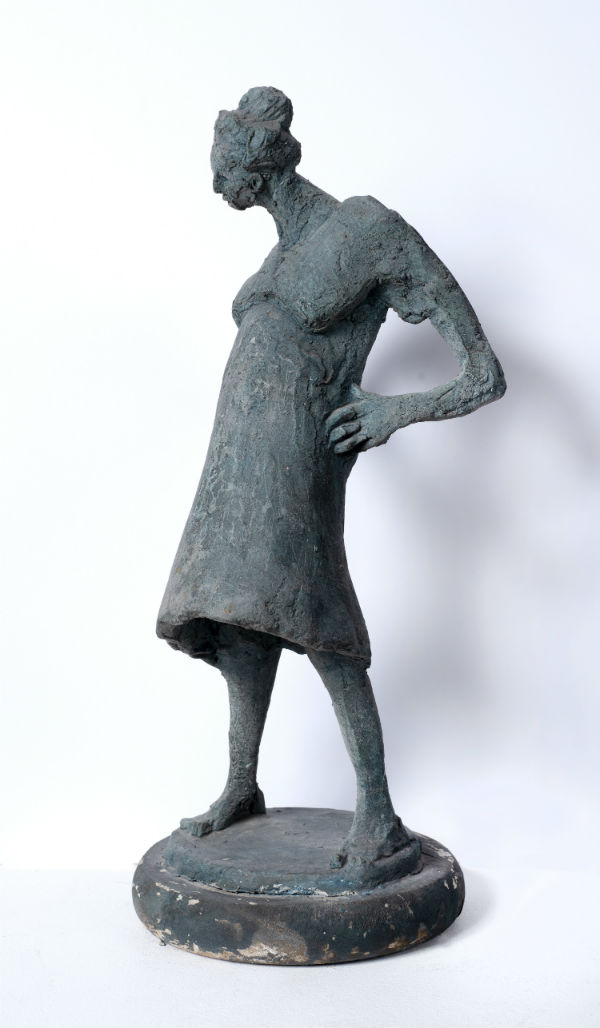
Woman with Hands on Hips (Pregnant)
Artist information
Name Peter László Peri (1899-1967)
Other name László Weisz, Ladislas Weiss
Born Budapest, Hungary
Died London, England
Find more work in the collection by this artist
Find out more about this artist
Peter László Peri (né László Weisz) was born in Budapest, Hungary on 13 June 1899, into a large proletarian Jewish family. Following a bricklaying apprenticeship, he studied at the Hungarian Soviet’s Proletarian Art Workshops (formed during the short-lived Hungarian Soviet Republic of 1919), where he produced his first Expressionist paintings. In 1920 he moved first to Paris, then, banished due to his political activities, to Vienna, finally settling in Berlin in late 1920, where he moved towards Constructivism, becoming a member of the Communist party and creating his first geometric reliefs. In 1922 and 1923 he exhibited with fellow Hungarian László Moholy-Nagy at Der Sturm Galerie in Berlin. Their first exhibition preceded the first Russian Art Show at Van Diemen gallery by several months, positioning both as pioneers of Constructivism outside Russia. Peri also attended Erich Bucholz's architecture classes at the Politechnical Institute and in 1924 displayed architectural plans alongside works by architect and Bauhaus teacher Ludwig Hilberseimer and Swedish painter Nell Walden in his final exhibition at Der Sturm. Later, he abandoned architecture, reworking his Constructivist theories via figurative forms.
In 1933, Peri immigrated to England after his wife, Mary Macnaghten (granddaughter of social reformer Charles Booth) was arrested for possession of Communist propaganda. In Britain, Peri contributed to the constructivist movement by producing irregularly shaped wall reliefs, opening up new planes and discovering concrete as a potential sculptural medium, which he manipulated to great effect. He exhibited concrete works in 1934 at the newly founded Left-wing Artists’ International Association (AIA) exhibition 'The Social Scene' and made contact with anti-Nazi photomontagist John Heartfield, followed in 1938 by a solo show entitled 'London Life in Concrete', sponsored by the Cement and Concrete Association. During the Second World War he volunteered for air raid rescue services and exhibited as a member of the Civil Defense Services at the Cooling Galleries, New Bond Street, in 1943. Postwar he showed work on these themes at Paul Wengraf’s Arcade Gallery, in a joint exhibition with the Surrealist Stella Snead. Peri participated in further AIA exhibitions including the AIA and FGLC Exhibition of Sculpture and Drawings (1941) and For Liberty (1943). In 1948 his solo exhibition at the AIA’s gallery in Soho, Peri’s People, included etchings from two series begun in the early 1940s; Londoners and People in Contrast. In 1951 he contributed a piece entitled 'The Sunbathers' (formerly thought lost, now restored and on display in Waterloo) to the Festival of Britain and held his largest exhibition, 'From Abstract Art to New Realism', comprising 90 works, at the Artist’s House, Soho in 1952. Peri created many public sculptures and reliefs for schools and universities including 'Man of the World' (1959) for Devonshire House at the University of Exeter.
Peter László Peri died in London, England on 19 January 1967. A joint exhibition, 'László Moholy-Nagy / Laszlo Peri', was held at the Graphisches Kabinett, Bremen in 1987 and a retrospective was held at Leicestershire Museums in 1991. His work is held in numerous collections including The Arts Council, the British Museum, the Henry Moore Institute, Leeds, Tate, MOMA, New York and the Pompidou, Paris.
Object Details
Date c. 1940s-50s
Object type sculpture
Medium coloured concrete
Materials and techniques sculpture (technique)
Unframed 36.7 x 17 x 17 cm
Signed (on base) 'Peri'
Acquisition Purchased 2019
Accession number 2019-24
Display status not on display
Peter Peri, grandson of Peter László Peri and manager of the artist's estate, has observed how Peri's 'early Constructivist works aimed to capture the dynamic forces of the cosmos for use in the coming Communist society. They were conceived as large as 17 metres across and also as small postcard sized photo collages. Shifts in scale are a perennial theme in his later Realist work and during the 1940s and 50s he produced literally hundreds of his ‘Little People’ series. In different coloured concrete the sculptures aim to capture emotion and character with a minimal touch through body poses and attitudes. He considered these modest figures to be his most significant achievement as an artist - they are a kind of index of his accumulated formal ideas and observations sketched from life'. Marxist critic Francis Klingender described Peri’s work as exhibiting a ‘rigorous economy of sculptural form. All superflous detail is omitted and the content is vitalised [...] by being reduced to its essential elements.’
This small example of a pregnant woman is similar in subject matter to the concrete sculpture called Motherhood in War shown at Peri's solo exhibition at Viennese refugee art dealer Paul Wengraf's Arcade Gallery in 1946, but came from Peri’s ‘Little People’ series begun two years later in 1948, and continuing for two decades, in which the artist observed the gestures and postures of ordinary people on the streets of London.
Keywords
Selected exhibition history
2020
New Acquisitions and Long-term Loans
Ben Uri Gallery
2024
Cosmopolis: The Impact of Refugee Art Dealers in London
Ben Uri Gallery
Hover mouse cursor over image to zoom (you can also use the mouse wheel).
© The Estate of Peter Laszlo Péri
Related works

Maternity
by Erna Nonnenmacher