Ben Uri Pre-Eminent Collection

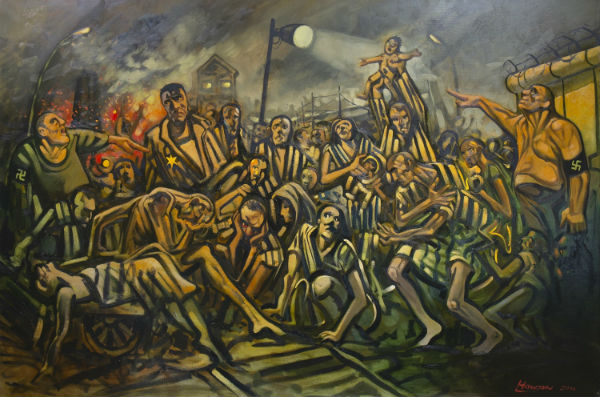
Holocaust Crowd Scene II
Artist information
Name Peter Howson (1958-)
Born London, England
Find more work in the collection by this artist
Find out more about this artist
Painter, printmaker and muralist Peter Howson was born in London, England on 27 March 1958 to Scottish parents and moved with his family to Prestwick, Ayrshire at the age of four. He studied at Glasgow School of Art (1975–77), alongside fellow students Steven Campbell, Ken Currie and Adrian Wiszniewski. Afterwards, he served in the army and travelled widely, before returning in 1979 to complete a Masters. Between 1982 and 1983 he painted murals for the Feltham Community Association in London, prior to becoming artist-in-residence at the University of St Andrews (1985), and also a part-time tutor at Glasgow School of Art. He won the Arthur Andersen Purchase Award at Compass Gallery, Glasgow (1986) and the Henry Moore Foundation award (1988), going on to become a central figure in the school of Scottish figurative painting; his work in this period reflects the economic deprivations of Scottish contemporary life in the 1970s and 1980s.
In 1992 he was commissioned by the Imperial War Museum to record the conflict in the former Yugoslavia, and was appointed official British war artist for Bosnia in 1993, producing a number of highly emotive, sometimes controversial paintings recording the violence of war. His largescale painting entitled The Massacre of Srebrenica is on loan to Glasgow Museums for an initial three year period. Other commissions include Scottish Opera’s production of Mozart’s opera Don Giovanni (2001) and the newly instated Saint of the Catholic Church, John Ogilvie for St Andrew’s Cathedral, Glasgow (2012), the subject of a BBC documentary. He has exhibited widely both in the UK and abroad. His solo exhibitions include a retrospective at McLellan Galleries, Glasgow (1993), Roger Billcliffe Gallery, Glasgow, (1999), Flowers West, Santa Monica, California (2001), Flowers Central (2002), Stations of the Cross, Flowers East (2003), a print retrospective, Flowers Graphics (2004), Phlegethon, Flowers Cork Street (2021), and Lacrimae Rerum, Flowers Hong Kong (2022). His upcoming exhibition, When the Apple Ripens: Peter Howson at 65, runs at City Art Centre, Edinburgh (May-Oct 2023).
Peter Howson was awarded the Lord Provost’s Medal, Glasgow, in 1995, and the following year was made Doctor of Letters, Honoras Causa, by the University of Strathclyde. He was appointed OBE in 2009. His work is held in numerous UK public collections including the Ben Uri Collection, the British Museum, the Imperial War Museum, Tate and the V&A, and abroad in the Metropolitan Museum of Art and the Museum of Modern Art, New York, USA.
Object Details
Date 2011
Object type painting
Medium oil
Materials and techniques oil (medium) painting (technique) canvas (support)
Unframed 122 x 183.3 x 3.7 cm
Acquisition Purchased 2020
Accession number 2020-01
Display status not on display
Howson’s Holocaust Crowd Scene graphically depicts the horror and brutality of the Nazi concentration camps with the crowd of Jewish prisoners, stripped of their own clothing and dressed in striped camp uniforms, depicted in attitudes of grief, suffering and lamentation. They are flanked by two thuggish Nazi guards wearing swastika armbands, one making a Nazi salute and the other pointing inward to focus attention on a prisoner prominently displaying the yellow badge with the Star of David that Jews were forced to wear in Nazi-occupied Europe, used here symbolically to indicate martyrdom. Both the structure and composition of the painting draw on classical themes and Christian imagery, with the naked child held aloft recalling Rubens 'Massacre of the Innocents' and the draped dead body to the lower left of the composition with a mourning figure draped over it suggesting the dead Christ or pietà. The mood of mourning also recalls British-Jewish artist Morris Kestelman’s 1943 painting Lama Sabachthani (Why have you forsaken me?) (Imperial War Museum), made in response to reports of the Holocaust in Britain.
Keywords
concentration camp | crowd | Holocaust | Nazi
Selected exhibition history
2023
A Brush with Evil: Peter Howson's Holocaust Crowd Scene II
Ben Uri Gallery
Literature
Sarah MacDougall (foreword), Important Additions to the Collection since 2000 (London: Ben Uri Gallery and Museum, 2025), p. 9, illus., p. 32.
Hover mouse cursor over image to zoom (you can also use the mouse wheel).
Related works
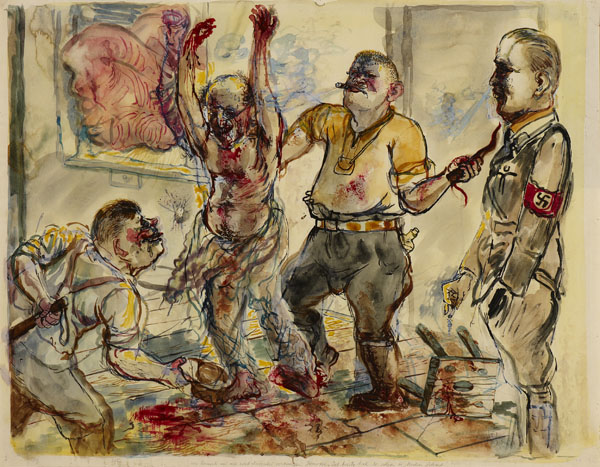
Interrogation
by George Grosz
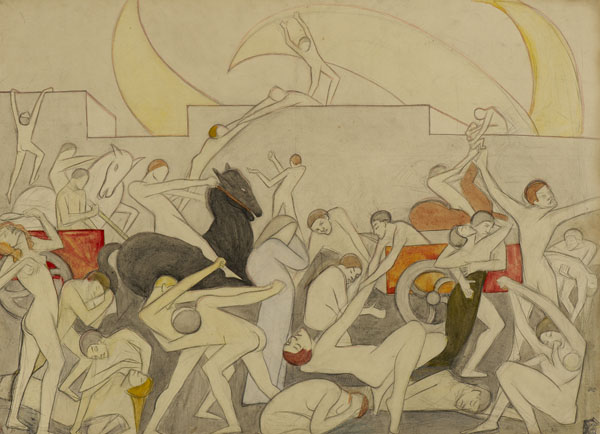
Attack
by Clare Winsten