Ben Uri Collection

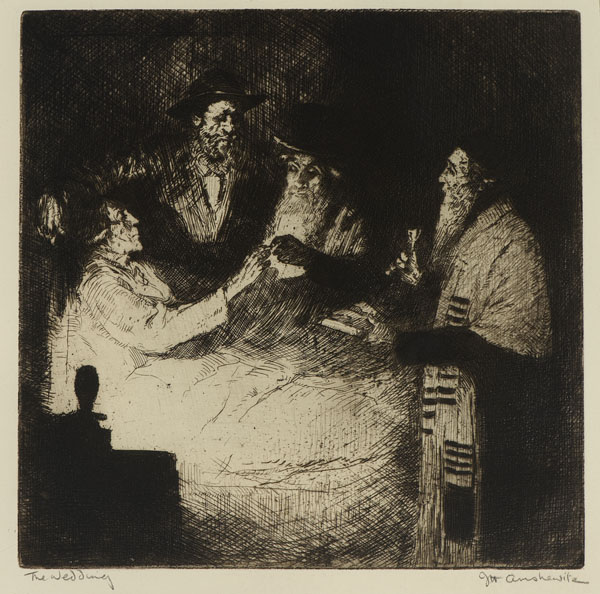
The Wedding
Artist information
Name John Henry Amshewitz (1882-1942)
Other name J H Amshewitz
Born Ramsgate, England
Died Muizenberg, South Africa
Find more work in the collection by this artist
Find out more about this artist
Painter, muralist and illustrator John Henry Amshewitz was born into a Jewish family in Ramsgate, England on 19 December 1882 (his father, Asher Amschejewitz, an Orthodox rabbi and scholar, born in Vilna, having settled in the town in 1867). In 1902 Amshewitz won an art scholarship to study at the Royal Academy schools (1902–07), under the direction of John Singer Sargent, Sir George Clausen and Solomon J. Solomon; his fellow students included Samuel R. Samuel (later Samuel Fyzee-Rahamin). While still a student, Amshewitz exhibited at the Royal Academy (from 1905), showing a portrait of his father in 1906. In 1905 he also won a £40 prize for mural decoration, then won both first and second place in an open competition to paint four murals for the Centenary Memorial at the Liverpool City Hall in 1907, and a mural for the Royal Exchange in London in 1910. A portrait sketch commemorates his friendship with aspiring poet-painter Isaac Rosenberg (1909). Amshewitz also illustrated works for the Jewish writer Israel Zangwill, including Ghetto Comedies (1907), and a Haggadah (1930). He was elected a member of the Royal Society of British Artists in 1914.
In 1916, after being rejected for military service (owing to an injury incurred during the creation of the Liverpool murals), he accepted a theatrical role in a Jewish comedy touring South Africa for six months, afterwards settling in Johannesburg for six years and painting local portraits. He held his first exhibition in South Africa in 1916 and was elected a member of the South African Society of Artists in 1917. In 1918, he married Sarah Briana Judes (who published The Paintings of JH Amshewitz in London in 1951); he founded the Johannesburg Sketch Club the same year and, as President, mentoring other Johannesburg artists, leading to the founding of the School of Art, and also became chief cartoonist for the Rand Daily Mail and Sunday Times. His commissions included a portrait of Mrs Louis Botha the wife of the first Prime Minister of the Union of South Africa (1920) and a War Memorial in Boksburg (1921).
Amshewitz returned to England in 1922, exhibiting in 1923 at both the Royal Society of British Artists and within the Jewish Artists exhibition at the Whitechapel Art Gallery, as well as the International Exhibition at the Royal Academy (1925). In 1927 he held a solo exhibition at the Fine Art Society. He also participated in group shows including the British Artists Exhibition in Italy (1929) and the Paris Salon. After some of his works were acquired by the Royal Family, Queen Mary visited his home in 1932. He continued to publish etchings for journals including the Sketch, the Sphere, the Graphic, Punch and the Illustrated London News, where in 1933 his sketch of Albert Einstein was printed on the front page. Further mural commissions included three large panels for South Africa House in London (1933) and another for Athlone Castle (1935). In 1936 Amshewitz returned to his Johannesburg studio. He was commissioned to create a mural for Pretoria City Hall in 1937, before moving to Cape Town in 1939 for health reasons.
John Henry Amshewitz died in his studio in Cape Town, South Africa on 6 December 1942. A memorial exhibition was held at the City Hall, Johannesburg in 1943. His work is represented in UK collections including the Ben Uri Collection, the National Portrait Gallery and the V&A, as well as the South African National Art Gallery in Cape Town, the Africana Museum in Johannesburg, the Metropolitan Museum, New York, and the Hebrew University in Jerusalem.
Object Details
Date c. 1923
Object type print
Medium etching on paper
Materials and techniques ink (medium) etching (technique) paper (support)
Unframed 26 x 26 cm
Framed 53.2 x 40.7 cm
Signed (lower right) 'J.H.Amshewitz'
Acquisition Presented by Mr and Mrs Sheldon 1981
Accession number 1987-13
Display status not on display
John Henry Amshewitz started to experiment with etching around 1923 and completely abandoned the medium after 1935. By that time, he had produced a total of twenty plates, Rembrandtesque in style and spirit, but also reflecting his sardonic sense of humour. ‘The Wedding’ is based on a Jewish myth that an unwed woman cannot enter Heaven. The artist's widow described the scene: the bride is 'the 'ugly, masculine-looking, crippled woman lying on her death-bed. Her brother, in his anxiety for her celestial welfare, has bribed an old passer-by to marry her and, together with an aged witness, they are standing at the bedside. The rabbi, holding a goblet of wine, has performed part of the ceremony, but as the ring is being placed on her finger, she drops back ... and does not gain paradise after all!' This etching was reproduced in ‘Fine Prints of the Year 1925’ and F. L. Emanuel's ‘Etching and Etchings’.
This particular print did not enter the Collection until 1981 but a version of this etching was exhibited at both the 1923 Exhibition of Jewish Art (cat. no 83) at the Whitechapel Art Gallery and the subsequent 1927 Exhibition of Jewish Art and Antiquities (cat no. 310) at the Whitechapel Art Gallery .
Selected exhibition history
1923
Jewish Artists
Whitechapel Art Gallery
1927
Exhibition of Jewish Art and Antiquities
Whitechapel Art Gallery
1934
The Opening of the Ben Uri Jewish Art Gallery and an Exhibition of Works by Jewish Artists
Ben Uri Jewish Art Gallery
1944
Opening Exhibition
Ben Uri Art Gallery
1945
Exhibition of Paintings by A. A Wolmark (Konstam Collection), Dobrinsky Paris, and a selection of work from the Ben Uri Collection
Ben Uri Art Gallery
1946
Selections from the Ben Uri Permanent Collection of Paintings, Sculpture & Drawings
Ben Uri Art Gallery
1946
Subjects of Jewish Interest: Paintings, Sculpture & Drawings
Ben Uri Art Gallery
1948
Exhibition of Jewish Art
North Western Reform Synagogue
1951
Festival of Britain, Anglo-Jewish Exhibition 1851-1951
Ben Uri Art Gallery
1954
Exhibition of Jewish Art
Hove Museum of Art
1960
Selections from the Permanent Collection
Ben Uri Art Gallery
1977
Selections from the Permanent Collection: Watercolours, Drawings, Graphics
Ben Uri Gallery
1980
Exhibition of Selected Works from the Permanent Collection of the Ben Uri Art Gallery
Ben Uri Gallery
Literature
Walter Schwab and Julia Weiner, eds., Jewish Artists: the Ben Uri Collection - Paintings, Drawings, Prints and Sculpture (London: Ben Uri Art Society in association with Lund Humphries Publishers Ltd, 1994), p. 19.; Frieda Harmsen "Etchings by J H Amshewitz 1882–1942", De Arte, vol. 20 no. 33, pp. 42-46.; S. B. Amshewitz, J. H. Amshewitz (London, 1951), p. 45.
Hover mouse cursor over image to zoom (you can also use the mouse wheel).