Ben Uri Collection

Albert Einstein
Artist information
Name Jacob Epstein (1880-1959)
Born New York, USA
Died London, England
Find more work in the collection by this artist
Find out more about this artist
Sculptor Jacob Epstein was born into a relatively prosperous family of Russian/Polish-Jewish immigrants in New York City, USA on 10 November 1880, but as a teenager rejected the Orthodoxy of his upbringing. From 1893–98 he attended classes at the Art Students' League and was inspired by the multicultural communities around him. After spending the winter of 1899–1900 cutting ice in New Jersey, he turned to sculpture, working in a bronze foundry (1901–2). On the proceeds of his first professional commission to illustrate Hutchins Hapgood’s The Spirit of the Ghetto (1902), he sailed to Europe. In Paris he studied at the École des Beaux-Arts (1902–3) and the Académie Julian (1903–4), sharing the appreciation of artists including Picasso and Modigliani, for Indian and West African art traditions.
Epstein moved to London in 1905 and in 1907 he received his first major British commission, creating 18 nude sculptures for the facade of the British Medical Association Building (now Zimbabwe House) on the Strand. This commission, like many of Epstein’s other early works, was highly controversial and criticised as indecent. Epstein’s second public commission to carve Oscar Wilde’s tomb for Père Lachaise cemetery, Paris (completed in 1912), directly inspired by Assyrian sculpture in the British Museum, abandoned the conventional figure and proved equally controversial. A champion of direct carving, he was also associated with the short-lived Vorticist group, co-curated the so-called 'Jewish Section' at the Whitechapel Art Gallery's 'Review of Modern Movements', with David Bomberg in 1914, and was a co-founder of the London Group. During the First World War, Epstein was conscripted into the Jewish 38th battalion of the Royal Fusiliers in 1917 but was discharged, without seeing active service following a breakdown in 1918.
Epstein's work often challenged prevailing notions of sexuality and beauty and favoured the non-European model. He had solo shows at the Leicester Galleries in 1917, 1920, 1924, 1939 and 1950, a retrospective at Tate in 1952. His public commissions continued to attract controversy including the carved relief Rima (1924–5, Hyde Park), a memorial to the naturalist and author W. H. Hudson, and the monumental figure groups, Night and Day (1928–9), for Charles Holden's London Underground headquarters, and later monumental carvings including Genesis (1930), Ecce Homo (1934–35), and his autobiographical Jacob and the Angel (1940-41, Tate). However, his portrait heads, usually cast in bronze, were always in demand. Epstein also painted in watercolour and gouache, and his scenes of Epping Forest were frequently exhibited in Leicester Galleries, London. He exhibited in group shows at Ben Uri Gallery from 1934 onwards, and was Patron of the Ben Uri art Society in 1936–37. During the Second World War was commissioned by the War Artists’ Advisory Committee to execute six portrait busts including one of Winston Churchill. Epstein was knighted in 1954.
Epstein completed his large bronze Bowater House group for Edinburgh Gate, Knightsbridge (1958–9) on the day that he died in London, England on 21 August 1959; he was buried in Putney Vale cemetery. A posthumous exhibition of bronzes was held at Ben Uri Gallery in November 1959. In 1980, his centenerary year, restropsectives were held at Ben Uri Gallery, Birmingham Museum & Gallery and Tate. More than 300 of his works are in UK public collections including the Ben Uri Collection, the National Portrait Gallery, Tate and the V&A.
Object Details
Date 1933
Object type sculpture
Medium bronze
Materials and techniques bronze (medium) sculpture (technique)
Unframed (height) 45 cm
Acquisition On long-term loan from a private collection
Accession number 2022-08
Display status not on display
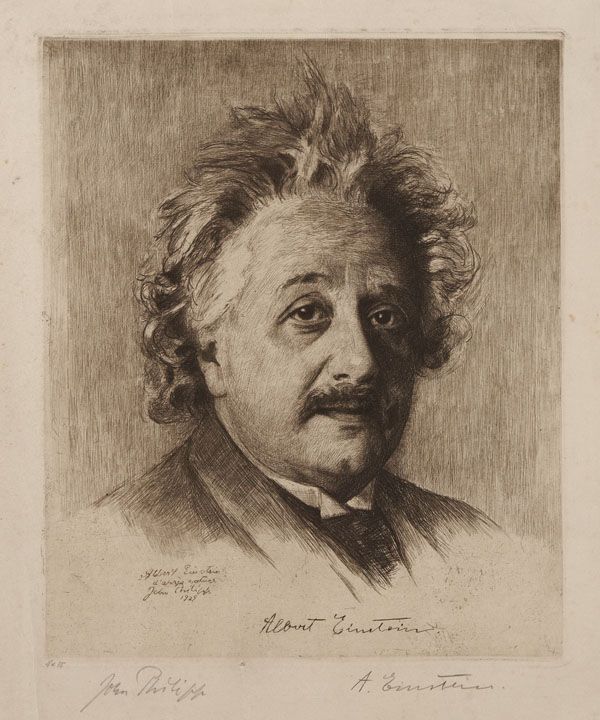
After Hitler’s accession to the German Chancellorship in 1933, the renowned German-Jewish physicist Albert Einstein (1879-1955), who was on a lecture tour in the USA, was unable to return to Germany and spent some months in Europe. He came to England in June and held lectures in Oxford and Glasgow, also meeting Winston Churchill. In September, Einstein spent three weeks at a secluded army camp near Cromer, Norfolk, at the invitation of Oliver Locker-Lampson MP. During this period, he also sat to Epstein for two hours each morning. Epstein noted how 'Einstein appeared dressed very comfortably in a pullover with his wild hair floating in the wind. His glance contained a mixture of the humane, the humorous, and the profound. This was a combination that delighted me. He resembled the ageing Rembrandt'. However, Einstein left to take up a professorship at Princeton in October, before the bust was completed. Before leaving for America, Einstein gave a speech in the Royal Albert Hall, attended by a crowd of 10,000, praising democracy and warning of the dangers ahead.
Other casts are in the Tate, Science Museum, the University of Liverpool, the City Art Gallery, Birmingham, the Fitzwilliam Museum, Cambridge, and a number in private collections.
In May 1934 a cast was exhibited at the Royal Academy's summer exhibition, causing the Jewish Chronicle to comment that 'This year's Royal Academy is dignified by the presence of one work of art— Epstein's head of Einstein'.
Selected exhibition history
2023
Shaping the Future: New Arrivals at the Ben Uri Collection
Ben Uri Gallery
2023
A Brush with Evil: Peter Howson's Holocaust Crowd Scene II
Ben Uri Gallery
2025
Sculptures from the Ben Uri Museum
Gallery One, Thirsk Hall Sculpture Garden
Literature
Robert Black, The Art of Jacob Epstein (New York: World Publishing Company, 1942), p. 91, pl. 62; Evelyn Silber, The Sculpture of Epstein, with a complete catalogue (Oxford: Phaidon Press, 1986), p. 174, cat no. 234, illus; Richard Buckle, Jacob Epstein: Sculptor (London: Faber and Faber, 1963), p. 206, pl. 320.

Hover mouse cursor over image to zoom (you can also use the mouse wheel).
Related works
Albert Einstein
by John Philipp