Ben Uri Collection

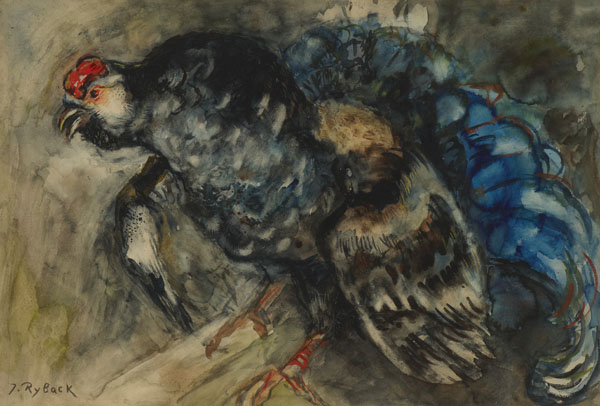
The Cockerel
Artist information
Name Issachar Ryback (1897-1935)
Born Elisavetgrad, Russia (now Kropyvnytskyi, Ukraine)
Died Paris, France
Find more work in the collection by this artist
Find out more about this artist
Issachar Ber Ryback was born into a Jewish family in Elisavetgrad, Russia (now Kropyvnytskyi, Ukraine) in 1897 and studied art in Moscow. After the 1917 Russian Revolution, he was part of a significant national Jewish art movement based on ghetto folk-art, Jewish popular traditions and humour, alongside fellow members including El Lissitzky, Natan Altman and Marc Chagall. In 1916, Ryback and El Lissitzky were commissioned by the Jewish Historical and Ethnographic Society to travel around the small towns of present-day Ukraine and Belarus, copying paintings in wooden synagogues and carved gravestones in Jewish cemeteries. This trip was the beginning of Ryback's sustained interest in Jewish folk art, and he continued to collect and appropriate this iconography in his work. In 1921 Ryback's experiments with Cubism and expressionism attracted acclaim in Berlin. He participated in the 'Der Sturm' group and completed an important series of lithographs depicting imaginary scenes of Jewish shtetl life.
He later returned to Russia to design for the Moscow Theatre before settling in Paris, where his style became more romantic and nostalgic. Issachar Ryback died in Paris, France in 1935. His work is held in the Ben Uri Collection in the UK and in many international collections.
Object Details
Date 1920
Object type painting
Medium watercolour on paper
Materials and techniques watercolour (medium) paper (support)
Unframed 33.5 x 50 cm
Framed 52 x 67.5 cm
Signed (lower left): I. Rybrack
Acquisition purchased 1935
Accession number 1987-354
Display status not on display
In The Cock, Ryback's cockerel bears comparison both with the romantic folkloric imagery of artists such as Chagall, and the expressionistic realism of Soutine's closely-observed studies. The cockerel, a staple of the French still-life, may be a symbol of his adopted French home, but also evokes the Jewish tradition of kapparot, where the sins of a person are symbolically transferred to a fowl.
Selected exhibition history
1935
Israel Zangwill Memorial Exhibition
Ben Uri Jewish Art Gallery
1944
Opening Exhibition
Ben Uri Art Gallery
1945
Exhibition of Paintings by A. A Wolmark (Konstam Collection), Dobrinsky Paris, and a selection of work from the Ben Uri Collection
Ben Uri Art Gallery
1960
Selections from the Permanent Collection
Ben Uri Art Gallery
1970
Paintings from the Ben Uri Art Gallery
Russell-Cotes Art Gallery and Museum
1977
Selections from the Permanent Collection: Watercolours, Drawings, Graphics
Ben Uri Gallery
2012
Chaim Soutine and his Contemporaries - from Russia to Paris and School of London works from the Ben Uri Collection
Ben Uri Gallery
2013
Chagall, Soutine and the School of Paris: touring exhibition
Manchester Jewish Museum
Literature
Rachel Dickson and Sarah MacDougall, eds., Ben Uri: 100 Years in London - Art, Identity, Migration (London: Ben Uri Gallery, 2015), p. 72 (illus.); Sarah MacDougall ed., Soutine and his Contemporaries - from Russia to Paris (London: Ben Uri Gallery, 2012) p. 34; Walter Schwab and Julia Weiner, eds., Jewish Artists: the Ben Uri Collection - Paintings, Drawings, Prints and Sculpture (London: Ben Uri Art Society in association with Lund Humphries Publishers Ltd, 1994), p. 92.
Hover mouse cursor over image to zoom (you can also use the mouse wheel).