Ben Uri Collection

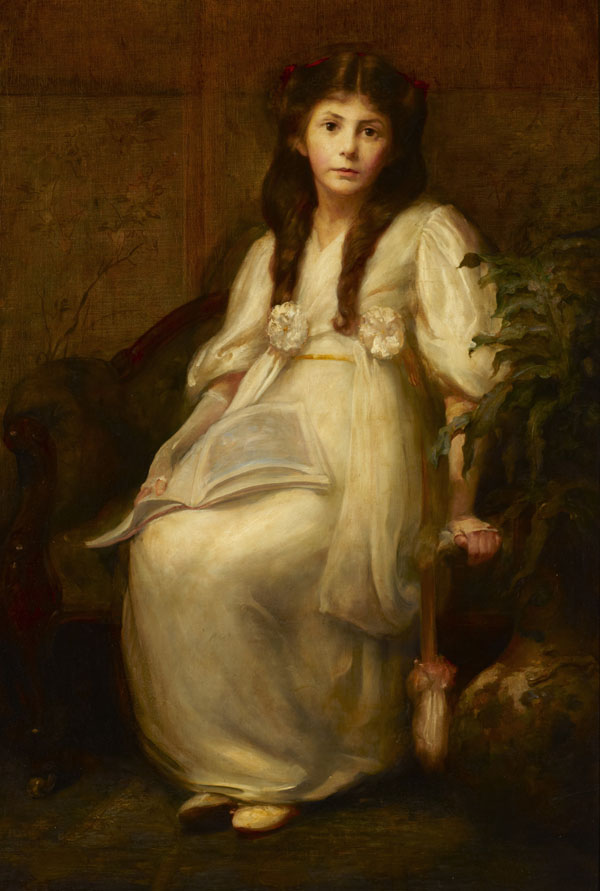
Portrait of Rosalind Adler
Artist information
Name Samuel Rahamin Samuel (Samuel Fyzee-Rahamin) (1880-1964)
Other name Samuel R. Samuel, Samuel Fyzee-Rahamin, Samuel Fyzee Rehamin, S. Fyzee-Rahamin, Fyzee Fyzee-Rahamin
Born Poona (now Pune), India
Died Karachi, Pakistan
Find more work in the collection by this artist
Find out more about this artist
Painter, muralist, dramatist and poet Samuel Fyzee-Rahamin was born Samuel Rahamin Samuel to a Jewish family belonging to India’s Bene Israel community in Poona (now Pune), India on 19 December 1880. He studied at the School of Art in Bombay, and then, on a scholarship in London at the Slade School of Fine Art (1903), and the Royal Academy school (1904-09) under John S. Sargent and Solomon J. Solomon, where his cohort included J H Amshewitz. His tutors’ influence can be seen in his Portrait of Rosalind Adler (1906, Ben Uri Collection), a typical Edwardian portrait of a young girl and almost certainly a commission, signed with a shortened form of his given name, 'Samuel R. Samuel'. In 1906 he also exhibited a naturalistic portrait (no. 765 The Derelict) at the Royal Academy.
In 1908 Samuel returned to India, becoming art advisor to the Maharaja of Baroda and soon abandoned naturalism in favour of the two-dimensional figuration traditionally associated with Rajput painting, a strand of the Bengal school. He maintained his connections with Britain, exhibiting critically acclaimed paintings in the latter style at galleries including the Goupil Galleries, London (1914), as well as Galerie Georges Petit, Paris (1914), the Knoedler Gallery, New York (1918), Arthur Tooth’s (1925) and the Arlington Galleries (1935), both in London, and Manchester City Art Gallery (1930). In 1924 his work was included in the British Empire Exhibition in Wembley and in 1925, he became the first Indian artist and the first Muslim artist to enter the Tate when two of his Ragmala paintings were acquired for its collection (one gifted by the Jewish businessman Victor Sassoon, the other presented by the State of Bhavnagar). In the 1930s, he helped the Victoria & Albert Museum reorganise its collection of Indian art and submitted a shortlisted proposal for a mural for India House in Aldwych. In 1926 as Samuel Fyzee-Rahamin he published an article ‘On Indian Art and Burne-Jones’, inspired by his commission as a muralist for the Delhi Imperial Secretariat and highlighting the difficulties of cultural exchanges under the auspices of the British Empire.
In the 1930s two of his plays were staged in London, choreographed by his wife, Atiya Fyzee-Rahamin, an important author, performer and patron of the arts, who belonged to a prominent Muslim family in Bombay. Prior to their marriage in 1912, Samuel converted to Islam and both he and Atiya unusually took each other’s family names. In 1914 Samuel Fyzee-Rahamin illustrated Atiya Fyzee-Rahamin’s book ‘Indian Music’, published by the Goupil Gallery to coincide with Samuel’s exhibition (later re-published in 1925 by Luzac & Co under the title ‘The Music of India’). In May 1939, he held a ‘Special Exhibition’ displaying ‘Modern Indian Art, on traditional lines’ at the American Association, New York.
In 1948, the Fyzee-Rahamins moved to Karachi, Pakistan following the partition of the Indian subcontinent in 1947. Samuel Fyzee-Rahamin died in Karachi, Pakistan on 1 January 1964. His work is held in UK collections including the Ben Uri Collection, Manchester City Art Gallery and Tate. He presented a collection of his own paintings and other artworks to the Aiwan-e-Riffat Museum in Karachi, intended to be housed in a separate building as the Fyzee Rahamin Art Gallery, a project which has not currently been realised. Posthumously in the UK, his work has featured in group exhibitions including 'Speech Acts: Reflection-Imagination-Repetition' at Manchester Art Gallery (2018-19), 'Beyond the Page: South Asian Miniature Painting and Britain, 1600 to Now' at MK Gallery, Milton Keynes and The Box, Plymouth (2024), and the exhibition of Heads from the Ben Uri Collection, supporting 'Lancelot Ribeiro - Heads In and Out of Our Time' at Ben Uri Gallery (2024).
Object Details
Date 1906
Object type painting
Medium oil on canvas
Materials and techniques oil (medium) painting (technique) canvas (support)
Unframed 126 x 85 cm
Framed 153 x 112.5 x 7 cm
Signed On reverse 'Samuel R. Samuel'
Acquisition presented to Ben Uri c. 1950s
Accession number 1987-357
Display status not on display
Samuel Rahamin Samuel's portrait of Rosalind Adler, the younger daughter of the Rev. Michael Adler, was executed in 1906, and was almost certainly a commission from a Jewish family. Little is known of Rosalind, except that she attended the Central Synagogue in London and assisted her mother and sister, Lilian, to decorate the Succah (temporary hut to celebrate the weeklong Festival of Sukkot) in 1907 and 1908. The portrait was painted towards the end of Samuel's years in London (1903-07) when he studied, firstly, at the Slade School of Fine Art, and then, at the Royal Academy School, under John S. Sargent and Solomon J. Solomon - the latter, in 1906, became only the second Jewish Royal Academician, President of the Royal Society of British Artists and an extremely influential figure in Jewish circles. Their influence can be seen in the naturalism and loose brushwork apparent in this classic Edwardian portrait of a young girl, dressed in white (traditionally denoting purity), set within a refined interior, and clearly belonging to the Western tradition. Samuel exhibited it in a joint exhibition with J. H. Amshewitz at the latter's London studio in April 1906, where it was admired, within a longer appreciation of Samuel's work, by the critic of the Jewish Chronicle as 'a charming example of child-portraiture' (Jewish Chronicle, 06 April 1906).
By 1908 Samuel had returned to India and abandoned naturalism in favour of the two-dimensional figuration traditionally associated with Rajput painting, a strand of the Bengal school, creating critically acclaimed paintings in this latter style under the name Samuel Fyzee-Rahamin, which he adopted after converting to Islam prior to his marriage in 1912.
The exact provenance of this rare early work, made under his given name and signed 'Samuel R. Samuel' is untraced but it is likely to have been with the Adler family prior to entering the collection, when it was logged in the Ben Uri Art Society Annual Report 1958-59 as no. 166 (but not as a new acquisition). It did not appear in the previous catalogue in 1946, indicating that it must have entered the collection between those dates.
Selected exhibition history
1906
Studio Exhibition: J H Amshewitz and Samuel R Samuel
The Studio of J H Amshewitz
1982
Exhibition of Selected Works from the Permanent Collection including Recent Acquisitions
Ben Uri Art Gallery
2004
The Modern and the New: An Examination of the Permanent Collection alongside New Works by Invited British, European and American Jewish Artists
Ben Uri Gallery - The London Jewish Museum of Art
2024
Lancelot Ribeiro – Heads In and Out of Our Time
Ben Uri Gallery
Literature
Oil Paintings in Public Ownership in Camden (London: The Public Catalogue Foundation, 2013), p. 38; Walter Schwab and Julia Weiner, eds., Jewish Artists: the Ben Uri Collection - Paintings, Drawings, Prints and Sculpture (London: Ben Uri Art Society in association with Lund Humphries Publishers Ltd, 1987, reissued 1994), p. 93, cat. no. 357; Catalogue of Exhibition of Selected Works from the Ben Uri Collection, 1982, cat. no. 38; Ben Uri Annual Report 1958-59; 'Round the Studios', Jewish Chronicle, 06 April 1906.
Hover mouse cursor over image to zoom (you can also use the mouse wheel).