Ben Uri Collection

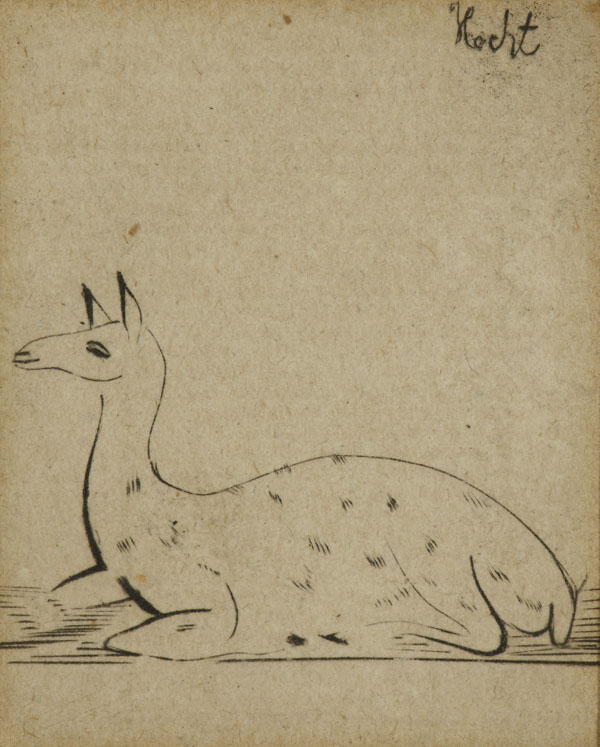
Fawn
Artist information
Other name Józef Hecht
Born Łódź, Poland
Died Paris, France
Find more work in the collection by this artist
Find out more about this artist
Joseph (né Józef) Hecht was born into a Jewish family in Łódź, then within the Congress Kingdom of Poland, part of the Russian Empire (now Poland) on 14 December 1891 and trained at the Krakow Academy of Art from 1909 to 1914. Finding himself in Berlin at the outbreak of the First World War, he spent the duration in neutral Norway, exhibiting in Christiania (1917), Oslo and Bergen (1918). After the Armistice he travelled to Italy, then in 1920, he moved to Paris, where he began exhibiting with the Salon d'Automne (1920) and Salon des Indépendents (1921), going on to exhibit in Washington, D.C. and Philadelphia in the USA, as well as continuing to show in Paris.
In 1926, he published 'l'Arche de Noë', a suite of six engravings (preface by Gustave Kahn) and 'l'Eubage aux Antipodes de l'Unité', five engravings (accompanying text by Blaise Cendrars). After meeting Stanley William Hayter, he introduced him to copper engraving using the traditional burin technique and in 1927 helped Hayter acquire a press to start a printmaking studio for artists to explore the engraving medium, which became known as Atelier 17. In 1928 he created a portfolio of engravings of animals and peoples from around the world, with a handwritten poem, printed in red ink, by André Suarès, under the title 'Atlas', published in Paris. Hecht also exhibited extensively both in Paris and internationally, including in 1929 at Gallery Georges, London. In 1937, he was awarded two gold medals at the Paris International Exposition. During the Second World War, he moved to the Savoy region near the Swiss-Italian border, where he worked as a labourer, returning to Paris after the war. In 1946, Hayter convinced Hecht to resume printmaking and he invented a new relief printing process in 1949.
Hecht died in his studio in Paris, France on 19 July 1951. His work is held in museums in Paris, London (including the Ben Uri Collection and the British Museum), Brooklyn, Amderstam and many other places. Examples of his work were exhibited posthumously at Ben Uri Gallery, London in the Annual Exhibition of Contemporary Jewish Artists in 1954.
Object Details
Date 1939
Object type print
Medium etching on paper
Materials and techniques ink (medium) etching (technique) paper (support)
Unframed 5.5 x 4.5 cm
Framed 14.5 x 13.5 cm
Signed (upper right): 'Hecht'
Acquisition presented by W.L.Goldstein 1986
Accession number 1987-133
Display status not on display
Hecht arrived in Paris in 1920 and specialised in engraving, later teaching the burin technique to Stanley William Hayter, with whom he later co-founded the experimental workshop, Atelier 17. In this period, Hecht focused on engravings of animal figures, published in Paris in various collections between 1926 and 1939.
Literature
Walter Schwab and Julia Weiner, eds., Jewish Artists: the Ben Uri Collection - Paintings, Drawings, Prints and Sculpture (London: Ben Uri Art Society in association with Lund Humphries Publishers Ltd, 1994), p. 50.
Hover mouse cursor over image to zoom (you can also use the mouse wheel).