Ben Uri Pre-Eminent Collection

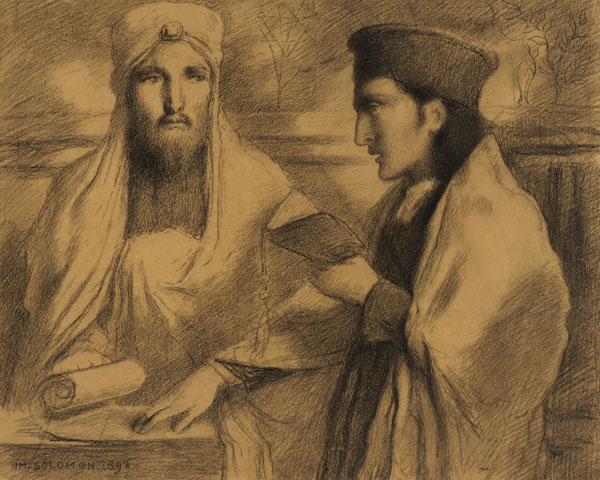
Renewal of Vows on the Scroll of the Law
Artist information
Name Simeon Solomon (1840-1905)
Born London, England
Died London, England
Find more work in the collection by this artist
Find out more about this artist
Simeon Solomon was born into a middle-class Jewish family in London, England on 9 October 1840, the youngest of the eight children of Meyer Solomon and Katherine (née Levy), an amateur miniature painter. Raised in Bishopsgate, he was tutored by his sister, Rebecca (1832-1886), herself a gifted artist and a regular RA exhibitor, employed as a copyist and drapery painter by John Everett Millais. Simeon also trained at F. S. Cary’s Academy (1852-56), and in the studio of his elder brother Abraham (1824-1862), who he followed to the Royal Academy Schools (1856–60). He made his exhibition debut at the Royal Academy in 1858, where he continued to show regularly until 1872. Two years later, his oil painting, Moses (Private Collection, New York), aroused controversy but was defended by the novelist William Makepeace Thackeray. Solomon’s earliest works, mostly on Old Testament subjects, were inspired by Jewish culture and tradition, the bible and Shakespeare. Around 1858, he was introduced to Gabriel Rossetti and became a member of the Pre-Raphaelite circle, later meeting Edward Burne-Jones, John Everett Millais, and William Holman Hunt. In 1862 he established his own studio and was influenced by the poet and critic Algernon Charles Swinburne, and the ideals of the Aesthetic movement. In the following decade, he regularly exhibited at the progressive Dudley Gallery in London and was elected a member of the Savile Club.
In 1873, however, Solomon was arrested in a public lavatory, convicted of gross indecency, and sentenced to 18 months imprisonment (subsequently suspended). Following a brief stay in a lunatic asylum and without consistent support, he drifted into alcoholism, living on charity and a meagre living from reproductions of his work, spending years in the St Giles Workhouse, Holborn, in London, where he died of a heart attack on 14 August 1905. Two memorial exhibitions were held in 1906 and in 1918 a tranche of works by Simeon Solomon, acquired for the Ben Uri Art Society with the assistance of Mosheh Oved, inaugurated the Ben Uri Collection.
Simeon Solomon's work is held in UK collections including Aberdeen Art Gallery, Aberystwyth University School of Art Museum and Galleries, Ashmolean Museum Oxford, the Ben Uri Collection, Birmingham Museums Trust, the Fitzwilliam Museum, the Higgins Bedford, the Jewish Museum London, Leamington Spa Art Gallery & Museum, Manchester Art Gallery, Tate, the V&A and the William Morris Gallery.
In 1956 he was included in the Whitechapel Art Gallery's Tercentenary Exhibition of Jewish Artists in England 1656-1956. In 2000 Roberto C Ferrari and Carolyn Conroy established the Simeon Solomon Research Archive devoted to his work and that of his siblings (http://www.simeonsolomon.com). In 2005-06 Birmingham Museum & Art Gallery curated the exhibition 'Love Revealed: Simeon Solomon and the Pre-Raphaelites', the first full-scale survey of his work, which toured to Ben Uri Gallery in London and to Museum Villa Stuck, Munich.Object Details
Date 1893
Object type drawing
Medium chalk on paper
Materials and techniques chalk (medium) paper (support)
Unframed 38.5 x 48 cm
Framed 56.5 x 65 cm
Signed and dated (lower left): 'Sim Solomon 1893'
Acquisition purchased with the assistance of Mosheh Oved 1918
Accession number 1987-387
Display status not on display
Renewal of Vows on The Scroll of the Law depicts the beginning of the celebration of Simchat Torah, a joyous festival, when Jews celebrate the completion of the reading the Torah (or the Five Books of the Law) for the year, before starting again. During the morning service, two portions from the Torah are read: the final passage from Deuteronomy recounting the death of Moses, and the opening passage from Genesis which recounts the Creation.
Solomon’s earliest works, mostly on Old Testament subjects, were inspired by Jewish culture and tradition, the bible and Shakespeare, and influenced by Pre-Raphaelitism. This work, however, was completed much later in his career as he moved closer to Symbolism. As Carolyn Conroy has noted, 'Many of these images maintain Solomon’s earlier use of the sexual and moral ambiguity of the androgyne but are generally simpler in composition than his earlier work, often concentrating on an image of one or two heads in profile.'
Strictly, there are a number of inaccuracies in his depiction of the ceremony: for instance, the Torah, although depicted as a scroll is not wound around a roller and only one of the Rabbis is dressed in pure white (denoting purity). Solomon had long been interested in the aesthetic qualities of the practice of faith and also depicted Catholic, Coptic and Greek Orthodox Christian, as well as Jewish, practice. He was also interested in Buddhism. His depictions of ritual, like this one, therefore often show young men in idealised roles as rabbis, priests, or acolytes, often rapt with religious fervour, and he is concerned to express the emotional experience of religious devotion rather than accurately depicting its practice. By this time, Simeon was also no longer an observant Jew and was probably drawing on memories of ceremonies he would have seen as a child.
Keywords
drawing | Judaic | Judaism | Scroll of the Law | Simchat Torah | Torah
Selected exhibition history
1925
Official Opening at Great Russell Street
Ben-Uri Jewish Art Society Gallery and Club
1927
Exhibition of Jewish Art and Antiquities
Whitechapel Art Gallery
1930
Mansell Street Gallery Opening: Catalogue and Survey of Activities
Jewish Art and Literary Society Ben-Uri
1990
Ben Uri Highlights: Key Works and Figures
Ben Uri Art Society
2003
Director's Choice: Highlights from the Ben Uri Permanent Collection
Ben Uri Gallery - The London Jewish Museum of Art
2009
Homeless & Hidden 1: World Class Collection Homeless & Hidden
Ben Uri Gallery
Literature
Walter Schwab and Julia Weiner, eds., Jewish Artists: the Ben Uri Collection - Paintings, Drawings, Prints and Sculpture (London: Ben Uri Art Society in association with Lund Humphries Publishers Ltd, 1994), p. 98; Catalogue and Survey of Activities: Jewish Art and Literary Society Ben-Uri (London: Ben Uri, 1930), p. 23, cat no. 57.
Hover mouse cursor over image to zoom (you can also use the mouse wheel).
To license this image contact Bridgeman images
Related works
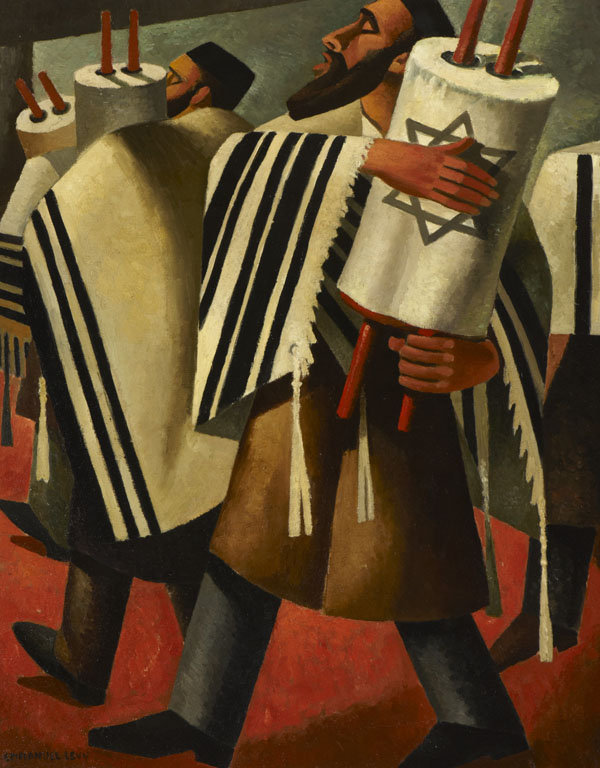
Two Rabbis Carrying the Scrolls of the Law
by Emmanuel Levy