Ben Uri Collection

Ghetto Comedies
Series: Fourteen Illustrations to the works Israel Zangwill
Artist information
Name Alfred Wolmark (1877-1961)
Born Warsaw, Poland
Died London, England
Find more work in the collection by this artist
Find out more about this artist
Aaron Wolmark was born into a Jewish family in Warsaw, Poland on 28 December 1877, and moved to England with his family in 1883, first to Devon and then to the East End of London. He trained at the Royal Academy (from 1895), where he added the English 'Alfred' to his name, exhibiting there (1901–36), as well as with the Allied Artists Association (1908–16) and the International Society (1911–25). He had his first solo exhibition at Bruton Galleries in London (1905). Wolmark's teenage years in London’s East End and two lengthy stays in his native Poland between 1903–6, had a huge visual and spiritual, impact on his early Rembrandtesque work and Jewish subject matter.
In July 1911, after an artistic epiphany on honeymoon in Concarneau, Brittany, Wolmark jettisoned his early methods in favour of the ‘New Art’ and embarked upon the pioneering 'colourist' path that he followed for the next two decades of his working life. A pioneer as a painter of both the Jewish community in London’s East End and as an early modernist, Wolmark has been called the ‘father’ of the Whitechapel Boys. He was the only artist to be included in both the Whitechapel Art Gallery’s 1906 'Jewish Art and Antiquities Exhibition' and in David Bomberg and Jacob Epstein's 'Jewish Section' at the 1914 exhibition 'Twentieth-Century Art: A Review of Modern Movements'.
Wolmark exhibited regularly with the Ben Uri Art Society, as well as at the Grafton (1911, 1916, 1917) and Whitechapel Galleries (1910, 1914, 1927, 1956). In 1915 he co-founded the JAAS (Jewish Association of Arts and Sciences) with Adrian Alfred Woolfstein (Adrian Wolfe). Closely associated with the Ben Uri for many years: in 1925, together with Solomon J Solomon, Wolmark presided over the official opening of the Ben Uri’s first gallery in Great Russell Street, also acting as Vice-President from 1923–56, and as an adviser on purchasing policy. In the 1930s he introduced Cyril Ross and Ethel Solomon (Mrs Robert Solomon) to the Society. His oeuvre also included theatre designs for two Diaghilev ballets, pottery and stained-glass windows. Despite his success, Wolmark was rejected from both the London Group (1914) and the Royal Academy (1938). He died in London, England on 6 January 1961. His work is in many UK collections including the Arts Council Collection, the Ferens Art Gallery, the Government Art Collection, the Jerwood Collection, Middlesbrough Institute of Modern Art (MIMA), the National Portrait Gallery, Southampton City Art Gallery and The Stanley and Audrey Burton Gallery at the University of Leeds.
Object Details
Date 1925
Object type painting
Medium watercolour, pen and ink on paper
Materials and techniques ink | pen (medium) paper (support)
Unframed 31.5 x 20 cm
Framed 61 x 45.5 cm
Signed and dated (upper right): Wolmark 1925
Acquisition purchased for Ben Uri with the assistance of Lord Sieff 1935
Accession number 1987-438vi
Display status not on display
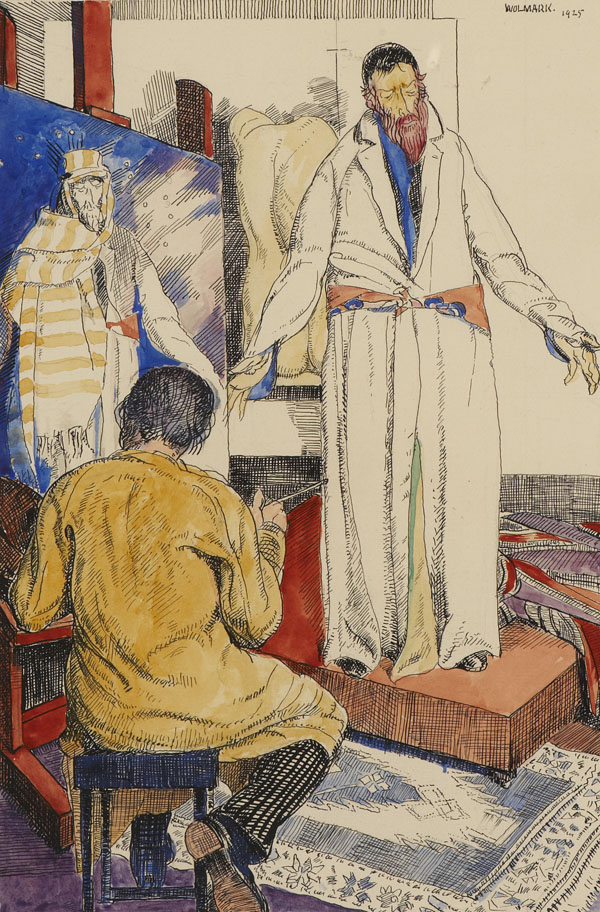
This watercolour is the ninth in a series of fourteen book illustrations Wolmark made to accompany the complete works of Israel Zangwill (1864-1926), the foremost Anglo-Jewish writer of his generation. Known as ‘the Jewish Dickens’, Zangwill’s best-known novel, Children of the Ghetto (1892), vividly described the Whitechapel slums; he also wrote the play The Melting Pot (1908) depicting American Jewish immigrant life and its rich mix of cultures. Both Wolmark and Zangwill were closely associated with Ben Uri from the early 1920s, Zangwill as President in 1922-23, and Wolmark as Vice President for almost a quarter of a century, from 1923-56.
Keywords
Selected exhibition history
1935
Israel Zangwill Memorial Exhibition
Ben Uri Jewish Art Gallery
2024
The Decorative Fair
Evolution London
Literature
Rachel Dickson, Sarah MacDougall, eds. Rediscovering Wolmark: a pioneer of British modernism, Alfred Aaron Wolmark (1877-1961) (London: Ben Uri Gallery, 2004), p. 55 (illus.); Walter Schwab and Julia Weiner, eds., Jewish Artists: the Ben Uri Collection - Paintings, Drawings, Prints and Sculpture (London: Ben Uri Art Society in association with Lund Humphries Publishers Ltd, 1994), p. 108.
Hover mouse cursor over image to zoom (you can also use the mouse wheel).