Ben Uri Pre-Eminent Collection

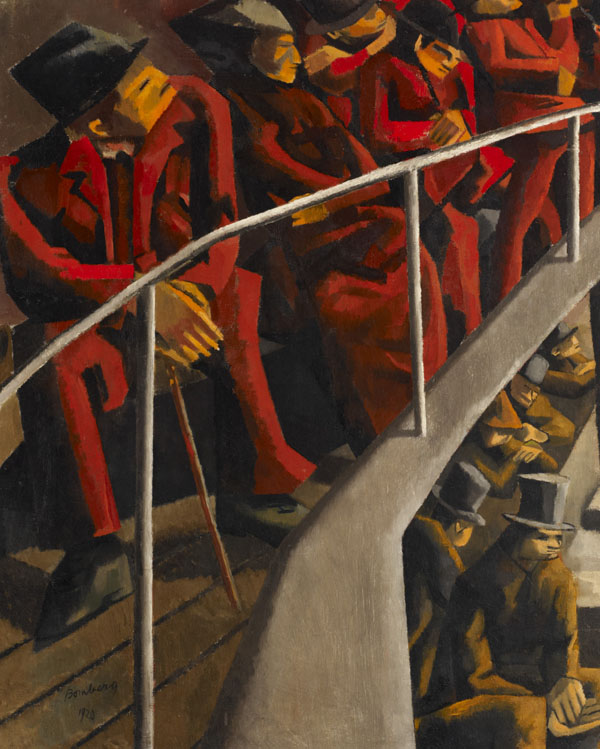
Ghetto Theatre
Artist information
Name David Bomberg (1890-1957)
Born Birmingham, England
Died London, England
Find more work in the collection by this artist
Find out more about this artist
David Bomberg was born to Polish-Jewish parents in Birmingham, England on 12 May 1890. The family moved to Whitechapel in 1895, where he later became prominent among the ‘Whitechapel Boys’ - the term applied to a loose, informal group of young, Jewish, mainly immigrant artists who were either born, raised or worked in the East End in the first two decades of the 20th century, and who, both collectively, and individually, made an important contribution to British Modernism. Initially apprenticed as a chromolithographer, he attended night classes under Walter Sickert and also worked as an artist’s model before studying at the Slade School of Fine Art, where he was seen as a ‘disturbing influence’. In 1913 Bomberg visited Paris with Jacob Epstein, making contact with artists including Modigliani and Picasso. Bomberg’s harrowing service in the trenches during the First World War was compounded by a disastrous experience as a commissioned war artist, explored in a series of related drawings. His postwar disillusionment is most powerfully expressed in the masterly Ghetto Theatre (1920), purchased the same year for the Ben Uri Collection, initiating a lifelong relationship. Afterwards Bomberg made a series of peopled landscapes before travelling in 1923 to Jerusalem, where he began to work en plein air for the first time. Following expeditions to Jericho, Petra and Wadi Kelt, he produced a series of detailed, realistic landscapes, which evolved from tightly topographical treatments into a looser, characteristically expressionistic style, heralding the painterly achievements of his final years.
After a series of disappointments in the 1930s and 1940s Bomberg concentrated on portraits of friends and family, as well as a series of searching self-portraits. Although only reluctantly granted a Second World War commission to paint a bomb store in 1942, Bomberg produced many drawings and paintings on the subject, among them an impressive, large-scale study for a projected (but unrealised) mural. Following his visit to Spain in 1929, a renewed vigour resulted in a series of works based on the cathedral at Toledo, flowering on his second visit in 1934–35, into dramatic landscapes of the gorge at Ronda and flickering night-time processions during Holy Week. These experiments were curtailed by the onset of the Spanish Civil War, but over a decade later picked up and progressed in the west country, where his loosened handling verged on the abstract, and in Cyprus in 1948. His final works culminated in the fulfillment of his early promise after his return to Ronda, where he spent his last years. After becoming seriously ill, Bomberg travelled back to England, but died in London shortly after his return, on 19 August 1957. His work is represented in the UK in a number of important public collections including the Ben Uri Collection, the British Museum, the Imperial War Museum, the Tate, and the V&A. A posthumous touring exhibition (Pallant House, Chichester; Laing Art Gallery, Newcastle; Ben Uri Gallery, London), accompanied by a monograph, was organised by Ben Uri in 2017-18.
Object Details
Date 1920
Object type painting
Medium oil on canvas
Materials and techniques oil (medium) painting (technique) canvas (support)
Unframed 74.4 x 62 cm
Framed 93.1 x 80.4 x 7 cm
Signed and dated (lower left): Bomberg 1920
Acquisition purchased 1920
Accession number 1987-46
Display status not on display
By the time he left the Slade in 1913, Bomberg had established a reputation as a leading member of the avant-garde. His work was admired by the Vorticist leader Percy Wyndham Lewis and he was among the non-members invited in 1915 to show work in the first Vorticist exhibition (although he was always careful to retain his independence). The previous year, in 1914, Bomberg had exhibited five works at The London Group (of which he was a founder member) and also held his first solo show at the Chenil Gallery, Chelsea. However, his enlistment in the Royal Engineers (he later transferred to the 18th King’s Royal Rifles) in November 1915 brought this audacious progress temporarily to a halt. His harrowing experiences at the Front, including the death of his brother, eventually resulted in him shooting himself in the foot. Escaping court-martial and temporarily invalided out, he was soon returned to active service. In 1918 Bomberg was commissioned by the Canadian War Memorials Fund to produce a painting of Sappers at Work. His first, severely abstracted version was woundingly rejected and although the second, more naturalistic version was accepted, the experience left Bomberg severely demoralized.
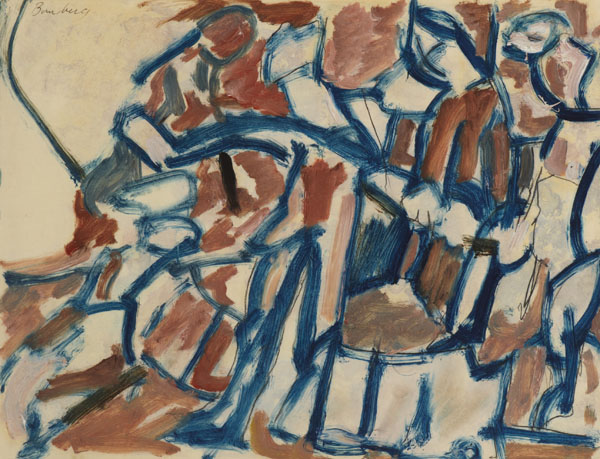
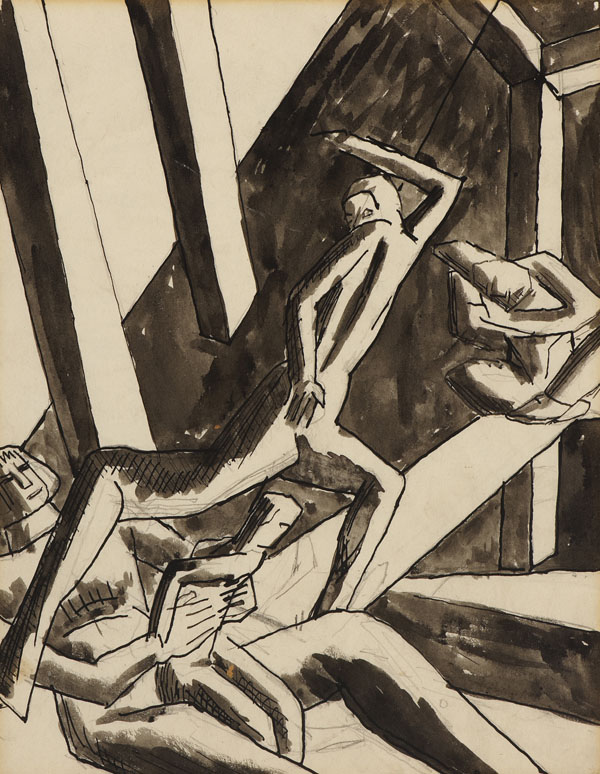
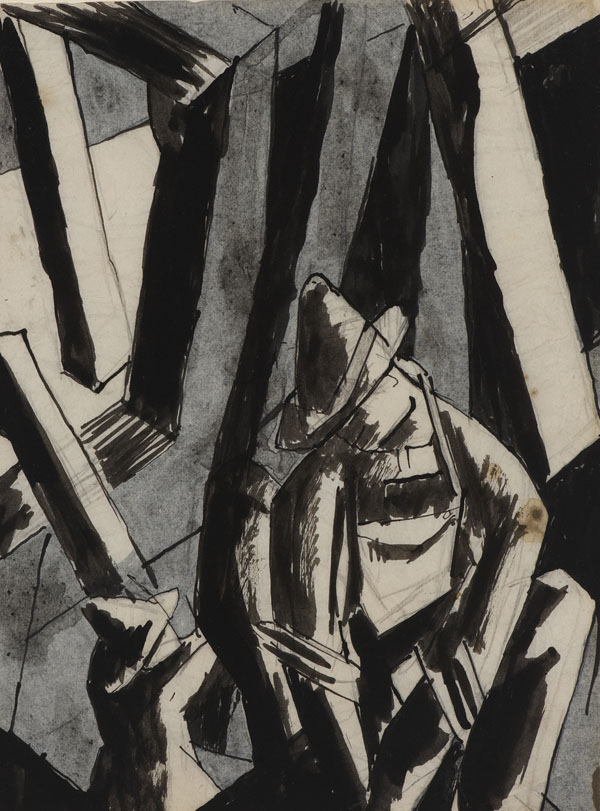
In Ghetto Theatre, set in Whitechapel’s lively Pavilion Theatre, where the classics were performed in Yiddish, Bomberg returned to the subject matter and setting of a number of his earlier sketches. Possibly, he hoped to recapture something of his earlier exuberance. In contrast to his animated prewar theatre-goers, however, these drably-dressed spectators with their mask-like faces and closed body language are indicative of his dismal, postwar vision. The hunched male figure (in the upper foreground) leaning wearily on a stick embodies his own personal disenchantment and the compressed space, cleaved by a bold and imposing balcony rail, echoes the claustrophobic tunnels of his wartime sappers. Only the bold sweep of red adds richness to an otherwise sombre palette. Painted on the eve of his departure from the East End, it reveals that for Bomberg, it was no longer a place of excitement and vitality. Yet elsewhere in a series of related Ghetto Theatre sketches, the artist’s looser handling once again liberates his audience from their constraints.
Selected exhibition history
1920
The 12th London Group Exhibition
The Mansard Gallery
1925
Official Opening at Great Russell Street
Ben-Uri Jewish Art Society Gallery and Club
1927
Exhibition of Jewish Art and Antiquities
Whitechapel Art Gallery
1930
Mansell Street Gallery Opening: Catalogue and Survey of Activities
Jewish Art and Literary Society Ben-Uri
1935
Israel Zangwill Memorial Exhibition
Ben Uri Jewish Art Gallery
1945
Exhibition of Paintings by A. A Wolmark (Konstam Collection), Dobrinsky Paris, and a selection of work from the Ben Uri Collection
Ben Uri Art Gallery
1946
Selections from the Ben Uri Permanent Collection of Paintings, Sculpture & Drawings
Ben Uri Art Gallery
1948
Exhibition of Jewish Art
North Western Reform Synagogue
1954
David Bomberg: paintings and drawings 1915-53 and The Borough Bottega: paintings and drawings by members
The Heffer Gallery
1958
David Bomberg: An Exhibition of Paintings and Drawings
The Arts Council
1960
Selections from the Permanent Collection
Ben Uri Art Gallery
1967
David Bomberg
Tate
1970
Decade 1920-1930
Leicester Museum and Art Gallery
1975
The Jewish Experience in the Art of the 20th Century
The Jewish Museum, New York
1976
Original Vicky Cartoons and Drawings together with items from the permanent collection
Ben Uri Art Gallery
1977
Selections from the Permanent Collection: Watercolours, Drawings, Graphics
Ben Uri Gallery
1980
Exhibition of Selected Works from the Permanent Collection of the Ben Uri Art Gallery
Ben Uri Gallery
1983
The Immigrant Generation: Jewish Artists in Britain, 1900-45
Jewish Museum New York
1985
Achievement: British Jewry Exhibition
Camden Arts Centre
1986
Jewish Artists in an English Context, 1900-1920
Brighton Polytechnic Gallery
1987
British Art in the 20th Century
Royal Academy of Arts
1988
David Bomberg
Tate
1990
Ben Uri Highlights: Key Works and Figures
Ben Uri Art Society
1990
David Bomberg: Centenary Exhibition, Works on Paper
Gillian Jason Gallery
1990
Chagall to Kitaj
Barbican Art Gallery
1994
Jewish Artists: The Ben Uri Collection, Paintings, Drawings, Prints and Sculpture
Ben Uri Art Society
2001
The Ben Uri Story: from Art Society to Museum
Phillips
2003
Director's Choice: Highlights from the Ben Uri Permanent Collection
Ben Uri Gallery - The London Jewish Museum of Art
2003
The Search for Identity: Immigrant Artists in Early Twentieth-century British art
Doncaster Museum and Art Gallery
2004
Faces in the Crowd: The Modern Figure and Avant-Garde Realism
Whitechapel Gallery
2005
Faces in the Crowd: The Modern Figure and Avant-Garde Realism Tour
Castello di Rivoli, Museo d'Arte Contemporanea
2006
Spirit in the Mass
Abbot Hall Gallery
2007
Bomberg's Relevance
Ben Uri Gallery - The London Jewish Museum of Art
2007
British Vision: Observation and Imagination in British Art, 1750-1950
Museum voor Schone Kunsten
2009
Sir Muirhead Bone: Artist & Patron
The Fleming Collection
2010
Apocalypse: unveiling a lost masterpiece by Marc Chagall and 50 selected masterworks from the Ben Uri Collection
Osborne Samuel
2013
Uproar! The First 50 Years of The London Group
Ben Uri Gallery
2015
Out of Chaos – Ben Uri: 100 Years in London
Somerset House
2016
100 for 100: Ben Uri Past, Present & Future
Christie's South Kensington
2016
Out of Chaos: Touring exhibition
Laing Art Gallery
2017
Bomberg: Touring Exhibition
Pallant House Gallery
2018
Bomberg
Ben Uri Gallery and Museum
2018
Exodus: masterworks from the Ben Uri Collection
Bushey Museum
2018
Bomberg: Touring Exhibition
Laing Art Gallery
2019
Mark Gertler: Paintings from the Luke Gertler Bequest & Selected Important UK Collections
Ben Uri Gallery
2023
Art, Identity, Migration - Ben Uri at the London Art Fair
Business Design Centre
2023
Futurliberty
Museo del Novecento
2025
British Art - Convergence
Centro de Arte Moderna, Calouste Gulbenkian Foundation
Literature
Sarah MacDougall (foreword), Important Additions to the Collection since 2000 (London: Ben Uri Gallery and Museum, 2025), p. 6; Sarah MacDougall and Rachel Dickson, Bomberg (London: Ben Uri Gallery and Museum, 2017); Rachel Dickson and Sarah MacDougall, eds., 'Out of Chaos: Ben Uri (London: Ben Uri Gallery, 2015), illus.; 100 Years in London' (London: Ben Uri Gallery, 2015), pp. 54-55., illus.; Sarah MacDougall ed., 'No Set Rules: A Century of Selected Works from the Schlee Collection, Southampton, and the Ben Uri Collection, London' (London: Ben Uri Gallery, 2015), p. 34, illus.; Sarah MacDougall and Rachel Dickson, eds., Uproar: The First 50 Years of The London Group 1913-63 (London: Ben Uri Gallery and Museum in association with Lund Humphries, 2013) pp. 100-101; Oil Paintings in Public Ownership in Camden (London: The Public Catalogue Foundation, 2013), p. 8, illus.; Apocalypse: Unveiling a lost masterpiece by Marc Chagall (London: Ben Uri Gallery, 2010); James Hyman, The Battle for Realism: Figurative Art in Britain during the Cold War, 1945-1960 (New Haven & London: Paul Mellon Centre for Studies in British Art, 2001), p. 59; illus., p. 60; Gillian Rathbone, ed., The Ben Uri Story from Society to Museum (London: Ben Uri Gallery, 2001); Walter Schwab and Julia Weiner, eds., Jewish Artists: the Ben Uri Collection - Paintings, Drawings, Prints and Sculpture (London: Ben Uri Art Society in association with Lund Humphries Publishers Ltd, 1994), p. 28; Avram Kampf, Chagall to Kitaj: Jewish Experience in 20th Century Art (London: Barbican Art Gallery, 1990), p. 54; Richard Cork, David Bomberg (London: Tate Gallery, 1988), p. 24; Richard Cork, David Bomberg (New Haven & London: Yale University Press, 1987), pp. 145-136, illus. no. 177; William Lipke, David Bomberg: A Critical Study of his Life and Work (London; Evelyn Adams & Mackay, 1967), p. 51; Jacob Sonntag, Ben Uri 1915-1965: 50 Years of Achievement in the Arts (London: Ben Uri, 1965), p. 13, illus; Catalogue and a Survey of Activities (London: Ben Uri Arts Society, 1930), p. 14, illus., opposite p. 22; Daily News (London) - Saturday 08 May 1920.
Hover mouse cursor over image to zoom (you can also use the mouse wheel).
© Ben Uri Collection, courtesy of David Bomberg estate
Related works
Ghetto Theatre, Study
by David Bomberg
The Family (Study for Ghetto Theatre II)
by David Bomberg
Study for Ghetto Theatre I
by David Bomberg