Ben Uri Collection

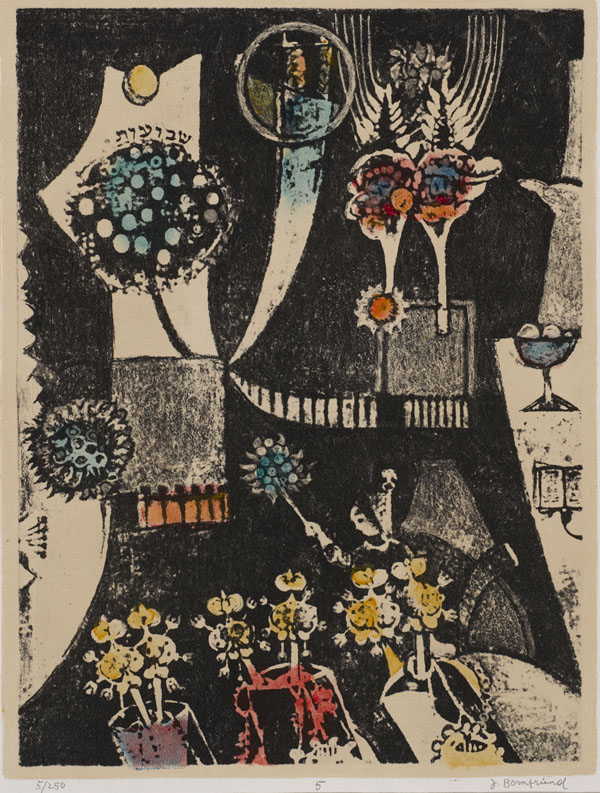
Shavuoth
Series: Jewish Festivals
Artist information
Name Jacob Bornfriend (1904-1976)
Other name Jakub Bauernfreund
Born Zborov, Austria-Hungary (then Czechoslovakia, now Slovakia)
Died London, England
Find more work in the collection by this artist
Find out more about this artist
Graphic artist and painter Jacob Bornfriend (né Jakub Bauernfreund) was born into a Jewish family in Zborov, Austria-Hungary (then Czechoslovakia, now Slovakia) on 25 October 1904. He studied at the Academy of Fine Arts, Prague under the tutelage of Willi Nowak, and developed an expressionistic style. In 1939, forced to flee his homeland after the German occupation, Bornfriend immigrated to Britain, losing much of his work in the process. He settled in London where he mixed with a wide circle of émigré artists including Oskar Kokoschka, which is sometimes termed as the Continental British School of Painting. Bornfriend's work was exhibited at German 'Hitler émigré' Jack Bilbo’s Modern Art Gallery (in existence from 1941–48), as well as the Czechoslovak Institute, London (1945). He also exhibited with the dealers Roland, Browse & Delbanco (1950–54, 1959, 1961, 1964–5) and at Ben Uri Gallery (1974). In 1957 he was commissioned by architect Eugene Rosenberg to design a mural for Jews’ College, London (11 Montagu Square, Marylebone (1954-early 1980s. The college was later sold, and the building now houses the Embassy of Sweden). He subsequently made a series of limited edition lithographs, based on ideas derived from the mural and celebrating Jewish festivals (one set is in the Ben Uri Collection).
By the late 1950s and 60s, Bornfriend had begun to focus on abstracting landscapes and still lifes using simplified, organic shapes in ambiguous space. His work from this period reveals his dialogue with the British abstractionists Patrick Heron and Peter Lanyon. Like these artists, Bornfriend used rhythmic patterns to convey a certain buoyancy of spirit and to capture the 'the dynamism of abundance' which he perceived in the British landscape. Three such abstract compositions were included in the 1963 exhibition entitled 'Eight Contemporary Artists: Carol Burns, Harvey Daniels, Fred Feigl, Alfred Harris, Ben Levene, Fred Uhlman and Archibald Ziegler' at Ben Uri Art Gallery and in 1977 his work was included in the exhibition ‘Six Continental British Artists: Jankel Adler, Marton Bloch, Jacob Bornfriend, Henryk Gotlib, Josef Herman, Zdzislaw Riszkowki' at Campbell & Franks Fine Arts Gallery in London. He also served as a member of Ben Uri's Arts Committee from 1962–68.
Jacob Bornfriend died in London, England on 8 November 1976. His work is represented in UK public collections including the Ben Uri Collection, the Bournemouth & Poole College Collection, the Hepworth Wakefield, Leeds Art Gallery, Southampton City Art Gallery, Tate, and the Victoria Gallery in Liverpool.
Object Details
Date 1957
Object type print
Medium lithograph on paper
Materials and techniques ink (medium) lithography (technique) paper (support)
Unframed 36 x 27 cm
Framed 54 x 46 cm
Signed (lower right): J. Bornfriend
Acquisition presented by the artist
Accession number 1987-53v
Display status not on display
Shavuot, or Shvues, is a Jewish holiday, one of the biblically ordained Three Pilgrimage Festivals. It occurs on the sixth day of the Hebrew month of Sivan; in the 21st century, it may fall anywhere between May 15 and June 14 on the Gregorian calendar. Associated rituals include the reading of the Book of Ruth, special prayer services, decorating homes with flowers and greenery to celebrate this spring festival and the eating of dairy foods. This lithograph, incorporating some of these elements, is one of six celebrating Jewish holidays that developed following Bornfriend's commission to paint a mural for Jews' College London in the 1950s.
Keywords
festival | jewish | Jewish holiday | judaic | print
Selected exhibition history
1974
Bornfriend. Harris
Ben Uri Art Gallery
Literature
Walter Schwab and Julia Weiner, eds., Jewish Artists: the Ben Uri Collection - Paintings, Drawings, Prints and Sculpture (London: Ben Uri Art Society in association with Lund Humphries Publishers Ltd, 1994), p. 30.
Hover mouse cursor over image to zoom (you can also use the mouse wheel).