Ben Uri Collection

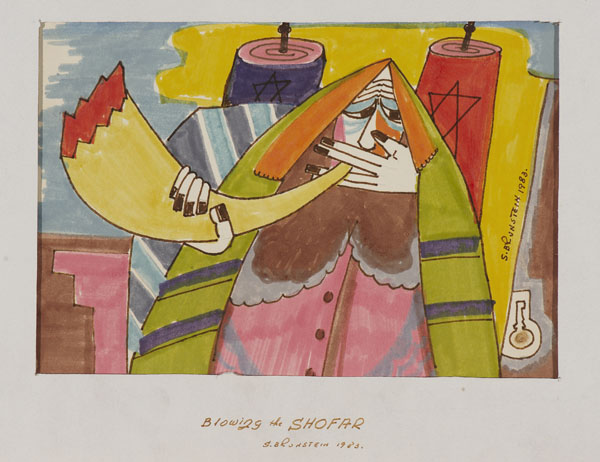
Blowing the Shofar
Artist information
Name Stanislaw Brunstein (1914-1994)
Born Warsaw, Poland
Died London, England
Find more work in the collection by this artist
Find out more about this artist
Stanislaw Brunstein died on 19 October 1994. In the UK his work is held in the Ben Uri Collection and the Imperial War Museum. Stanislaw Brunstein's daughter is the artist Lorna Brunstein. A posthumous exhibition, 'TO LIFE! From Memory to Canvas: celebrating the life and work of Stanislaw Brunstein', was held at Oaks Lane Reform synagogue in 2024.
Object Details
Date 1983
Object type painting
Medium watercolour on paper
Materials and techniques watercolour (medium) painting (technique) paper (support)
Unframed 13.5 x 19.5 cm
Signed and dated (lower right and edge): 'S. Burnstein 1983'
Acquisition presented by the artist 1983
Accession number 1987-55
Display status not on display
Polish-Jewish emigre Stanislaw Brunstein specialised in images depicting the lost world of Polish Jewry, executed in a naive style. This watercolour depicts the act of blowing the shofar (typically made from a ram's horn). This occurs in the synagogue service on Rosh Hashanah, the Jewish New Year, and to mark the completion of the fast at the very end of Yom Kippur, or the Day of Atonement, the holiest day of the Jewish year. It is also blown every weekday morning in the month of Elul running up to Rosh Hashanah. Brunstein shows this as an act of joy, its celebratory nature underlined by the colourful palette.
Keywords
beard | horn | judaic | musical instrument
Literature
TO LIFE! From Memory to Canvas: celebrating the life and work of Stanislaw Brunstein (2024); Walter Schwab and Julia Weiner, eds., Jewish Artists: the Ben Uri Collection - Paintings, Drawings, Prints and Sculpture (London: Ben Uri Art Society in association with Lund Humphries Publishers Ltd, 1994), p. 31.
Hover mouse cursor over image to zoom (you can also use the mouse wheel).
To license this image contact Bridgeman images
Related works
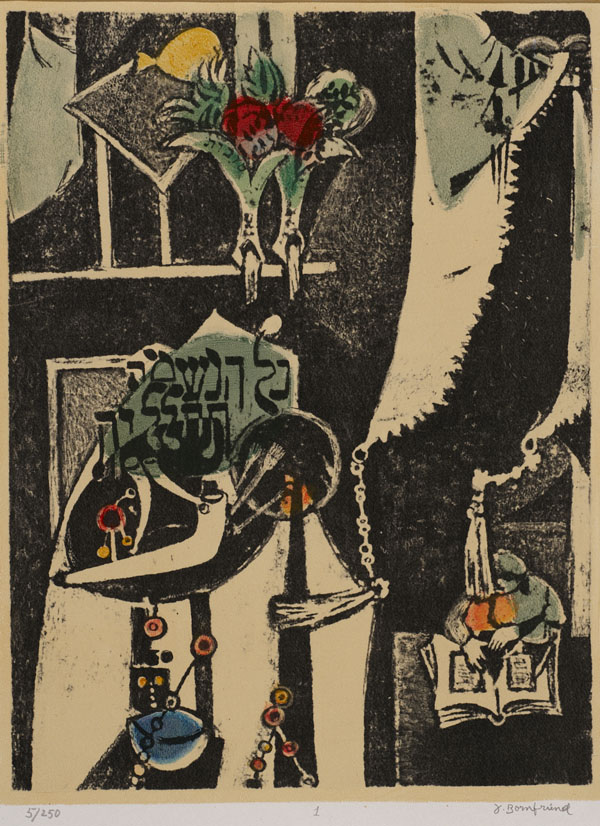
Shofaroth
by Jacob Bornfriend