Ben Uri Collection

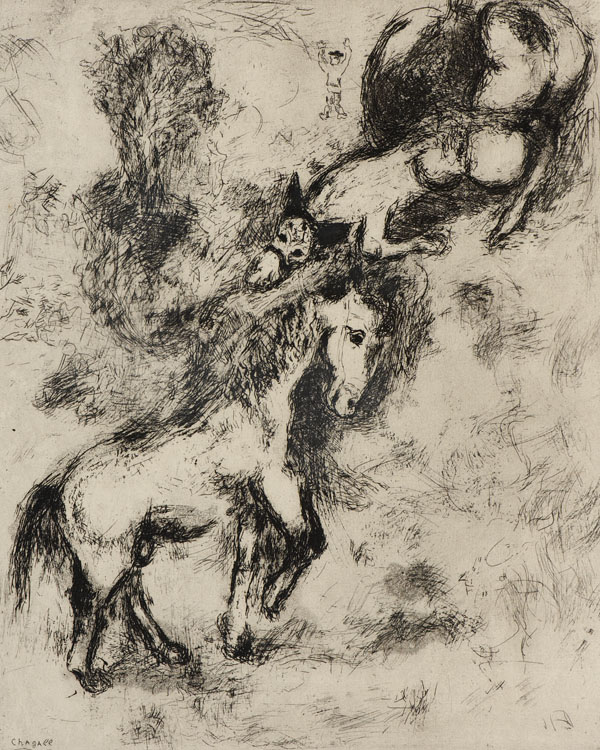
Le cheval et l'âne (The Horse and the Donkey)
Artist information
Other name Moishe Shagal, Moishe Zakharovich Shagalov
Born Vitebsk, Russia (now Belarus)
Died Saint Paul de Vence, France
Find more work in the collection by this artist
Find out more about this artist
Artist Marc Chagall was born into a Jewish family in the town of Vitebsk, Russia (now in Belarus) on 7 July 1887. He attended a traditional Jewish school and a Russian high school, moving to St Petersburg in 1907, where he studied at the Imperial School for the Protection of the Fine Arts, and later at the Zvantseva School, led by Léon Bakst. In May 1911, Chagall arrived in Paris, where he enrolled at the Académie de La Palette and settled at La Ruche (the Beehive) studios in Montparnasse, mixing with other Jewish immigrant artists, subsequently known as the Ecole de Paris juifs, including Modigliani and Chaïm Soutine, as well as key figures in French modernism, among them Guillaume Apollinaire and Robert Delaunay. Chagall frequently used animals for symbolic purposes in his dream-like paintings that brought together aspects of French tradition with Russian folklore and Jewish motifs. His first solo exhibition took place at Der Sturm Gallery in Berlin, in 1914 and he returned to Russia to visit his family the same year. During his visit, the outbreak of the First World War prevented his return to Paris and following the 1917 Bolshevik Revolution, he was appointed Fine Arts Commissar for the province of Vitebsk. In 1922 he left again for Berlin, where his work was published by the periodical Der Sturm.
In 1923 Chagall returned to Paris, where he stayed until 1940, becoming a French citizen in 1937. He visited Palestine in 1931. Following the German occupation in May 1940, Chagall and his wife Bella remained in 'Vichy France', until one year later, with help from Alfred Barr of the New York Museum of Modern Art (who added Chagall’s name to that of prominent artists and intellectuals at risk), the American journalist Varian Fry and American Vice-Consul in Marseilles, Hiram Bingham IV, the Chagalls escaped to the USA on forged visas. They found refuge in New York, where Chagall remained for the rest of the war, however, after Bella's sudden death in September 1944, Chagall plunged into mourning and stopped painting until the following April when news of the Holcaust breaking through pathé newsreels compelled his artistic response. In 1946 a major Chagall retrospective was held at The Museum of Modern Art; he remained in America for a further two years before returning to France in 1948, and settling in the south-eastern town of Saint-Paul-de-Vence in 1952. In later life, Chagall produced the windows for the synagogue of the Hadassah Medical Centre in Jerusalem depicting the Twelve Tribes of Israel. He also accepted commssions for stained-glass schemes for the cathedrals of Reims and Metz, the Peace Window for the UN in New York (1963-64), and the windows in memory of Sarah d'Avigdor-Goldsmid at Tudeley chapel in Kent (1968-85). Marc Chagall died in Saint-Paul-de-Vence, France on 28 March 1985. The Musée National Marc Chagall is in Nice and his work is in international collections all over the world including the Museum of Modern Art, New York; Musée National d'Art Moderne, Centre Pompidou, Paris; the Philadelphia Museum of Art; Stedelijk Museum, Amsterdam; Musée d'Art et d'Histoire du Judaïsme, Paris; and in the UK, the Ben Uri Collection, and the Tate, London.
Object Details
Date 1952
Object type print
Medium etching on paper
Materials and techniques ink (medium) etching (technique) montval paper (support)
Unframed 29.5 x 23.5 cm
Framed 48.5 x 40.5 cm
Signed (lower left): 'Chagall'
Acquisition presented by Ralph N. Emanuel 1987
Accession number 1987-63
Display status not on display
Le Cheval et l’âne (The Horse and the Donkey) belongs to a series of works which the dealer Ambroise Vollard comissioned Chagall to produce in 1926 to illustrate the French seventeenth-century poet La Fontaine’s famous Fables. The commission caused much controversy, as commentators asked why a Russian Jew, a foreigner to French culture, should be selected to illustrate a classic of French literature. Vollard responded that Chagall’s aesthetic had something akin to La Fontaine’s: it was ‘at once sound and delicate, realistic and fantastic’. Chagall frequently used animals for symbolic purposes bringing together aspects of French tradition and Russian folklore in dream-like settings. Here, a horse and a donkey are shown out of perspective with a despairing farmer behind them: the horse after refusing to share the donkey’s heavy load must now carry his dead companion. The cycle was completed by 1927 and the works (in gouache) were sold on to the dealer Bernheim-Jeune, who showed them in a highly successful exhibition in February 1930, which travelled on to the Flechtheim Gallery in Berlin; every work was sold. The illustrations were not printed in book form during Vollard's lifetime however owing to technical difficulties; Chagall made a number of etchings in 1939, completing them in 1952. This etching is included in the two-volume edition of the Fables, "Fables, Eaux-fortes originales de MARC CHAGALL", published by Tériade in February 1952, followed by an exhibition of the etchings at the Galeries Maeght in Paris in March.
Selected exhibition history
1989
Prints and Drawings from the Permanent Collection
Ben Uri Art Gallery
2012
Chaim Soutine and his Contemporaries - from Russia to Paris and School of London works from the Ben Uri Collection
Ben Uri Gallery
2013
Chagall, Soutine and the School of Paris: touring exhibition
Manchester Jewish Museum
2018
Exodus: masterworks from the Ben Uri Collection
Bushey Museum
Literature
Rachel Dickson and Sarah MacDougall, eds., Ben Uri: 100 Years in London - Art, Identity, Migration (London: Ben Uri Gallery, 2015), p. 67 (illus.); Sarah MacDougall ed., Soutine and his Contemporaries - from Russia to Paris (London: Ben Uri Gallery, 2012) p. 18; Walter Schwab and Julia Weiner, eds., Jewish Artists: the Ben Uri Collection - Paintings, Drawings, Prints and Sculpture (London: Ben Uri Art Society in association with Lund Humphries Publishers Ltd, 1994), p. 33
Hover mouse cursor over image to zoom (you can also use the mouse wheel).