Ben Uri Collection

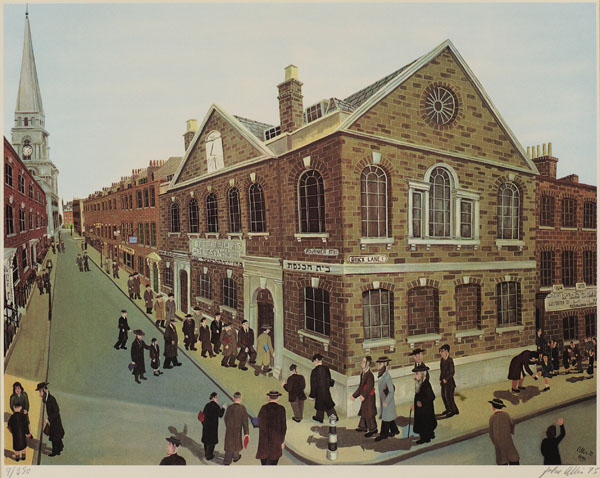
Spitalfields Great Synagogue
Series: East End Series
Artist information
Born London, England
Died London, England
Find more work in the collection by this artist
Find out more about this artist
Painter John Allin was born in the East End of London, England in 1934. He showed artistic talent as a child but joined the Merchant Navy when still in his teens and travelled the world; served in the army in North Africa during National Service, then worked in a variety of jobs including in a park planting trees, then as a swimming pool attendant and finally, as a long-distance lorry driver. While serving a six-month prison sentence he began to paint, afterwards he devoted himself entirely to his artistic career, mentored by the artist Sotirakis Charalambou, who remarked, 'I never taught him because I don’t believe in teaching but I encouraged him, I thought he was extremely talented and it was just a question of finding the confidence in his talent' (The Gentle Author, interview with Sotirakis Charalambou on the ‘Spitalfields Life’ website, 17 July 2017, cited Gerrish Fine Art).
Allin drew deeply on his memories of the communal life of the East End in which he had been raised, then home to a thriving Jewish community. In 1969 he had his first exhibition at the Portal Gallery, and in 1979 he was the first British artist to win the international Prix Suisse Du Peinture Naïve award, making his mark within what is today considered the Folk/Outsider Art movement in Britain. Allin's paintings evoke mood and memory, particularly of the East End, such that he was often referred to as the ‘London Lowry’ or the ‘Pied Painter of Hackney’. Later in life, he spent three years with a circus team producing a series of paintings based on circus life. His first book, 'Say Goodbye: You May Never See Them Again' (1974), was produced with Stepney-born Jewish playwright Arnold Wesker, who also introduced Allin's series of eight Stepney prints.
John Allin died in London, England in 1991. His work is in UK public collections including the Ben Uri Collection, which holds a complete set of his Stepney prints, and the Jewish Museum London.
Object Details
Date 1975
Object type print
Medium lithograph on paper
Materials and techniques ink (medium) lithography (technique) paper (support)
Unframed 48 x 60 cm
Framed 66.5 x 77.5 cm
Signed and dated (lower left): John Allin 75
Acquisition presented by Mr Jonathan Stone 1982
Accession number 1987-6v
Display status not on display
Situated on the corner of Brick Lane and Fournier Street, the former Spitalfields Great Synagogue reflects the fluidity of migration to the East End: originally a church for Huguenot refugees, then a Wesleyan Chapel, as the Machzikei Hadath community synagogue, it observed strict orthodox standards of religious worship: Allin’s male congregants, dressed in shtreimels and wearing side curls, typify the largely Eastern European Jewish community it served until 1952 (it is now a mosque for the Bangladeshi muslim community). Neighbouring Brick Lane also housed a school for Jewish children to learn Hebrew; while beyond Fournier Street, looms the ever commanding tower of Christ Church, Spitalfields.
Keywords
architecture | East End | Jewish | London | mosque | print | religious | Spitalfields | street scene | synagogue | urban
Selected exhibition history
2000
Jewish East End Collections and Recollections: From Shtetl to City
The Manor House
2016
Unexpected: continuing narratives of identity and migration
Ben Uri Gallery
2018
Exodus: masterworks from the Ben Uri Collection
Bushey Museum
Literature
Walter Schwab and Julia Weiner, eds., Jewish Artists: the Ben Uri Collection - Paintings, Drawings, Prints and Sculpture (London: Ben Uri Art Society in association with Lund Humphries Publishers Ltd, 1994), p. 18.
Hover mouse cursor over image to zoom (you can also use the mouse wheel).