Ben Uri Collection

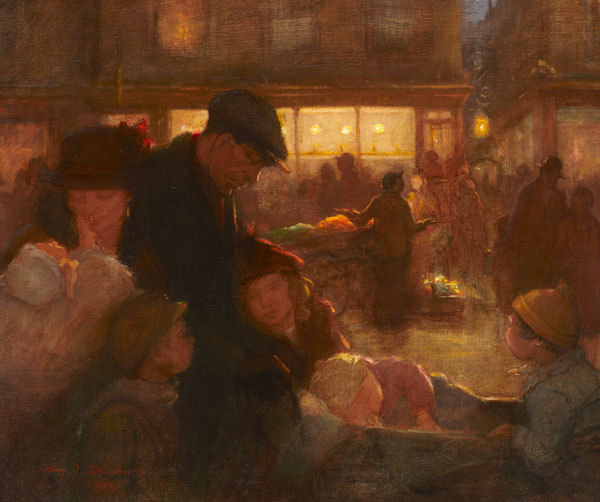
For He Had Great Possessions
Artist information
Other name Amy Drukker, Amy J. Drucker
Born London, England
Died London, England
Find more work in the collection by this artist
Find out more about this artist
Painter, etcher, miniaturist, lithographer, woodcut engraver and teacher Amy Julia Drucker was born in Hampstead, London, England in 1873 to German-Jewish émigré parents. She trained at St John’s Wood and Lambeth Schools of Art, then maintained a studio in Bloomsbury. Her first major commission was from Queen Mary for an ivory miniature of Henry, the young Duke of Gloucester in 1904. She later studied sculpture at the Central School (where she befriended younger artist Clare Winsten (née Birnberg), c. 1910. Afterwards, she also lived in Paris, where she completed her training at the Académie Colarossi and exhibited at the Paris Salon. She exhibited extensively both in Britain and abroad throughout her career in groups shows including at the Royal Academy (1899-1946), the Whitechapel Art Gallery (1906 and 1914), the Royal Glasgow Institute (1907), the Royal Hibernian Academy (1936), and Ben Uri Gallery (1937), as well as with the Society of Women Artists (1908-30) and the Women’s International Art Club (1940). She became known for her portraits and genre scenes including atmospheric paintings of London (particularly East End Coster) life. During the First World War she served in the Land Army and her works included a multi-figure painting entitled 'Air Raid Shelter' (1916, Russell-Cotes Art Gallery & Museum).
Afterwards she travelled extensively, spending several months in Palestine in 1920, India in 1922 (where she taught Japanese colour printing in Calcutta (Kolkata), travelling to and from the Far East, 3rd class on the Trans-Siberian railway in 1925 (an experience she wrote up in the Manchester Guardian), to South America, where she depicted peasants and local subjects, and to Abyssinia (Ethiopia), where she was commissioned to paint a life-size portrait of the Emperor, H. M. Haile Selassie. In 1932 she spoke on national radio about her 'wanderings' in Palestine and China. She held solo exhibitions in Jerusalem, Shanghai, Peking, Buenos Aires, Lima, and Panama, and at the Jerusalem School of Art, as well as taking private pupils in London. In 1927 her work was included in the Exhibition of Jewish Art & Antiquities at the Whitechapel Art Gallery in London. During the Second World War she worked as a factory hand and night-watchman.
Amy Drucker died in London, England in November 1951. In 1952 a memorial exhibition was held at Ben Uri Gallery, where a bi-annual prize (of £10) was twice awarded in her memory to a promising young Jewish artist: Henry Sanders (1952) and Alfred Harris (1954). Her work is in UK public collections including the Ben Uri Collection, Royal Holloway (the University of London), Royal Pavilion & Museums Trust (Brighton & Hove) and the Russell-Cotes Art Gallery & Museum, as well as in collections in China, South America and Israel.
Object Details
Date 1932
Object type painting
Medium oil on canvas
Materials and techniques oil (medium) painting (technique) canvas (support)
Unframed 48 x 59 cm
Framed 64.5 x 75.5 cm
Signed and dated (lower left): 1932
Acquisition presented by Dr Geoffrey Konstam 1952
Accession number 1987-76
Display status not on display
Following strong sales from Amy Drucker's 1952 memorial exhibition at Ben Uri Gallery, the Ben Uri Arts Committee (7 April 1952) decided to purchase 'For He Had Great Possessions'; however, the work was instead acquired and presented by Dr Geoffrey Konstam (a patron of Alfred Wolmark).
The painting draws on Drucker's enduring motifs. In 1906 she had exhibited a well-received painting, entitled 'The Aliens' at the Whitechapel Art Gallery’s 'Jewish Art and Antiquities' exhibition, which had been largely conceived in response to the 1905 ‘Aliens Act’ (designed to limit foreign immigration rights). 'For He had Great Possessions', is possibly a later reworking of The Aliens, and perhaps depicts a family newly-arrived in England, seeking work and shelter. This single family unit is emblematic of the vast wave of eastern-European Jews escaping persecution and financial hardship who fled to Britain before, during and after the Second World War. However, the date also suggests that they are economic migrants, victims of the 1930s ‘slump’ and the presence of a barrow boy locates the picture in London's East End, where Drucker painted many studies of the local costers. The family's clothing also suggests that they may be locals, rather than refugees. The title invokes the biblical story in which a man refuses to part with his earthly riches in exchange for spiritual enlightenment, the subject of a well-known single figure painting by G. F. Watts (1894, Tate). However, Drucker’s painting suggests that although the father is not materially wealthy, the members of his family are nonetheless his ‘great possessions’.
An earlier version of this composition, known as Family Portrait in Market, was exhibited at the Royal Academy in 1914 under the title A Street Market, Whitechapel. The market is believed to have been held in Marchment Street, Whitechapel.
Selected exhibition history
1952
Memorial Exhibition of Works by Amy J. Drucker
Ben Uri Art Gallery
1954
Exhibition of Jewish Art
Hove Museum of Art
1956
Jewish Artists in England 1656-1956: A Tercentenary Exhibition
Whitechapel Art Gallery
1960
Selections from the Permanent Collection
Ben Uri Art Gallery
1980
Exhibition of Selected Works from the Permanent Collection of the Ben Uri Art Gallery
Ben Uri Gallery
2009
Homeless & Hidden 1: World Class Collection Homeless & Hidden
Ben Uri Gallery
2015
Out of Chaos – Ben Uri: 100 Years in London
Somerset House
2016
Out of Chaos: Touring exhibition
Laing Art Gallery
2018
Exodus: masterworks from the Ben Uri Collection
Bushey Museum
2023
“Sheer Verve”: The Women's International Art Club 1898–1978
Ben Uri Gallery
Literature
Rachel Dickson and Sarah MacDougall, eds., 'Out of Chaos: Ben Uri; 100 Years in London' (London: Ben Uri Gallery, 2015) pp. 72-73; Oil Paintings in Public Ownership in Camden (London: The Public Catalogue Foundation, 2013), p.12 (illus. included); Walter Schwab and Julia Weiner, eds., Jewish Artists: the Ben Uri Collection - Paintings, Drawings, Prints and Sculpture (London: Ben Uri Art Society in association with Lund Humphries Publishers Ltd, 1994), p. 37; Annual Report 1951-1952.
Hover mouse cursor over image to zoom (you can also use the mouse wheel).