Ben Uri Collection

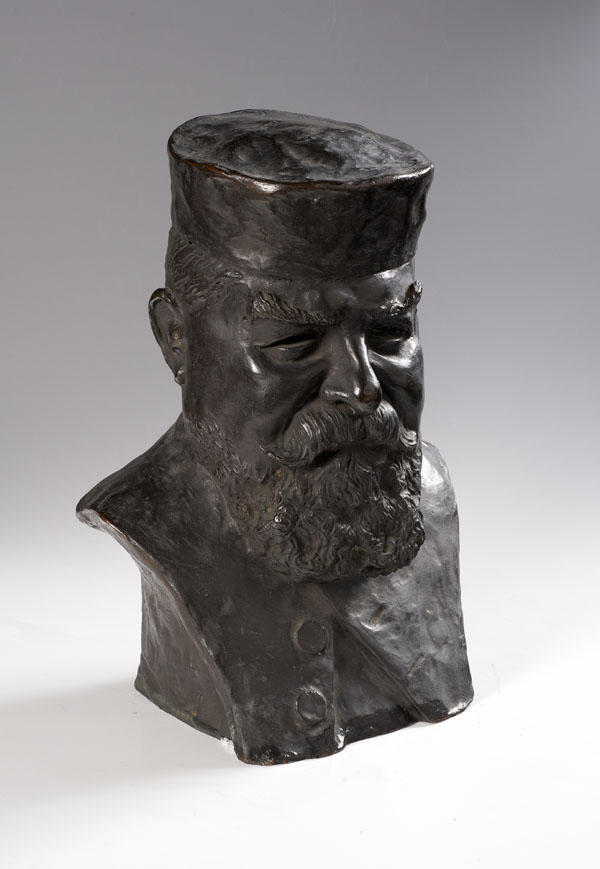
Chief Rabbi Dr J.H. Hertz
Artist information
Born Dortmund, Germany
Died London, England
Find more work in the collection by this artist
Find out more about this artist
Sculptor Benno Elkan was born into a Jewish family in Dortmund, Germany on 2 December 1877, and studied languages in Lausanne before becoming a merchant in Antwerp. He moved to Munich to study painting at the Academy, then to Karlsruhe to study sculpture, before visiting Paris, where he encountered Rodin and Matisse, and belonged to the circle of German artists who met at the Café du Dôme; he was introduced to Alfred Flechtheim and other French sculptors including Albert Bartholomé and Antoine Bourdelle, and painter Jules Pascin. Afterwards Elkan also lived in Rome. He married the daughter of a Rabbi, pianist Hedwig Einstein, and they later moved to Frankfurt am Main with their children. Following Hitler's accession to the Chancellorship and the introduction of anti-Semitic legislation, the couple immigrated to London in 1933 and Elkan's work was included in his absence in the notorious 'Entartete Kunst' ('Degenerate Art') exhibition launched in Munich in July 1937. Two of his sculptures were also included in the 'Exhibition of German-Jewish Artists' Work: Painting, Sculpture, Architecture' (5–15 June 1934) organised at the Parsons Gallery, London by German-Jewish émigré dealer, Carl Braunschweig (later Charles Brunswick) to support artists suffering persecution under the Nazi regime. In 1938-39 the Ben Uri Chairman's report noted that Elkan, many of whose public monuments had been destroyed by the Nazis, had given a talk at the society on 'Conception and Style in Sculpture' in June 1939. Elkan first showed in a mixed exhibition of works by Jewish artists at Ben Uri Gallery in 1935 (and subsequently in 1944, 1947, 1949, 1950, 1951, 1956, 1960, 1962 and 1983); he also showed three works (heads of Prince Edward, Toscanini and the German-Jewish art dealer, Alfred Flechtheim) in the 'Exhibition of Twentieth Century German Art' in July 1938 at the New Burlington Galleries in London, designed as a riposte to the Nazi 'Degenerate Art' show. Postwar, Elkan was also involved with the Ben Uri Arts Committee.
He exhibited regularly at the Royal Academy (1934-1956), and had a one-man show at Knoedler's Galleries in New York in 1936. Elkan created the first statue in Britain of Sir Walter Raleigh, and designed Frankfurt’s Great War Memorial, which included mourning mothers as a symbol of loss in the First World War (removed by the Nazis in 1933, it was re-erected in 1946). His bust of Flechtheim was shown in Ben Uri's Spring exhibition in 1947. Elkan's sculpture included lifelike busts of recognised artists and politicians including Lord Keynes, Winston Churchill, Lord Samuel, James de Rothschild, Claude Montefiore, and Chaim Weizmann (on his 75th birthday), but he also created works deriving from religious stimuli; the Knesset Menorah in Jerusalem features engravings of biblical themes and significant events from the history of the Jewish people. His Old Testament and New Testament Candelabra incorporating around 80 figures, were donated by Arthur Hamilton Lee (1868–1947) to Westminster Abbey in 1939 and 1942. In 1950 he had a solo exhibition at Wildenstein & Co. in London.
Benno Elkan died in London, England on 10 January 1960. His work is held in UK collections including the Ben Uri Collection, Emmanuel College, University of Cambridge; New College, University of Oxford; The Courtauld, London; and the Parliamentary Art Collection, as well as in Dortmund, Düsseldorf, Hamburg, Beverly Hills, Copenhagen, The Hague, and Rome.
Object Details
Date 1933
Object type sculpture
Medium bronze
Materials and techniques bronze (medium) sculpture (technique)
Dimensions 42 x 32 x 22 cm
Acquisition on permanent loan from Rabbi Dr Solomon Schonfeld 1951
Accession number 1987-80
Display status not on display
Elkan’s sculpture includes both lifelike busts of well-known artists and politicians and work on religious themes. Both interests are combined in this portrait of Slovakian-born émigré Dr. Joseph Herman Hertz (1872–1946), Chief Rabbi of the British Empire from 1914-46, one of the foremost spiritual leaders of Jewry, and a dedicated Zionist. (Hertz's daughter Judith married Rabbi Solomon Schonfeld (1912–1984), who owned the work, and was responsible for saving thousands of Jewish lives during the Holocaust, in 1940).
The sculpture was created in 1933, the year that Elkan arrived in England. He also carved stone and marble, but worked mostly in bronze and precious metals. He was a successful portraitist, portraying many leading figures of the day including the émigré art dealer Alfred Flechtheim and Winston Churchill.
Selected exhibition history
1951
Festival of Britain, Anglo-Jewish Exhibition 1851-1951
Ben Uri Art Gallery
1954
Exhibition of Jewish Art
Hove Museum of Art
1956
Jewish Artists in England 1656-1956: A Tercentenary Exhibition
Whitechapel Art Gallery
1960
Selections from the Permanent Collection
Ben Uri Art Gallery
2009
Homeless & Hidden 1: World Class Collection Homeless & Hidden
Ben Uri Gallery
2017
Refugees: The Lives of Others - German Refugee Artists to the UK
Ben Uri Gallery and Museum
2017
Entartete Kunst (“Degenerate Art”) Remembered
Ben Uri (Online)
2024
German Expressionists & the Third Reich
Holt Festival Exhibition
Literature
Walter Schwab and Julia Weiner, eds., Jewish Artists: the Ben Uri Collection - Paintings, Drawings, Prints and Sculpture (London: Ben Uri Art Society in association with Lund Humphries Publishers Ltd, 1994), p. 37.
Hover mouse cursor over image to zoom (you can also use the mouse wheel).
To license this image contact Bridgeman images