Ben Uri Collection

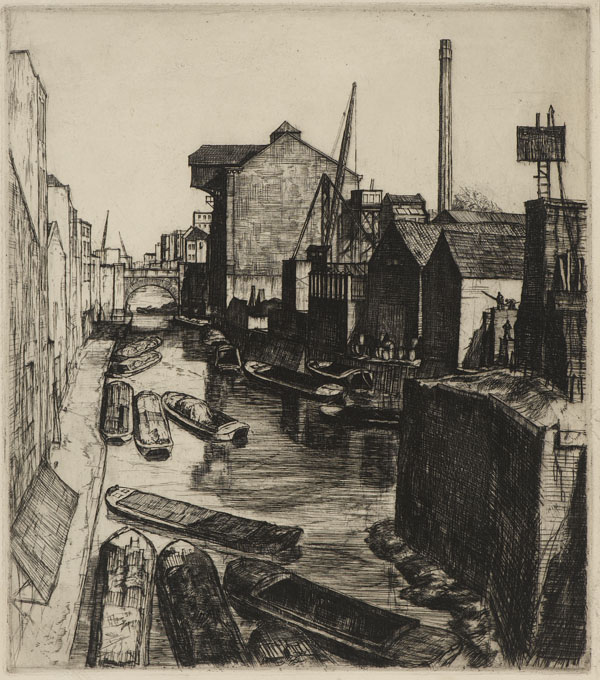
Limehouse Cut
Artist information
Name Naphtali Kornbluth (1914-1997)
Other name Nathaniel
Born London, England
Died London, England
Find more work in the collection by this artist
Find out more about this artist
Draughtsman and etcher Napthali (also known as Nathaniel) Kornbluth was a second-generation immigrant, born to orthodox Polish-Jewish parents in London's East End on 25 October 1914. Owing to parental opposition to his chosen career as an artist, he worked in the wholesale menswear ‘rag’ trade during the day, while studying art at evening classes variously at Hackney Technical School (1933), the Central School of Arts and Crafts (1934-7), under W. P. Robbins, Paul Drury and James Fitton, where he specialised in etching, and at the Cass School of Art in the 1970s. He participated in mixed exhibitions at the East End Academy at the Whitechapel Art Gallery from the 1930s. Much of Kornbluth’s subject matter was inspired by his own neighborhood, often featuring the hidden canals and industrial riversides and docklands of east London. In a review of the 1936 East End Academy exhibition, the Jewish Chronicle noted that the ‘Black and whites are dominated by two very fine etchings by N. Kornbluth – 'Waterloo Bridge Demolition’ (No. 263) and ‘Regent's Canal Dock’ (No. 266). The heavy masses of the former are carefully observed from a well-chosen angle, and in the latter he achieves the same sense of ‘body’ with clarity and lightness’ (S. 1936, p. 10). Examples of both are in the British Museum (which houses 26 etchings in total) and a different iteration of Regent's canal is in the Ben Uri Collection. In 1939 Kornbluth also etched the return of the International Brigade of men and women who fought fascism in Spain between 1936 and 1939, among them was one of his childhood friends. He exhibited with Ben Uri Gallery over a forty year period, from the Annual Exhibition of Works by Jewish Artists (1935, 1936, 1937) to the annual open exhibitions in the 1970s (1970, 1973, 1974). Kornbluth had solo exhibitions at Campbell & Franks (1980), Sir John Cass (1986), and the Lamont Gallery (1988).
Napthali Kornbluth died in northwest London, England on 18 April 1997. His work is held in public collections including the Ben Uri Collection, the British Museum, The Guildhall Library, the National Maritime Museum, the Bibliothèque Nationale, in Paris, and the New York City Library.
Object Details
Date 1935-36
Object type print
Medium etching on paper
Materials and techniques ink (medium) etching (technique) paper (support)
Unframed 14.6 x 18.7 cm
Framed 25.9 x 31.5 cm
Acquisition presented by the artist
Accession number 1987-81
Display status not on display
Much of Naphtali Kornbluth’s subject matter was inspired by the East End neighbourhood in which he was born and raised, and often features the hidden canals and industrial riversides of east London. This etching depicts Limehouse Cut, a canal which historically linked the lower reaches of the Lee Navigation to the River Thames, and currently connects Lee Navigation to the Limehouse Basin. The work was admired, together with another etching of Regent's Canal Dock, as 'noteworthy local studies' by the art critic of East End News and London Shipping Chronicle (Friday, 11 June 1937) when displayed at the Ben Uri Gallery's Annual Exhibition of Works by Jewish Artists in June 1937. Kornbluth’s intricately executed etching of Limehouse Cut in the 1930s, with its shipyards and barges, is part of an invaluable record of the historical London riverside industry.
Selected exhibition history
1937
Annual Exhibition of Works by Jewish Artists
Ben Uri Jewish Art Gallery
Literature
East End News and London Shipping Chronicle, Friday, 11 June 1937; Walter Schwab and Julia Weiner, eds., Jewish Artists: the Ben Uri Collection - Paintings, Drawings, Prints and Sculpture (London: Ben Uri Art Society in association with Lund Humphries Publishers Ltd, 1994), p. 60.; ed., The Gentle Author, 'East End Vernacular: Artists who painted London's East End streets in the 20th Century' (London: Spitalfields Life Books, 2017), p. 17.
Hover mouse cursor over image to zoom (you can also use the mouse wheel).