Ben Uri Pre-Eminent Collection

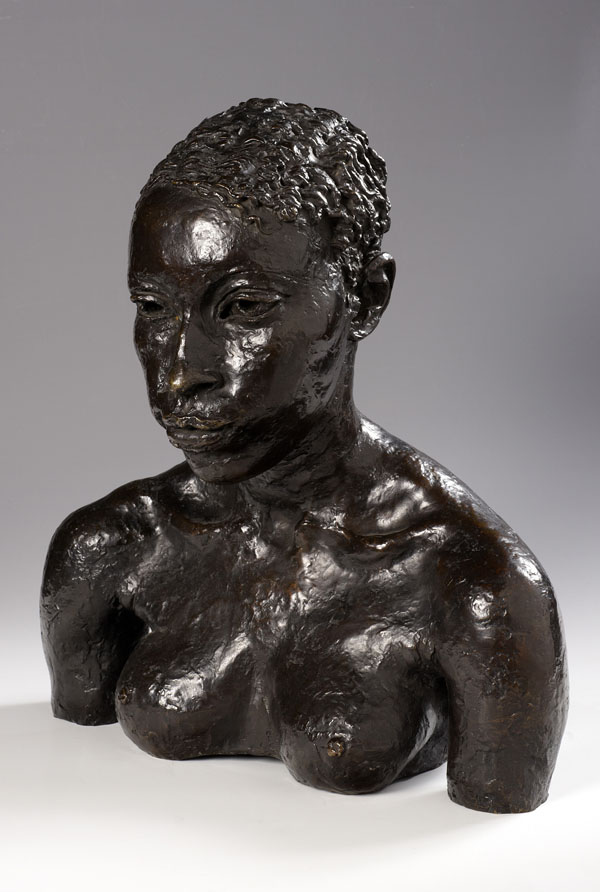
Lydia (aka Second Portrait of Lydia)
Artist information
Name Jacob Epstein (1880-1959)
Born New York, USA
Died London, England
Find more work in the collection by this artist
Find out more about this artist
Sculptor Jacob Epstein was born into a relatively prosperous family of Russian/Polish-Jewish immigrants in New York City, USA on 10 November 1880, but as a teenager rejected the Orthodoxy of his upbringing. From 1893–98 he attended classes at the Art Students' League and was inspired by the multicultural communities around him. After spending the winter of 1899–1900 cutting ice in New Jersey, he turned to sculpture, working in a bronze foundry (1901–2). On the proceeds of his first professional commission to illustrate Hutchins Hapgood’s The Spirit of the Ghetto (1902), he sailed to Europe. In Paris he studied at the École des Beaux-Arts (1902–3) and the Académie Julian (1903–4), sharing the appreciation of artists including Picasso and Modigliani, for Indian and West African art traditions.
Epstein moved to London in 1905 and in 1907 he received his first major British commission, creating 18 nude sculptures for the facade of the British Medical Association Building (now Zimbabwe House) on the Strand. This commission, like many of Epstein’s other early works, was highly controversial and criticised as indecent. Epstein’s second public commission to carve Oscar Wilde’s tomb for Père Lachaise cemetery, Paris (completed in 1912), directly inspired by Assyrian sculpture in the British Museum, abandoned the conventional figure and proved equally controversial. A champion of direct carving, he was also associated with the short-lived Vorticist group, co-curated the so-called 'Jewish Section' at the Whitechapel Art Gallery's 'Review of Modern Movements', with David Bomberg in 1914, and was a co-founder of the London Group. During the First World War, Epstein was conscripted into the Jewish 38th battalion of the Royal Fusiliers in 1917 but was discharged, without seeing active service following a breakdown in 1918.
Epstein's work often challenged prevailing notions of sexuality and beauty and favoured the non-European model. He had solo shows at the Leicester Galleries in 1917, 1920, 1924, 1939 and 1950, a retrospective at Tate in 1952. His public commissions continued to attract controversy including the carved relief Rima (1924–5, Hyde Park), a memorial to the naturalist and author W. H. Hudson, and the monumental figure groups, Night and Day (1928–9), for Charles Holden's London Underground headquarters, and later monumental carvings including Genesis (1930), Ecce Homo (1934–35), and his autobiographical Jacob and the Angel (1940-41, Tate). However, his portrait heads, usually cast in bronze, were always in demand. Epstein also painted in watercolour and gouache, and his scenes of Epping Forest were frequently exhibited in Leicester Galleries, London. He exhibited in group shows at Ben Uri Gallery from 1934 onwards, and was Patron of the Ben Uri art Society in 1936–37. During the Second World War was commissioned by the War Artists’ Advisory Committee to execute six portrait busts including one of Winston Churchill. Epstein was knighted in 1954.
Epstein completed his large bronze Bowater House group for Edinburgh Gate, Knightsbridge (1958–9) on the day that he died in London, England on 21 August 1959; he was buried in Putney Vale cemetery. A posthumous exhibition of bronzes was held at Ben Uri Gallery in November 1959. In 1980, his centenerary year, restropsectives were held at Ben Uri Gallery, Birmingham Museum & Gallery and Tate. More than 300 of his works are in UK public collections including the Ben Uri Collection, the National Portrait Gallery, Tate and the V&A.
Object Details
Date 1931
Object type sculpture
Medium bronze
Materials and techniques bronze (medium) sculpture (technique)
Dimensions 49.7 x 44.4 x 26 cm
Acquisition bequest of Ethel Solomon 1985
Accession number 1987-88
Display status not on display
Lydia, a jazz singer and/or dancer, was working as a waitress at Epstein’s favourite Chinese restaurant in London’s Wardour Street when they met. Epstein made three busts of her between 1929 and 1934: the first, head-and-shoulders portrait in bronze with a green patina (1929-30), in which Lydia has bobbed hair; this second, bronze head-and-shoulders portrait (1931) with short hair; and a third bronze (head only) entitled 'Lydia (laughing' (1934), with bobbed hair. This version was exhibited in Epstein's solo exhibition at the Leicester Galleries in 1933.
Selected exhibition history
1933
Carvings and Bronzes by Jacob Epstein
Leicester Galleries
1945
Autumn Exhibition of Paintings, Sculptures and Drawings by Contemporary Jewish Artists
Ben Uri Art Gallery
1956
Fortieth Anniversary Exhibition: Selected Works by Artists Exhibited over the Past Forty Years
Ben Uri Art Gallery
1959
Sir Jacob Epstein: Exhibition of Bronzes
Ben Uri Art Gallery
2004
The Modern and the New: An Examination of the Permanent Collection alongside New Works by Invited British, European and American Jewish Artists
Ben Uri Gallery - The London Jewish Museum of Art
2006
Embracing the Exotic: Jacob Epstein & Dora Gordine
Ben Uri Gallery - The London Jewish Museum of Art
2009
Homeless & Hidden 1: World Class Collection Homeless & Hidden
Ben Uri Gallery
2009
Dora Gordine: Sculptor, Artist, Designer Exhibition
Dorich House Museum, Kingston University
2010
Apocalypse: unveiling a lost masterpiece by Marc Chagall and 50 selected masterworks from the Ben Uri Collection
Osborne Samuel
2016
Unexpected: continuing narratives of identity and migration
Ben Uri Gallery
2017
The Poetry of the Real
Beaux Arts Gallery
2019
Mark Gertler: Paintings from the Luke Gertler Bequest & Selected Important UK Collections
Ben Uri Gallery
2021
Becoming Gustav Metzger: Uncovering the Early Years, 1945-59
Ben Uri Gallery & Museum
2024
The Decorative Fair
Evolution London
2024
US: From There to Here - Britain's Gain
Ben Uri Gallery and Museum
2025
Sculptures from the Ben Uri Museum
Gallery One, Thirsk Hall Sculpture Garden
2025
Born in the USA: USA to UK - American Immigrant Artists' Contribution to British Visual Culture since 1900 from the Ben Uri Collection
Ben Uri Gallery
Literature
Arnold Haskell and Jacob Epstein, The Sculptor Speaks - Jacob Epstein to Arnold L. Haskell a series of conversations on art (London: William Heinemann Ltd, 1931), p. 191; Carvings and Bronzes by Jacob Epstein, May, 1933, Leicester Galleries, London (exhibition catalogue); Robert Black, The Art of Jacob Epstein (New York: World Publishing Company, 1942 p. 238; Autumn Exhibition of Paintings, Sculptures and Drawings by Contemporary Jewish Artists, Ben Uri Art Gallery, 1945, cat. no. 78A (exhibition catalogue); Fortieth Anniversary Exhibition: Selected Works by Artists Exhibited over the Past Forty Years, Ben Uri Art Gallery, 1956, cat. no. 27 (exhibition catalogue); Sir Jacob Epstein 1880–1959: Exhibition of Bronzes, Ben Uri Art Gallery, 1959, cat. no. 14 (exhibition catalogue); Richard Buckle, Jacob Epstein: Sculptor (London: Faber and Faber, 1963), p. 183, pl. 276; Evelyn Silber, The Sculpture of Epstein, with a complete catalogue (Oxford: Phaidon Press, 1986), pp. 42 and 169, cat 209, illus.; Walter Schwab and Julia Weiner, eds., Jewish Artists: the Ben Uri Collection - Paintings, Drawings, Prints and Sculpture (London: Ben Uri Art Society in association with Lund Humphries Publishers Ltd, 1994), p. 38; Sarah MacDougall and Rachel Dickson, Embracing the Exotic: Jacob Epstein and Dora Gordine (London: Ben Uri Gallery/Papadakis Publishing, 2006), pp. 10, 12 & 62, cat. no. 22, illus., p. 10 (exhibition catalogue); Jonathan Black, Dora Gordine: Sculptor, Artist, Designer (London: Philip Wilson Publishers, 2008), p. 76, illus., fig. 17.
Hover mouse cursor over image to zoom (you can also use the mouse wheel).
To license this image contact Bridgeman images
Related works
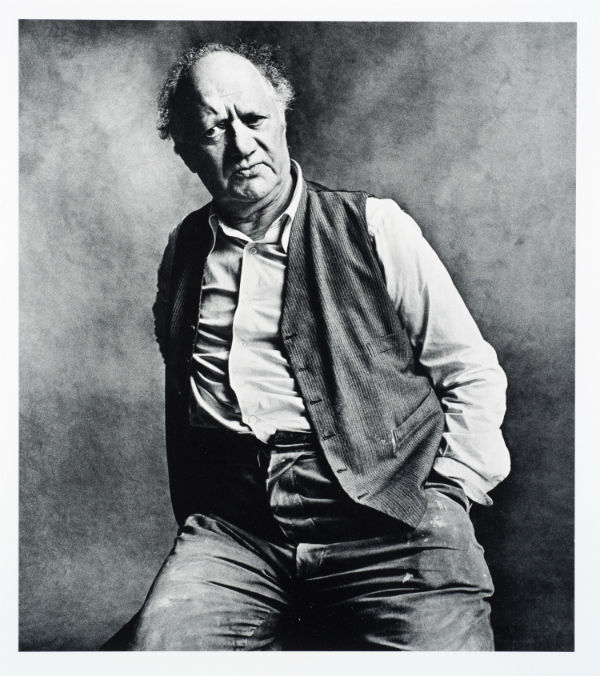
Jacob Epstein
by Irving Penn