Ben Uri Collection

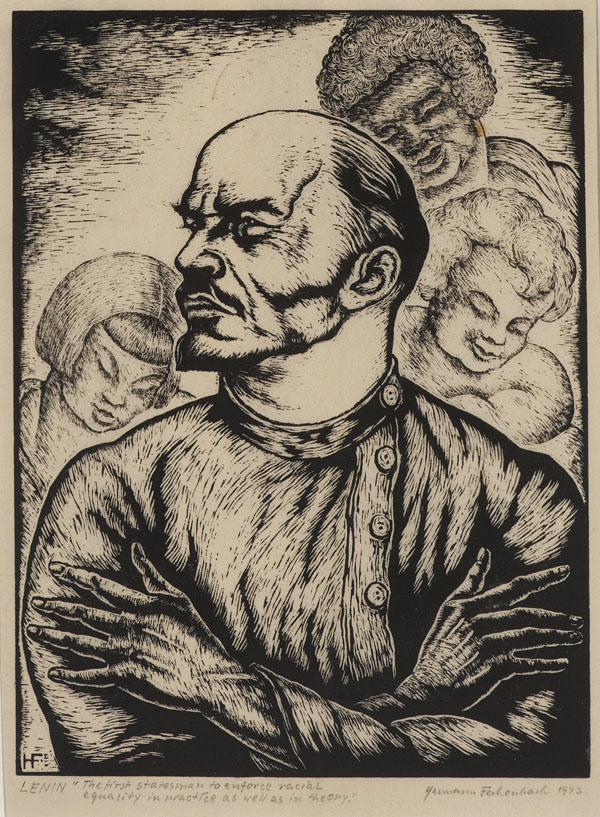
Lenin
Artist information
Name Hermann Fechenbach (1897-1986)
Born Wurttemberg, Germany
Died Denham, England
Find more work in the collection by this artist
Find out more about this artist
Painter and graphic artist Herman Fechenbach was born into a Jewish family in Württemberg, Germany on 11 January 1897 and raised in Bad Mergentheim. He developed a passion for drawing at the age of three but initially worked as a window dresser in Dortmund before being conscripted in 1915. He was severely wounded in August 1917 and his left leg was amputated. In 1918 he studied in Stuttgart at a handicraft school for war invalids, then studied painting and restoration at the Art Academies of Stuttgart and Munich for three years, influenced by Max Liebermann. In 1923 he spent a year Florence, making a series of miniature wood engravings illustrating the story of Genesis, also travelling to Pisa, Venice, Vienna and Amsterdam. He returned to Stuttgart in 1924, where his work was influenced by Die Neue Sachlichkeit (New Objectivity) movement and exhibited at the Kunstgebaute (spring and autumn exhibitions). In 1926, with an architect friend, he built a bungalow in suburban Hohenheim, also retaining his Stuttgart studio, afterwards shared with his photographer wife, Greta Batze, whom he married in 1930. Forbidden to work or by the Nazis in 1933, examples of Fechenbach's woodcuts were included in the 'Exhibition of German-Jewish Artists' Work: Painting, Sculpture, Architecture' (5-15 June 1934, Parsons Gallery, London) by German-Jewish émigré dealer, Carl Braunschweig (later Charles Brunswick), which included in total 220 artworks by 86 artists suffering persecution under the Nazi regime.
Initially, the couple retreated to Hohenheim, but in 1938 fled, first to Palestine, then Britian; Greta arriving first on a domestic visa and Fechenbach following a few months later. Sales of Fechenbach’s paintings and wood engravings helped his parents escape Germany, but his twin sister Rosa perished in a concentration camp. In 1940 Hermann was interned in Bury as a so-called ‘enemy alien’, hunger striking in protest; he was moved first to prison in Liverpool before being interned on Hutchinson, Isle of Man in the so-called 'Artists' camp' with Kurt Schwitters, Erich Kahn, Paul Hamann, Fred Uhlman, Hellmuth Weissenborn, and art historian Klaus Hinrichsen. He produced a series of linocuts entitled 'My Impressions as Refugee', as well as landscapes, including one of Douglas, Isle of Man (1941) at sunset, crisscrossed by barbed wire.
After release in 1941, sponsored by Austrian émigré art publisher Bela Horovitz, the Fechenbachs moved to Oxford, where Hermann held two solo exhibitions in 1942. In 1944 the coupled resettled in Hammersmith and he participated in the spring Open exhibitions at the Embankment (1946–51), with the Anglo-Palestinian club in Piccadilly (1944, 1948) and at Ben Uri Art Gallery (1945, 1947). In 1969 Fechenbach published a book of 137 wood engravings, 'Genesis: the First Book of Moses', and a part autobiography, ‘The last Jews of Mergentheim’ in 1972. In 1985, a solo selling prints exhibition was mounted at Blond Fine Art, London (1985) and in his final year, his work was included in the touring exhibition 'Kunst im Exil in Großbrittanien 1933–45' (Berlin, Oberhausen, Vienna, London, 1986).
Herman Fechenbach died in Denham Green, Buckinghamshire, England on 6 December 1986. In the UK his work is held in the Ben Uri Collection. His work was included posthumously in (a copy was included in the touring exhibition Forced Journeys: Artist in Exile in England, c. 1933-45 (Ben Uri Gallery 2009, Sayle Gallery, Isle of Man; and Williamson Art Gallery, Birkenhead, 2010).
Object Details
Date 1943
Object type print
Medium woodcut on paper
Materials and techniques ink (medium) woodcut (technique) paper (support)
Unframed 21.6 x 16 cm
Framed 35.8 x 27.2 cm
Signed and dated (lower right): 'Hermann Fechenbach 1943'
Acquisition presented by Alfred Wolmark 1948
Accession number 1987-92a
Display status not on display
Fechenbach specialised in wood engravings and was influenced by Die Neue Sachlichkeit (new objectivity). This woodcut of Russian revolutionary, politician, and political theorist Vladimir Lenin (1870-1924) was made in England after Fechenbach's release from internment and is inscribed 'Lenin - the first statesman to enforce racial equality in practice as well as in theory'.
Selected exhibition history
2009
Forced Journeys: Artists in Exile in Britain, c. 1933-45
Ben Uri Gallery and Museum
2010
Forced Journeys: Artists in Exile in Britain, c. 1933-45, touring exhibition
Williamson Art Gallery & Museum
2018
Finchleystrasse: German artists in exile in Great Britain and beyond 1933-45
Embassy of the Federal Republic of Germany, London (Department of Culture and Education)
2020
Interstices: Discovering the Ben Uri Collection - An Online Exhibition Curated by René Gimpel
Ben Uri Gallery
2020
Internment: In Memory of Eva Aldbrook
Ben Uri Gallery
Literature
Sarah MacDougall ed., 'Interstices - Discovering the Ben Uri Collection Guest curated by René Gimpel' (London: Ben Uri Gallery, 2020), pp. 64-65.; 'Finchleystrasse: German artists in exile in Great Britain and beyond 1933-45' (London: Ben Uri Gallery and Museum in association with the German Embassy London, 2018), p. 20.; Rachel Dickson and Sarah MacDougall, eds., Ben Uri: 100 Years in London - Art, Identity, Migration (London: Ben Uri Gallery, 2015), p. 85 (illus.); Walter Schwab and Julia Weiner, eds., Jewish Artists: the Ben Uri Collection - Paintings, Drawings, Prints and Sculpture (London: Ben Uri Art Society in association with Lund Humphries Publishers Ltd, 1994), p. 40; Annual Report 1948-1949.
Hover mouse cursor over image to zoom (you can also use the mouse wheel).