Ben Uri Collection

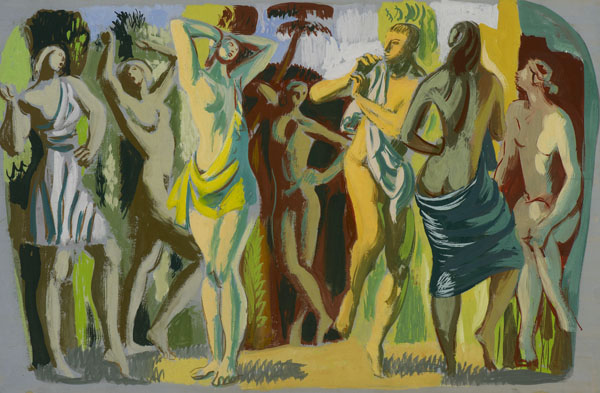
The Dance
Artist information
Name Hans Feibusch (1898-1998)
Born Frankfurt, Germany
Died London, England
Find more work in the collection by this artist
Find out more about this artist
Painter, illustrator, lithographer, author, muralist and sculptor Hans Feibusch was born into a Jewish family in Frankfurt, Germany on 15 August 1898. After serving in the First World War, he settled in Berlin in 1920 to study painting, where he won the Prix de Rome and travelled to Italy, encountering and admiring Italian Renaissance mural paintings, before completing his studies in Paris. Upon his return to Germany, as a member of the Frankfurt Künstlerbund, he was tasked with his fellow members with designing a set of murals and undertook to teach himself the necessary techniques and procedures. After winning the Prussian State Prize for Painting in 1930 however, he aroused Nazi antagonism. After his pictures were publicly burned, and he was forbidden to paint he found refuge in Britain in 1933, joining his British fiancée in London.
In 1934 Feibusch first exhibited with the Ben Uri Gallery in May-June, showing concurrently in the 'Exhibition of German-Jewish Artists' Work’ at the Parsons Gallery, London, organised by German-Jewish émigré dealer Carl Braunschweig (Charles Brunswick) to highlight artists suffering persecution under the Nazi regime. Later that year, Feibusch held the first of five solo shows at the Lefevre Galleries, London, and also began to exhibit regularly with the London Group (until 1939), where his work attracted attention. In 1937 his work was included in the notorious touring Nazi 'degenerate' art show, first mounted in Munich, and in 1938 it also featured in the important exhibition of ‘Twentieth-century German Art’ at the New Burlington Galleries in London, intended as a riposte to the Nazi show. In spring 1943 Feibusch also participated in the AIA 'For Liberty' exhibition in the basement of John Lewis’ department store in Oxford Street.
Following his first public mural in England, ‘The Footwashing’, for the Methodist Chapel in Colliers Wood, commissioned by Edward D. Mills in 1937, Feibusch was championed by Dr George Bell, the Bishop of Chichester, and commissioned to paint a chapel in Brighton, which led to many other Church of England commissions, including for Chichester Cathedral. Feibusch went on to become Britain’s most prolific muralist, creating work in some 35 Anglican churches and cathedrals, among them St. John's Waterloo, as well as five panels for the Stern Hall at West London Synagogue (now in the Ben Uri Collection), and two town halls; he published his book on mural painting in 1946. He featured in the 1951 Festival of Britain as both a painter and a muralist and post-war served on the Ben Uri Arts Committee.
Feibusch exhibited widely including with the AIA (Artists' International Association), including the For Liberty exhibition (1943), at the Royal Academy (from 1944), the Ben Uri Gallery, including solo exhibitions in 1970 and 1977, and at Pallant House Gallery, Chichester in 1995 (subsequently touring to Ben Uri and other venues). In the 1970s Feibusch was forced to abandon painting after his eyesight began to fail and he took up sculpture. Although he had converted to Anglicanism in the 1960s, in his later years he reverted to his Jewish faith. He died in London, England on 18 July 1998 and his estate bequeathed the entire contents of his studio to Pallant House Gallery in Chichester. His work is also held in other UK collections including the Tate.
Object Details
Date c. 1950
Object type painting
Medium gouache on paper
Materials and techniques gouache (medium) paper (support)
Unframed 48.5 x 75 cm
Framed 76 x 100 cm
Signed (verso): 'Hans Feibusch'
Acquisition on permanent loan
Accession number 1987-93
Display status not on display
This joyful painting is typical of Feibusch’s colourful, figurative work.
Selected exhibition history
1954
Exhibition of Jewish Art
Hove Museum of Art
1977
Selections from the Permanent Collection: Watercolours, Drawings, Graphics
Ben Uri Gallery
2009
Homeless & Hidden 2: World Class Collection Homeless & Hidden
Ben Uri Gallery
2016
Out of Chaos: Touring exhibition
Laing Art Gallery
2017
Entartete Kunst (“Degenerate Art”) Remembered
Ben Uri (Online)
2018
Finchleystrasse: German artists in exile in Great Britain and beyond 1933-45
Embassy of the Federal Republic of Germany, London (Department of Culture and Education)
2019
Art-exit: 1939 - A Very Different Europe
12 Star Gallery
2023
Joy
Ben Uri Gallery
2025
Always Changing. Always Welcoming: Open-air art exhibition celebrating refugee and immigrant artists’ contribution to British visual culture
Open-air facsimile exhibition outside O2 Centre
Literature
'Finchleystrasse: German artists in exile in Great Britain and beyond 1933-45' (London: Ben Uri Gallery and Museum in association with the German Embassy London, 2018), p. 21.; Walter Schwabe and Julia Weiner, eds., Jewish Artists: the Ben Uri Collection - Paintings, Drawings, Prints and Sculpture (London: Ben Uri Art Society in association with Lund Humphries Publishers Ltd, 1994), p. 41.
Hover mouse cursor over image to zoom (you can also use the mouse wheel).