Ben Uri Pre-Eminent Collection

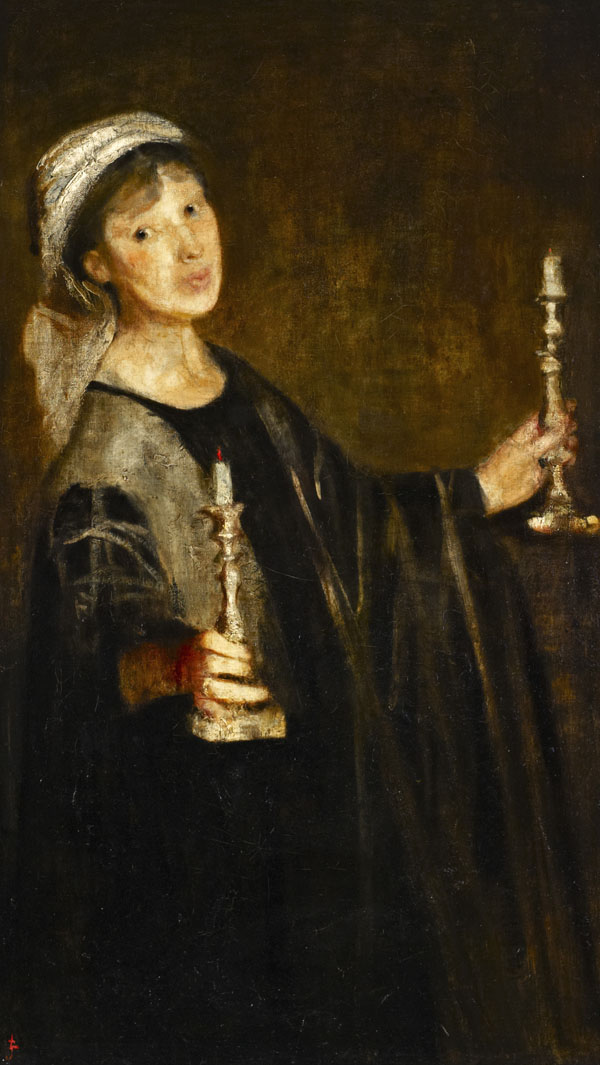
Self-Portrait with Candles (aka A Portrait of The Painter, aka Silver Candlesticks)
Artist information
Name Lily Delissa Joseph (1863-1940)
Other name Lily Solomon, Leah Alice Solomon, Leah Joseph, Lily Joseph, Lily D. Joseph, Delissa J. L.
Born London, England
Died London, England
Find more work in the collection by this artist
Find out more about this artist
Lily Delissa Joseph (née Leah Alice Solomon) was born to an Anglo-Jewish father, Joseph Solomon, and an Austrian-Jewish mother Helena (née Lichtenstadt) in Bermondsey, London, England on 24 June 1863; one of 11 siblings, her older brother was the artist Solomon J Solomon, RA (1860–1927). She trained at the Ridley School of Art and the Royal Academy of Art, becoming a portrait, landscape and interior painter and established a studio in Bedford Row, London, overlooking the Old Bailey. She exhibited with the New English Art Club (1888–1890s), the Society of Portrait Painters (1890s), the Royal Society of British Artists, the Women's International Art Club (1902–04, member, and posthumously, 1963) and the Society of Women Artists. In 1900 she participated in the Women's Exhibition at the Earl's Court Exhibition Centre. Deeply involved with women's suffrage, she was famously unable to attend her own Private View for her solo exhibition 'Some London and Country Interiors' at the Baillie Gallery, London (mostly depicting interiors of the National Gallery), after being detained at Holloway Gaol on a charge in connection with the movement in 1912. An advertisement to this effect was placed by her husband, the architect Delissa Joseph F.R.I.B.A. (1859–1927), whom she had married in 1887, an ardent supporter of women's rights. Both were listed as subscribers to the Women’s Social & Political Union (WSPU) and Lily appears on the Suffragette Roll of Honour under the name Leah Joseph, along with her sister, Henrietta Lowy, and her nieces, Getrude Lowy and Ethel Lowy. An early cyclist, Lily Delissa Joseph was one of the first women to own and drive a car (motoring to Palestine in the 1920s) and also learnt to fly aeroplanes when in her fifties.
Delissa Joseph built two of her brother Solomon's studios including Whitecliffe at Birchington, Kent, where Solomon had a bungalow, and where he built a large bungalow, North Sea Lodge, for himself and Lily, which she depicted in a number of interiors, one of which is in the Ben Uri Collection. As Lily Delissa Joseph, she also exhibited at the Royal Academy (1905–38), as well as in the Paris Salons (honourable mention, 1898; silver medal, 1929; gold medal, 1934) and at the Glasgow Institute of the Fine Arts and Walker Gallery in Liverpool. In 1923 she exhibited in the survey exhibition of works by Jewish artists at the Whitechapel Art Gallery and in 1927 showed two paintings (including a portrait of her brother) in the Exhibition of Jewish Art and Antiquities at the same venue. In 1924 she had a joint exhibition with her husband Delissa Joseph, exhibiting 61 of her paintings (not for sale) alongside 64 of his drawings at the Suffolk Street Galleries. During her later years, she also exhibited at Ben Uri's Opening exhibition at Woburn House in 1934 and at the annual exhibition in 1937. In the same year her 'Roofs, High Holborn' was purchased by the Chantrey Bequest for the Tate Gallery. She painted with a limited palette of white, cobalt, rose madder, orange madder and black, following the precepts of Sir Joshua Reynolds.
A committed member of the Jewish community, she was also involved in many charitable ventures. In 1911 she met the young poet Isaac Rosenberg when painting at the National Gallery. Her sister, Mrs. Henrietta Lowy Solomon employed Rosenberg briefly as a tutor to her children, before introducing him to their wealthier friend Mrs Herbert Cohen, who sponsored Rosenberg's studies at the Slade School of Fine Art. Lily was also religiously observant and a communal singer at the Brook Green synagogue in Hammersmith (having also been active in its establishment). Lily Delissa Joseph died in London, England on 24 July 1940. In 1946 the Ben Uri Art Society held a joint exhibition of paintings by Solomon J. Solomon and Lily Delissa Joseph at its London Gallery. She was also included posthumously in group exhibitions including the Tercentenary Exhibition of Jewish Artists in England 1656-1956 at the Whitechapel Art Gallery and Jewish Artists of Great Britain, 1845-1945 at the Belgrave Gallery, London in 1978. Her work is represented in UK Collections including the Ben Uri Collection and Tate.
Object Details
Date 1895
Object type painting
Medium oil on canvas
Materials and techniques oil (medium) painting (technique) canvas (support)
Unframed 105.5 x 59.5 cm
Framed 126 x 80.4 cm
Signed (lower left) with monogram of initials
Acquisition presented by Mrs Redcliffe Salaman 1946
Accession number 1987-160
Display status not on display
In Self-Portrait with Candles, the artist successfully negotiates her Jewish, artistic and politically radical identities. She shows herself in modest dress and with her head covered, holding the two Shabbat candles which are traditionally kindled by the woman of the house in religiously observant Jewish households about twenty minutes before sundown to mark the formal beginning of the Sabbath on Friday evening, but she looks out confidently, engaging the eyes of the viewer. The work combines her interest in portraiture and interiors, and is influenced by her admiration for Rembrandt, particularly in the use of light and shadow. It also shows her characteristic use of a limited palette of white, cobalt blue and rose or orange madder.
Initially the portrait had a mixed reception. A contemporary reviewer in The Echo, London (17 Oct 1895) remarked that 'Lily Delissa Joseph's portrait of herself carrying two silver candlesticks is so morbidly fantastical that we are unwilling to believe she really looks like that', while S.M.S. in the Jewish Chronicle (25 Oct 1895, p. 18), calling it 'A very strong piece of work for a lady', also remarked, 'There is a suggestion of Lady Macbeth about the picture, which, as a whole, does not flatter its painter'. A future edition of the same paper (Jewish Chronicle, 13 Dec 1895, p. 16) noted however, that Sir Walter Besant in The Queen magazine had 'devoted considerable space' to the painting and 'a highly appreciative description' and when subsequently shown at the Paris Salon in 1898, together with another painting, Lily Delissa Joseph received an ‘honourable mention’ (Jewish Chronicle, 8 July 1898). In 1900 she again exhibited the painting at the Society of Women Artists exhibition, under the title ‘Silver Candlesticks’, when it was called 'a curious study [...] remarkable both for its qualities and its failings' (Ladies Field, 24 February 1900), and then again, under this title, at the Women’s International Art Club in 1902, where it went unremarked beside her ambitious 20-person family portrait. By the time it was exhibited again at the joint exhibition held with her architect husband, Delissa Joseph, at the Suffolk Street galleries in 1924, its quality was recognised and The City Press called both this and her painting Blue Mantle, 'excellent pieces of artistic work'.
In 1946 this portrait was included in a joint posthumous exhibition of works by Lily Delissa Joseph and her brother, Solomon J Solomon at Ben Uri Gallery and presented the same year to the Ben Uri Collection by the artist's niece, Gertrude (the second Mrs. Redcliffe Salaman).
Keywords
candle | candlesticks | Judaism | Sabbath | self-portrait | Shabbat
Selected exhibition history
1895
Fifth Exhibition of the Society of Portrait Painters
New Gallery
1898
Société des artistes français Salon
Paris Salon
1900
Society of Women Artists
The Suffolk Street Galleries
1902
Women's International Art Club
Grafton Gallery
1924
Exhibition of Mrs. Lily Delissa Joseph's Paintings and of Illustrations of Mr. Delissa Joseph's Architectural Work
The Suffolk Street Galleries
1946
A Loan Exhibition of Paintings and Drawings by Solomon J. Solomon RA and Lily Delissa Joseph (brother and sister)
Ben Uri Art Gallery
1946
Recent Additions to the Permanent Collection and Works by Pissarro, Liebermann, Epstein, Modigliani, Chagall
Ben Uri Art Gallery
1951
Festival of Britain, Anglo-Jewish Exhibition 1851-1951
Ben Uri Art Gallery
1954
Exhibition of Jewish Art
Hove Museum of Art
1956
Jewish Artists in England 1656-1956: A Tercentenary Exhibition
Whitechapel Art Gallery
1960
Selections from the Permanent Collection
Ben Uri Art Gallery
1970
Paintings from the Ben Uri Art Gallery
Russell-Cotes Art Gallery and Museum
1976
Original Vicky Cartoons and Drawings together with items from the permanent collection
Ben Uri Art Gallery
1979
Paintings, Watercolours, Drawings and Sculpture
Ben Uri Gallery
1985
Achievement: British Jewry Exhibition
Camden Arts Centre
1992
Judische Lebenswelten (Patterns of Jewish Life)
Martin Gropius Bau
2001
The Ben Uri Story: from Art Society to Museum
Phillips
2003
Director's Choice: Highlights from the Ben Uri Permanent Collection
Ben Uri Gallery - The London Jewish Museum of Art
2006
Jewish Artists in Britain Celebrating the 350
Arts Depot
2009
Homeless & Hidden 1: World Class Collection Homeless & Hidden
Ben Uri Gallery
2009
Fragmented Mirror: Exhibition of Jewish Artists, Berlin, 1907
Tel Aviv Museum of Art
2015
Out of Chaos – Ben Uri: 100 Years in London
Somerset House
2018
Exodus: masterworks from the Ben Uri Collection
Bushey Museum
2018
Liberators: Extraordinary women artists from the Ben Uri Collection
Ben Uri Gallery
2022
Me, Myself, I: Artists’ Self-Portraits
Royal West of England Academy
2023
“Sheer Verve”: The Women's International Art Club 1898–1978
Ben Uri Gallery
Literature
Lydia Figes, Ten women artists of Jewish heritage represented in UK collections, Art UK, Posted 22 Sep 2020; Jonathan Freedman, The Jewish Decadence: Jews and the Aesthetics of Modernity (Chicago: University of Chicago Press, 2021), illus., pl. 2.2; Rachel Dickson and Sarah MacDougall, eds., 'Out of Chaos: Ben Uri; 100 Years in London' (London: Ben Uri Gallery, 2015) pp. 32-33.; Rachel Dickson and Sarah MacDougall, eds., Ben Uri: 100 Years in London - Art, Identity, Migration (London: Ben Uri Gallery, 2015), p. 137, illus.; Oil Paintings in Public Ownership in Camden (London: The Public Catalogue Foundation, 2013), p. 21, illus.; Gillian Rathbone, ed., The Ben Uri Story from Society to Museum (London: Ben Uri Gallery, 2001); Batsheva Goldman Ida, Fragmented Mirror: Exhibition of Jewish Artists, Berlin, 1907 (Tel Aviv: Tel Aviv Museum of Art, 2009), p. 95; Walter Schwab and Julia Weiner, eds., Jewish Artists: the Ben Uri Collection - Paintings, Drawings, Prints and Sculpture (London: Ben Uri Art Society in association with Lund Humphries Publishers Ltd, 1994), p. 55; Anon., Mrs. Delissa Joseph's Work, The City Press, I March 1924; Ladies' Field, Saturday, 24 February 1900; Jewish Chronicle, 13 Dec 1895, p. 16; S.M.S., Jewish Chronicle, 25 Oct 1895, p. 18; The Echo, London, 17 Oct 1895.
Hover mouse cursor over image to zoom (you can also use the mouse wheel).